Commercial Pool Construction Osceola County: A Framework for Mitigating 30% of Long-Term Maintenance Costs
For any commercial property manager in Osceola County, from the sprawling resorts in Kissimmee to the meticulously planned HOAs in Celebration, a new pool is a significant capital expenditure. The real challenge, however, isn’t the initial build; it’s preventing that asset from becoming a perpetual drain on your operational budget. I’ve seen far too many projects fail not because of poor construction, but because the initial plan completely ignored the specific environmental stressors of Central Florida: our high water table, corrosive humidity, and intense, year-round UV radiation. My entire approach is built on a single principle: preemptive engineering against local conditions. This isn't about simply meeting code; it's about building a commercial pool that actively resists the costly degradation endemic to our region. This means a direct focus on material science, hydraulic efficiency, and soil mechanics from day one, a process that consistently reduces long-term chemical, energy, and repair costs for my clients.My Diagnostic Method: The Subtropical Integrity Protocol
Before a single shovel hits the ground, I deploy what I call the Subtropical Integrity Protocol. It's a non-negotiable diagnostic phase I developed after inheriting a failing project near Lake Tohopekaliga where the previous contractor’s standard-issue plan resulted in shell blistering within 24 months. Their mistake was treating our soil and climate like anywhere else. My protocol is an upfront investment in analysis to prevent catastrophic downstream failures.Deep-Dive Technical Analysis
- Geotechnical & Hydrological Assessment: The first step is always a series of geotechnical soil borings. In areas like St. Cloud, the soil composition and water table can vary dramatically from one parcel to another. We analyze soil stability and, most critically, establish the seasonal high water table. Ignoring this leads to hydrostatic pressure that can literally lift a poorly designed pool shell out of the ground. This data dictates the necessity and type of underdrain systems.
- Materials Specification for High-Humidity & UV Exposure: I specify materials far beyond the minimum standard. For all metal components, including rails and ladders, 316-grade stainless steel is the only option, due to its superior resistance to chloride and humidity compared to the commonly used 304 grade. For the pool shell, I demand a shotcrete mix with a minimum 4,500 PSI compressive strength, enhanced with crystalline waterproofing admixtures to combat water penetration from the start.
- Advanced Hydraulic Modeling: For large-scale commercial pools, especially in resorts along the US-192 corridor, energy consumption is a major operational expense. I model the entire plumbing system to calculate the precise Total Dynamic Head (TDH). This allows for the selection of correctly sized pumps and pipes, often resulting in a 15-20% reduction in annual energy costs by avoiding the all-too-common mistake of overpowering the system.
Implementation Framework: From Excavation to First Fill
With the protocol complete, the execution phase is a matter of strict adherence to the specifications. Every step is a critical control point designed to lock in the pool's long-term durability and performance. My process is systematic and transparent.- Site Preparation and Strategic Dewatering: Based on the hydrological data, we establish a wellpoint dewatering system to artificially lower the water table around the excavation site. This ensures the rebar and initial shotcrete application occur in a dry, stable environment, which is absolutely critical for proper curing and structural integrity.
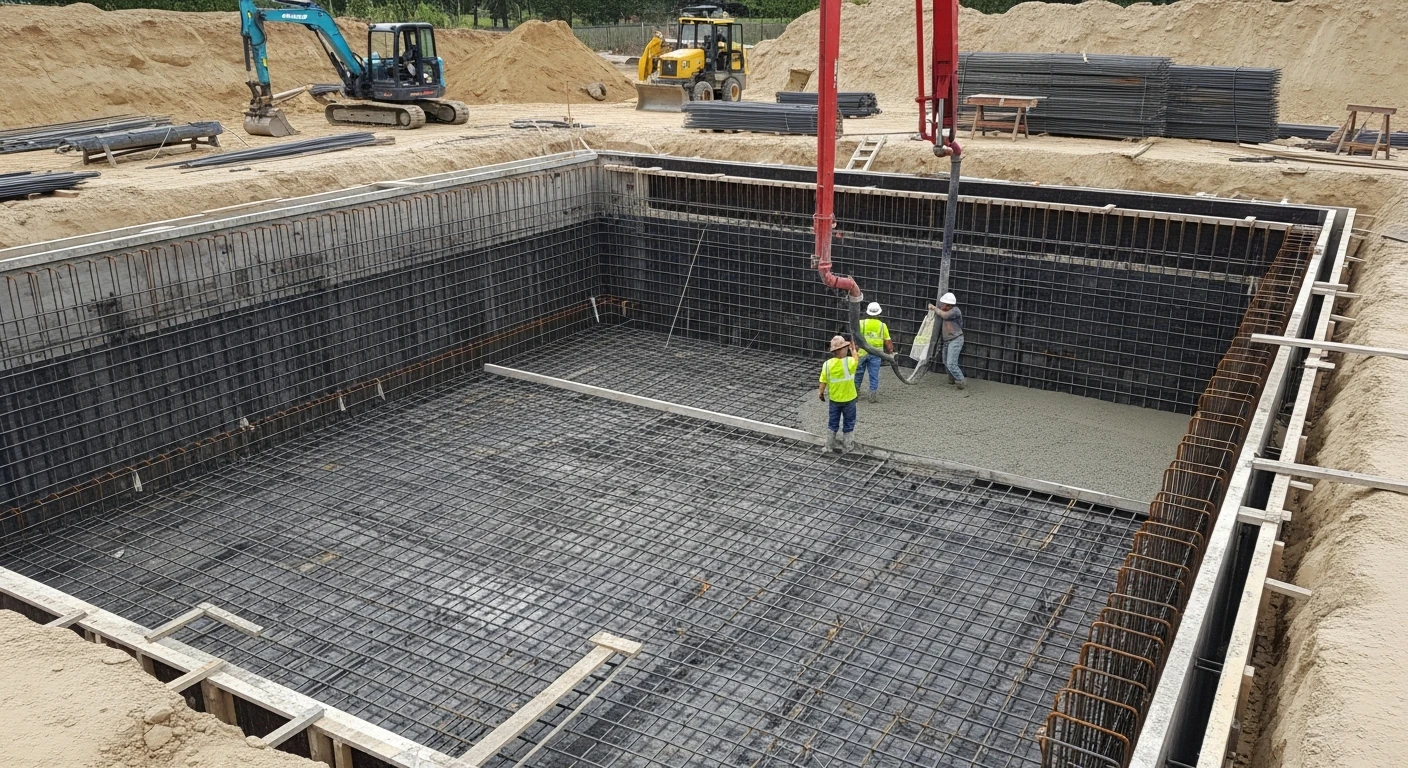
- Reinforcing Steel Cage and Equipotential Bonding: The rebar cage is the pool’s skeleton. I personally inspect the grid for correct spacing and clearance before any concrete is applied. A crucial step often overlooked is installing the equipotential bonding grid. This isn't just about safety; a proper bond mitigates galvanic corrosion, extending the life of all metal components within the pool structure.
- Shotcrete Application and Curing: The shotcrete is applied pneumatically to create a monolithic, joint-free shell. The critical phase here is the cure. In the Osceola County sun, an improper cure can ruin the shell. I mandate a 7-day wet cure, keeping the surface consistently moist to allow the concrete to achieve its full design strength.
- Multi-Layer Waterproofing and Interior Finish: After the shell is fully cured, we apply a dedicated cementitious or polymer-modified waterproofing membrane. This is a redundant layer of protection I insist on. Only then is the final interior finish, such as a high-grade quartz aggregate, applied. This multi-layer approach is the single best defense against delamination and leaks.
Precision Tuning and Quality Assurance Standards
The final 5% of the work determines 95% of the client's satisfaction. Before handover, my team executes a rigorous quality assurance checklist. This includes a 24-hour hydrostatic pressure test of all plumbing lines *before* backfilling the trenches—a simple step that has saved clients from devastating post-installation excavation and repairs. We also perform a comprehensive chemical startup, carefully balancing the water based on Osceola's specific source water profile, not generic guidelines. Finally, we precisely calibrate the Variable Frequency Drives (VFDs) on the pumps, ensuring the system operates at peak efficiency from the moment it’s turned on. I’ve seen installations where a VFD was installed but never properly programmed, completely wasting the investment.
How are you currently validating your contractor's material specifications to ensure they can withstand the specific humidity and soil conditions of your Osceola County property?