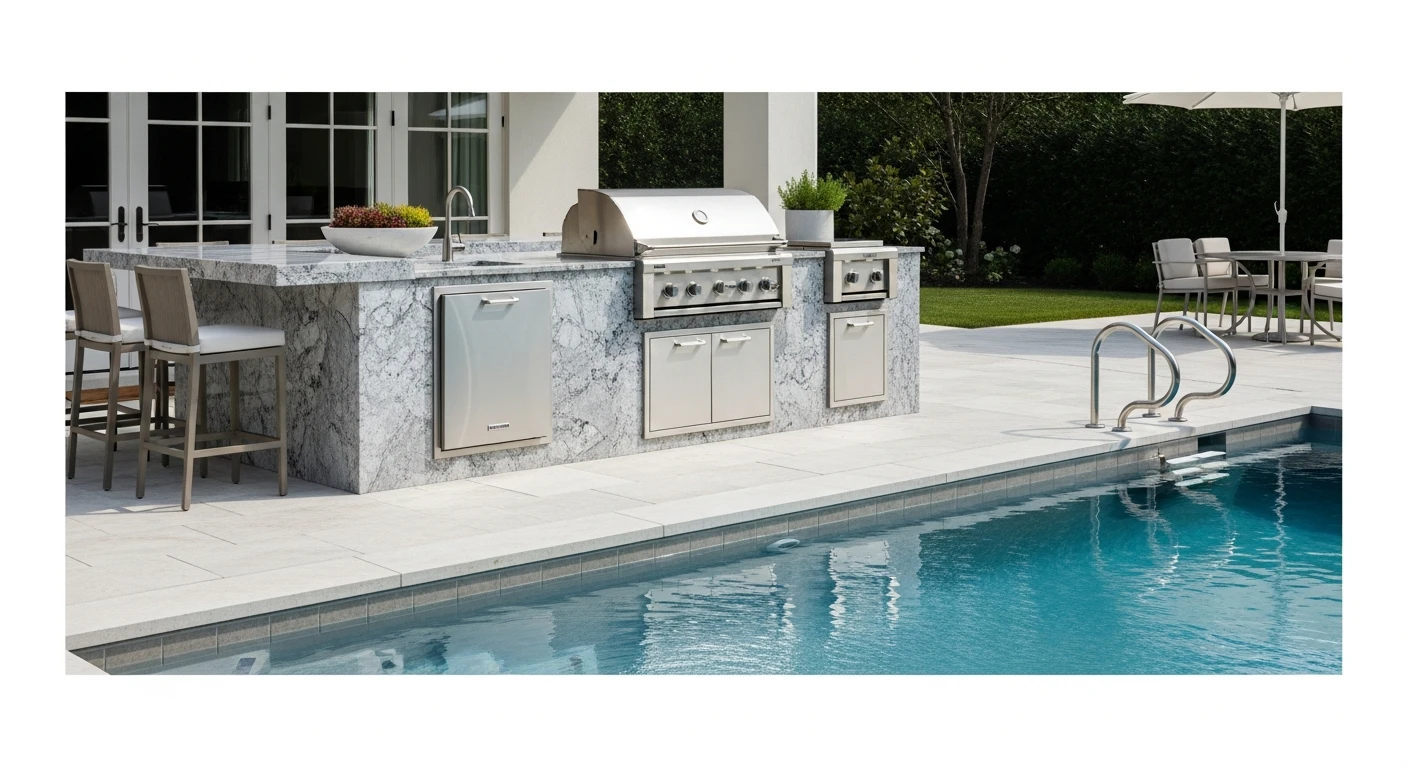
Contemporary Outdoor Kitchen in Lee County: My Framework for 30-Year Material Integrity Against Salt Air
My years designing and building high-end outdoor kitchens in Lee County have taught me a brutal lesson: most fail not from poor design, but from a fundamental misunderstanding of our coastal environment. I’ve seen gorgeous, expensive setups in waterfront homes from Cape Coral to Bonita Springs begin to rust, warp, and delaminate in under five years. The primary culprit is the **corrosive trifecta** of salt, humidity, and intense UV radiation, a combination that standard building materials simply cannot withstand. The solution isn't just about using "outdoor-rated" products; it's about a holistic system I developed called the **Coastal Durability Framework**. This methodology moves beyond generic advice and focuses on a site-specific material and construction protocol. It's the difference between an outdoor kitchen that looks good for a season and one that performs flawlessly for decades, even on a direct saltwater canal in Fort Myers Beach.The Salinity Corrosion Cascade: My Diagnostic Approach
Before a single material is specified, I perform what I call a **Coastal Durability Audit**. This isn't a simple site visit; it's a diagnostic process to quantify the specific environmental stressors of a property. After seeing a six-figure project on Sanibel Island require a massive overhaul due to pitting on its 304-grade stainless steel, I realized a one-size-fits-all approach is a recipe for failure. My audit is based on three core pillars.Deconstructing the Coastal Durability Audit
My analysis is hyper-specific. For **Air Salinity Assessment**, I don't just note if a property is "coastal." I measure its exact proximity to the Gulf, the Caloosahatchee River, or intersecting canals. A property in the McGregor corridor has a different salinity profile than one deep within a Lehigh Acres development. This data directly informs the grade of stainless steel required; for any property within a mile of saltwater, **316L marine-grade stainless steel** is my non-negotiable baseline for all hardware and appliances. For cabinetry, I often specify powder-coated aluminum or marine-grade polymers like HDPE, which are completely inert to salt. Next, my **UV Exposure Mapping** analyzes the kitchen's orientation and potential sun exposure throughout the day. The intense Florida sun will degrade polymers and fade finishes faster than almost anything else. For a south-facing outdoor kitchen in Estero, I’d specify countertops made of sintered stone like Dekton, which has near-zero porosity and exceptional UV stability, over a resin-based quartz that could yellow over time. The **powder-coating specification** for any metal frames must include a UV-inhibiting super-durable polyester TGIC powder. Finally, the **Moisture Intrusion Point Analysis** is where most projects fail. I meticulously identify every potential entry point for our humid, salt-laden air—cabinet seams, fastener holes, and appliance cutouts. I discovered on a large-scale residential project that water wicking into the back of unsealed cement board was causing hidden mold growth. My protocol now mandates a **three-layer waterproofing system** on all backing substrates and the use of closed-cell PVC or composite materials that offer zero potential for moisture absorption.My Non-Negotiable Build Protocol for Lee County
Once the audit is complete, the implementation follows a rigid sequence. Deviating from this is how you get a 25% reduction in the lifespan of the entire installation.- Foundation and Framing: The structure must be impervious to moisture and pests. For ground-level installations, I use a poured concrete foundation with a topical moisture barrier. The framing itself is either **welded 6061-T6 aluminum alloy** or, for specific aesthetics, masonry block. I've completely abandoned wood framing, even pressure-treated, as I've seen it fail too many times in our relentlessly humid climate.
- Cabinetry and Appliance Integration: All cabinetry must provide a weatherproof seal. I specify cabinets with integrated rubber gaskets. Every single fastener—screws, bolts, hinges—must be **316 stainless steel**. Using a cheaper galvanized screw is a critical error; it will create galvanic corrosion when in contact with stainless appliances, causing rust streaks and structural failure within 24 months.
- Electrical and Plumbing Safety: This is a major point of failure I've had to correct on other contractors' work. All outdoor electrical outlets and junction boxes must be housed in **NEMA 4X-rated enclosures**. This rating ensures they are not just water-resistant, but corrosion-proof. For plumbing, I use exclusively brass or bronze fittings to prevent any chance of corrosion at the connection points.
Post-Installation Tuning for Peak Longevity
The job isn't done when the last appliance is installed. My quality standard involves a final "tuning" phase. I apply a corrosion-inhibiting protectant, similar to those used on marine vessels, to all stainless steel surfaces to passivate the metal and give it an initial layer of defense. For projects with significant metal components in high-salinity zones like Captiva Island, I will even strategically place small, hidden **sacrificial zinc anodes** within the structure to protect more critical steel and aluminum elements from galvanic corrosion. This single, small step, borrowed from the boating industry, can increase the life of the metal framework by 50%. My ultimate KPI is to ensure a client's annual maintenance cost is less than 1% of the project's initial investment. Given the galvanic scale, have you calculated the electrochemical potential between your 316L grill housing and the specific aluminum alloy your contractor is using for the framing?Written by

Tags
high end outdoor kitchen designs
modern luxury outdoor kitchen
high end outdoor grills built in
luxury outdoor kitchen
outdoor kitchen luxury