Outdoor Kitchen Cost in Pinellas County: My Framework for Avoiding the 30% 'Salt Air Surcharge'
I'm often asked for the "average cost" of an outdoor kitchen in Pinellas County, and I start by stating the typical range: anywhere from $15,000 for a functional, compact setup to well over $75,000 for a high-end culinary space in a St. Pete Beach waterfront home. However, this range is misleading. The real cost isn't in the initial build; it's in the premature replacement of components that weren't specified for our unique coastal environment. The biggest mistake I see is contractors applying inland building logic to a project that will be battered by salt spray, intense humidity, and hurricane-season winds. My entire approach is built on a single principle: engineering for a 20-year lifespan, not a 5-year one. This involves a cost-benefit analysis that front-loads investment in materials and infrastructure to drastically reduce long-term maintenance and replacement expenses. I developed this after dismantling a three-year-old, $40,000 outdoor kitchen in Tierra Verde that was failing due to rampant corrosion on its 304-grade stainless steel components—a completely avoidable error.My Coastal Durability Audit: Deconstructing True Project Costs
Before a single dollar is quoted, I run every project through my proprietary Coastal Durability Audit. It's a non-negotiable diagnostic phase that prevents the most common and costly failures I've encountered in Pinellas County. The audit focuses on three critical pillars that dictate the final, real-world cost.Material Selection Logic for the Gulf Coast Climate
This is where most budgets fail. Choosing the right material isn't about aesthetics alone; it's a technical decision against corrosion and UV degradation.- Stainless Steel: I exclusively specify 316L marine-grade stainless steel for all metallic components, from cabinet doors to grill fasteners. Standard 304-grade steel, while cheaper, will show pitting and rust within 18-24 months in a Clearwater Beach environment. The upfront cost difference is minimal compared to replacing rusted-out appliance doors.
- Cabinetry: While powder-coated metal looks sleek, I've seen it chip and then corrode from the inside out. For most projects, I recommend a HDPE (High-Density Polyethylene) polymer. It's impervious to saltwater, won't delaminate in our humidity like some composite woods, and is incredibly easy to clean.
- Countertops: Granite is popular, but many porous varieties can stain and harbor mildew in our damp climate. I lean toward ultra-compact surfaces like Dekton, which offers near-zero porosity and superior UV resistance, preventing the fading I've seen on darker stones in sunny Dunedin backyards.
The Phased Build-Out: A Pinellas County Blueprint
Executing the build requires precision. A flawed foundation or improper utility run can compromise the entire structure. My implementation follows a strict sequence to ensure structural integrity and code compliance.- Phase 1: Foundation and Footings: We never build on existing pavers. I require a monolithic concrete slab with proper footings designed to exceed local wind load requirements. This prevents the settling and cracking I’ve had to repair on improperly founded kitchens.
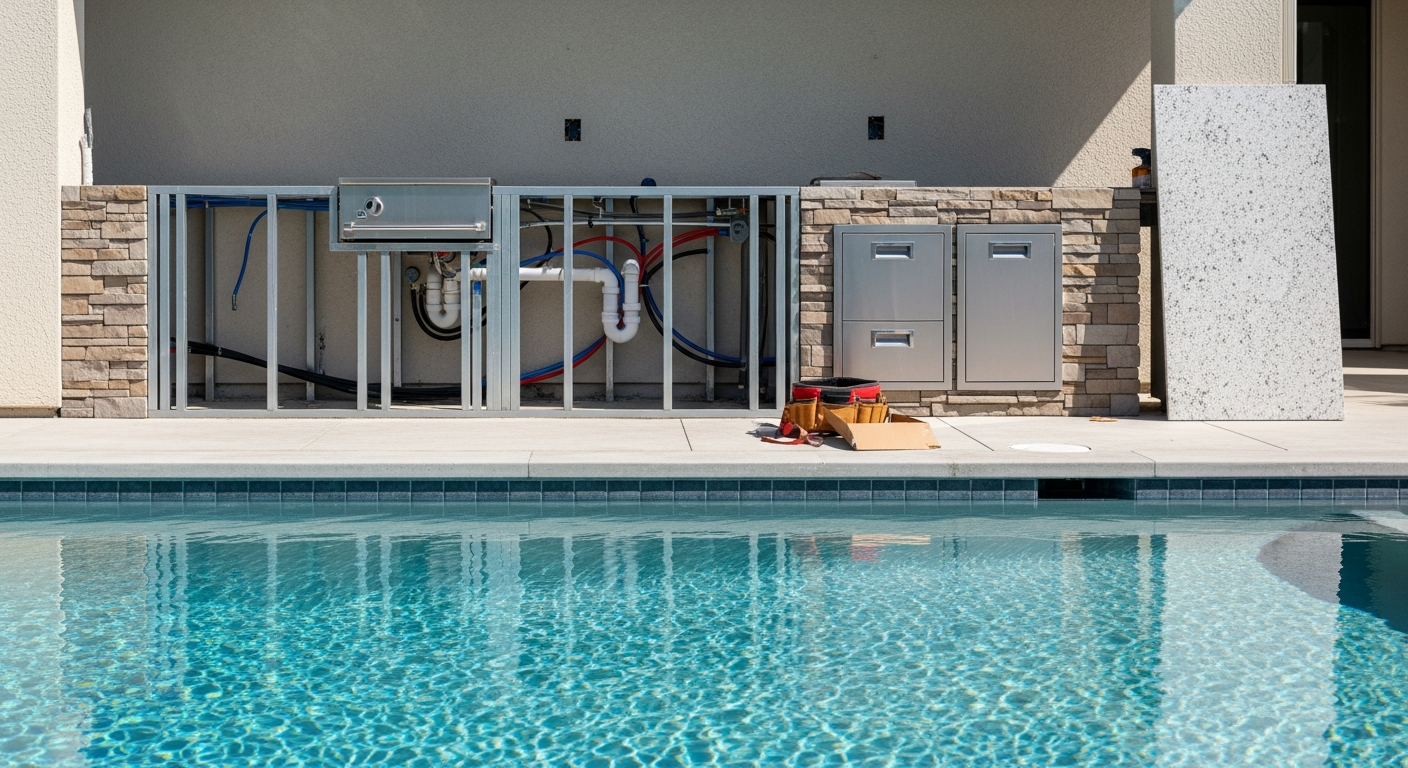
- Phase 2: Utility Rough-In: All electrical runs must use weatherproof conduit and be connected to dedicated GFCI outlets. Gas lines undergo a 24-hour pressure test well above the standard requirement to detect micro-leaks, a critical safety step.
- Phase 3: Frame and Cabinet Installation: The frame is anchored directly to the concrete slab, not just resting on it. This creates a single, rigid structure capable of withstanding extreme weather events.
- Phase 4: Appliance Integration and Ventilation: This is a major failure point. A powerful, correctly sized vent hood is non-negotiable for any kitchen under a covered lanai or roofline to prevent grease buildup, fire risk, and premature ceiling damage.
Beyond the Build: Critical System Checks for Longevity
Once the kitchen is built, my job shifts to quality control and system calibration. This is the fine-tuning that ensures performance and safety. I personally check the calibration of the refrigerator thermostat to handle our high ambient temperatures and verify that the countertop has a slight, imperceptible grade to shed water away from the house, preventing water intrusion issues that are common in Old Northeast St. Pete homes with tight lot lines. I also inspect every drainage point to ensure it can handle a torrential summer downpour without backing up. Given that the corrosive effects of salt air can be amplified by electrical currents, have you verified that your appliance selection and electrical plan eliminate the risk of galvanic corrosion between dissimilar metals in your outdoor kitchen's structure?Written by

Tags
cost for an outdoor kitchen
outdoor kitchen budget
average cost for outdoor kitchen
cost to build outdoor kitchen
outdoor kitchen prices