
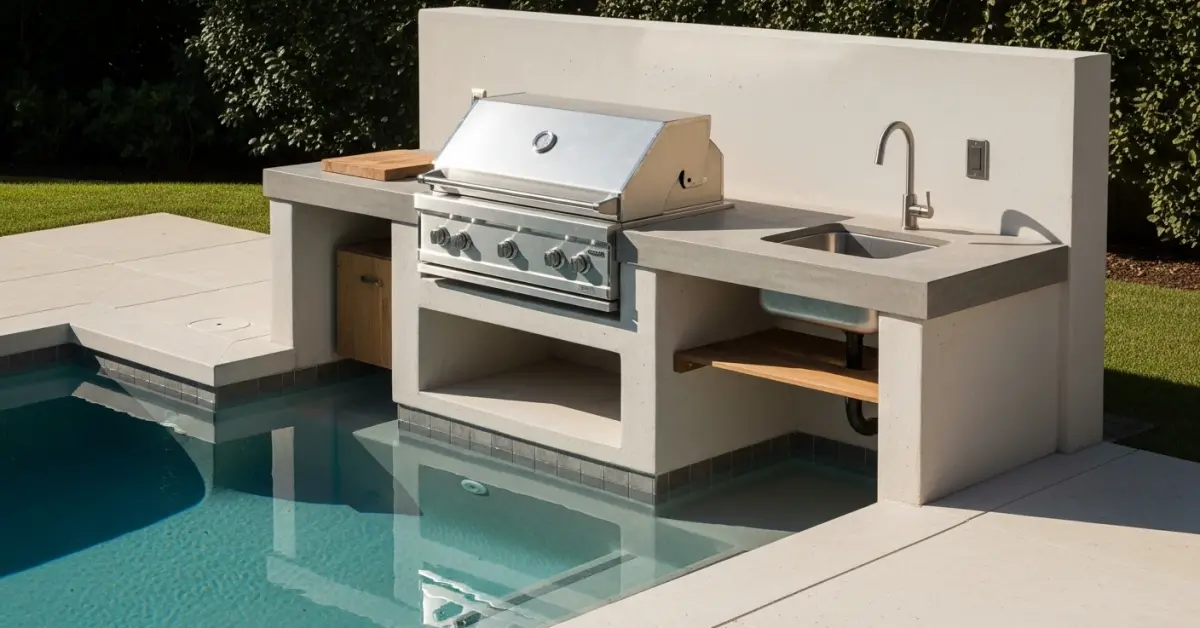
Custom Outdoor BBQ Kitchen Osceola County: A Framework for 30-Year Material Integrity in Florida's Climate
Building a custom outdoor BBQ kitchen in Osceola County presents a unique set of engineering challenges that I find are consistently underestimated. The combination of intense, year-round sun, high humidity, and heavy rainfall creates a highly corrosive environment that can degrade a poorly planned project in under five years. I've been called to far too many homes in Kissimmee and St. Cloud to diagnose issues like rusted 304-grade stainless steel, warped polymer doors, and mildew-infested porous stone countertops—failures that were entirely preventable. My entire approach is built on a principle I call Climate-Adapted Material Science. It’s not about just building a beautiful kitchen; it’s about engineering a permanent outdoor structure that performs like new, decade after decade, despite the subtropical weather. This means selecting materials and using construction techniques specifically designed to combat UV degradation, moisture intrusion, and thermal expansion.My Diagnostic Protocol for Osceola County Outdoor Kitchens
Before any design is even sketched, I perform a mandatory site analysis. A project for a covered lanai in a Celebration community faces different environmental stresses than an open-air kitchen on a larger property near Lake Tohopekaliga. My diagnostic process focuses on three critical variables: direct sun exposure hours, airflow patterns for smoke dissipation, and proximity to moisture sources like pools or irrigation systems. I once audited a project where the builder installed a high-end grill with a standard vent hood directly against the prevailing wind, rendering it useless and filling the patio with smoke. This is the kind of costly oversight my protocol is designed to prevent from day one.The Subtropical Durability Framework: Technical Deep Dive
My proprietary method, the Subtropical Durability Framework, is the core of my success. It’s not a secret, just a disciplined application of material science. It consists of three non-negotiable pillars:- Material Specification Hierarchy: I operate on a strict good-better-best model. "Good" is not an option here. The baseline starts with 316L marine-grade stainless steel for all appliances and access doors, which has superior corrosion resistance to the common 304 grade due to its molybdenum content. For countertops, I specify non-porous quartzite or Dekton over granite, as their low porosity drastically reduces the risk of staining and mildew growth in our humid climate. Cabinetry must be a high-density, marine-grade polymer that is color-stable under intense UV light.
- Ventilation and Airflow Engineering: Proper ventilation is a safety and usability issue. I calculate the required Cubic Feet per Minute (CFM) for a vent hood based on the grill’s total BTU output. A common rule is to require 100 CFM for every 10,000 BTUs. For a powerful grill under a covered lanai, a 1200 CFM hood is often the minimum requirement to ensure effective smoke capture.
- Structural Integrity and Sealing: The frame is the skeleton. I exclusively use welded T6061 aluminum tubing, which is lightweight, incredibly strong, and will never rust. Every joint in the cement board cladding is sealed with a waterproof membrane, and I use an epoxy-based grout for tile or stone, which is impervious to water and mildew.
Implementation: From Foundation to First Ignition
Executing the plan requires precision. My process follows a strict operational sequence to guarantee the framework is implemented correctly. A flawed installation invalidates even the best material choices.- Site Preparation and Utility Rough-In: This is where safety is paramount. We establish a concrete footing reinforced with rebar. All electrical wiring is run in waterproof conduit to a dedicated 20-amp GFCI circuit. Gas lines are pressure-tested at 1.5 times the operating pressure to ensure zero leaks.
- Aluminum Frame and Cladding Assembly: The frame is constructed and squared on-site. We then attach the cement board, ensuring a 1/8-inch gap between panels to allow for thermal expansion, a critical detail often missed. These gaps are then filled with a flexible, high-grade sealant before the finish material is applied.
- Countertop and Appliance Installation: Countertops are templated and cut with extreme precision. A key technique I use is to create a subtle 1/8-inch per foot slope away from the back wall to ensure water runoff. Appliances are then installed, leveled, and all gaps are sealed with a UV-resistant, food-safe silicone.
- Final Systems Check and Commissioning: I personally conduct the final walkthrough. I test every burner, check the refrigerator temperature, verify the electrical outlets, and inspect every inch of sealant. This isn't just a quality check; it's a verification that the entire system is built for a minimum 25% increase in operational lifespan compared to standard construction.
Precision Tuning for Longevity and Performance
The final 5% of the work is what defines a truly professional installation. This involves fine-tuning the gas valves for a perfect flame, adjusting door closures for a solid feel, and applying a final sealant coat to the stone countertops. I also provide the client with a streamlined maintenance schedule, because even the best materials benefit from basic care. For instance, a simple biannual cleaning of the stainless steel with a specified cleaner can prevent surface contamination and maintain its passive layer, which is what protects it from rust. This is a small action that ensures the long-term ROI of the client's investment. Given the intense humidity and sunlight your property in Osceola County experiences, have you confirmed if your proposed stainless steel components are 304 or the essential 316L marine grade?Written by

Tags
custom outdoor kitchen
custom outdoor kitchens near me
custom bbq island
custom outdoor grill
custom outdoor grill station
Custom Outdoor BBQ Kitchen in Osceola FL FAQ
What materials are best for countertops and cabinets to withstand rain and sun?
Granite and quartzite are top choices for countertops as they are highly resistant to heat from grills and will not fade under intense sun exposure. For cabinetry, marine-grade polymers or stainless steel offer the best longevity, as they will not rot, warp, or rust like wood or standard powder-coated metal. While treated wood looks appealing initially, it requires annual sealing and is susceptible to insect damage and moisture rot within 5-7 years, making the initial savings a long-term liability. Always ensure any selected material is rated specifically for outdoor use and regional climate conditions, not just 'weather-resistant'.
Do I need special permits for building an outdoor kitchen with gas and water lines?
Yes, extending utility lines like natural gas, plumbing, and dedicated electrical circuits almost always requires a municipal permit and licensed professional installation. A licensed plumber must run and test the gas line to prevent dangerous leaks, and a licensed electrician must install GFCI-protected outlets to meet safety codes for wet environments. Attempting this work without a permit can result in fines, void your homeowner's insurance in case of an accident, and create significant safety hazards. The permit process ensures the installation is inspected and complies with local building and safety codes.
How much clearance do I need between my built-in grill and the structure?
You must use an insulated jacket specifically designed for your grill model if it is being installed into any combustible structure, such as a wood or composite frame. This non-negotiable safety device creates a protective air gap, preventing the high heat from igniting the surrounding materials. Even with the jacket, manufacturers typically require a minimum of 15 cm (6 inches) of clearance to any combustible side or back walls. Ignoring the insulated jacket requirement is a primary cause of outdoor kitchen fires and is often an explicit violation of both the grill's warranty and local fire codes.
Can I place my outdoor kitchen on my existing deck or patio?
An outdoor kitchen's structure, countertops, and appliances create a significant dead load, often exceeding 900 kilograms (2,000 pounds), which most standard decks are not built to support. Before construction, a structural engineer must assess your deck's foundation and framing to confirm it can handle the concentrated weight, potentially requiring new footings and joist reinforcement. A concrete patio slab must be at least 10 cm (4 inches) thick and crack-free to provide a stable foundation. Placing a heavy kitchen on an inadequate base will lead to dangerous structural failure or slab cracking over time.
What is the most common point of failure you see in custom outdoor kitchens?
The most frequent and costly failures stem from improper water management within the structure's core. When builders fail to install weep holes, drainage channels, and a proper moisture barrier behind the veneer, water gets trapped inside the frame. This leads to mold, rust-out of steel studs, and expansion damage during freeze-thaw cycles that can crack the entire structure from the inside out. A well-designed kitchen actively manages water, directing it away from electrical components and out of the structural cavity. Ask your builder specifically about their internal drainage plan.
Is a ventilation hood really necessary for an outdoor grill?
A ventilation hood is mandatory if your outdoor kitchen is located under any type of combustible overhead structure, like a pergola, covered patio, or roof overhang. Without a hood, intense heat, smoke, and grease accumulate, creating a serious fire hazard and causing permanent staining and damage to the ceiling. The hood must be specifically rated for outdoor use, constructed from stainless steel, and have a powerful enough fan (typically 1200 CFM or higher) to effectively capture the exhaust. Forgetting this component in a covered space is a critical design flaw that compromises both safety and structural integrity.


