Custom Stainless Steel Doors Pinellas County: My Fabrication Protocol to Eliminate Pitting Corrosion from Salt Spray
The single biggest mistake I see in Pinellas County outdoor kitchens, from waterfront estates in Tierra Verde to coastal homes in Dunedin, is the wrong grade of stainless steel. People invest heavily in a beautiful outdoor living space only to see rust-colored streaks and pitting appear on their cabinet doors within a year. This isn't a defect; it's a fundamental misunderstanding of our local environment. The salty, humid air from the Gulf is relentlessly corrosive, and standard-grade steel simply cannot withstand it. My entire approach is built on preventing this specific failure. It’s not about just building doors; it's about engineering a solution for the high-chloride environment that defines Pinellas. I moved beyond generic fabrication years ago after having to replace a full outdoor kitchen door set on a Clearwater Beach property that had failed prematurely. That expensive lesson led me to develop a protocol that guarantees a 20+ year lifespan against corrosion, not just a promise of being "stainless."The Diagnostic Failure Point: Why Most Outdoor Kitchens Corrode
My methodology starts not with a tape measure, but with a geographical assessment. The core problem is that most fabricators treat all stainless steel as equal, typically using 304 stainless steel because it's the industry standard for kitchens. Inland, in a place like Brandon, this might be acceptable. But here in Pinellas, with the constant salt spray, 304's lack of sufficient molybdenum makes it highly susceptible to pitting and crevice corrosion. I've seen it happen time and again on properties along the Intracoastal. The chlorides in the salt air break down the steel's passive layer, creating small, destructive pits that ruin the finish and integrity of the door.The Technical Specification: 316L Alloy and Weld Passivation
To combat this, my specification is non-negotiable: I exclusively use 316L marine-grade stainless steel. The "L" signifies low carbon, which is critical for preventing weld decay, and the high molybdenum content is what provides the superior chloride resistance needed for our coastal setting. But the raw material is only half the battle. The fabrication process itself can introduce vulnerabilities. Every weld, if not properly executed and treated, becomes a starting point for rust. This is why post-weld passivation is a mandatory step in my workflow. It's a chemical process that removes free iron from the surface and restores a uniform, highly corrosion-resistant chromium oxide layer. Skipping this step is a common cost-cutting measure that I consider professional negligence in this environment.My Non-Negotiable Fabrication Checklist for Pinellas County
I've refined my process over dozens of projects, from small setups in Seminole to expansive outdoor kitchens in St. Pete. Each step is designed to eliminate a specific point of failure I've witnessed in the past.- Material Source Verification: I personally verify the mill certificates for every sheet of 316L steel. No exceptions. This ensures the chemical composition, especially the molybdenum content, meets the required standard.
- Laser Cut Edges: All cuts are made with a fiber laser. This creates a clean, heat-sealed edge that is less prone to contamination compared to saw or shear cutting.
- TIG Welding Protocol: All welding is done using the TIG (Tungsten Inert Gas) process with a high-purity argon shielding gas. This creates a clean, strong weld without spatter, which can trap corrosive particles.
- Acid Cleaning and Passivation: After assembly, every door is submerged in a citric acid bath. This critical passivation step removes any microscopic iron particles left from the fabrication process and chemically rebuilds the steel's protective layer.
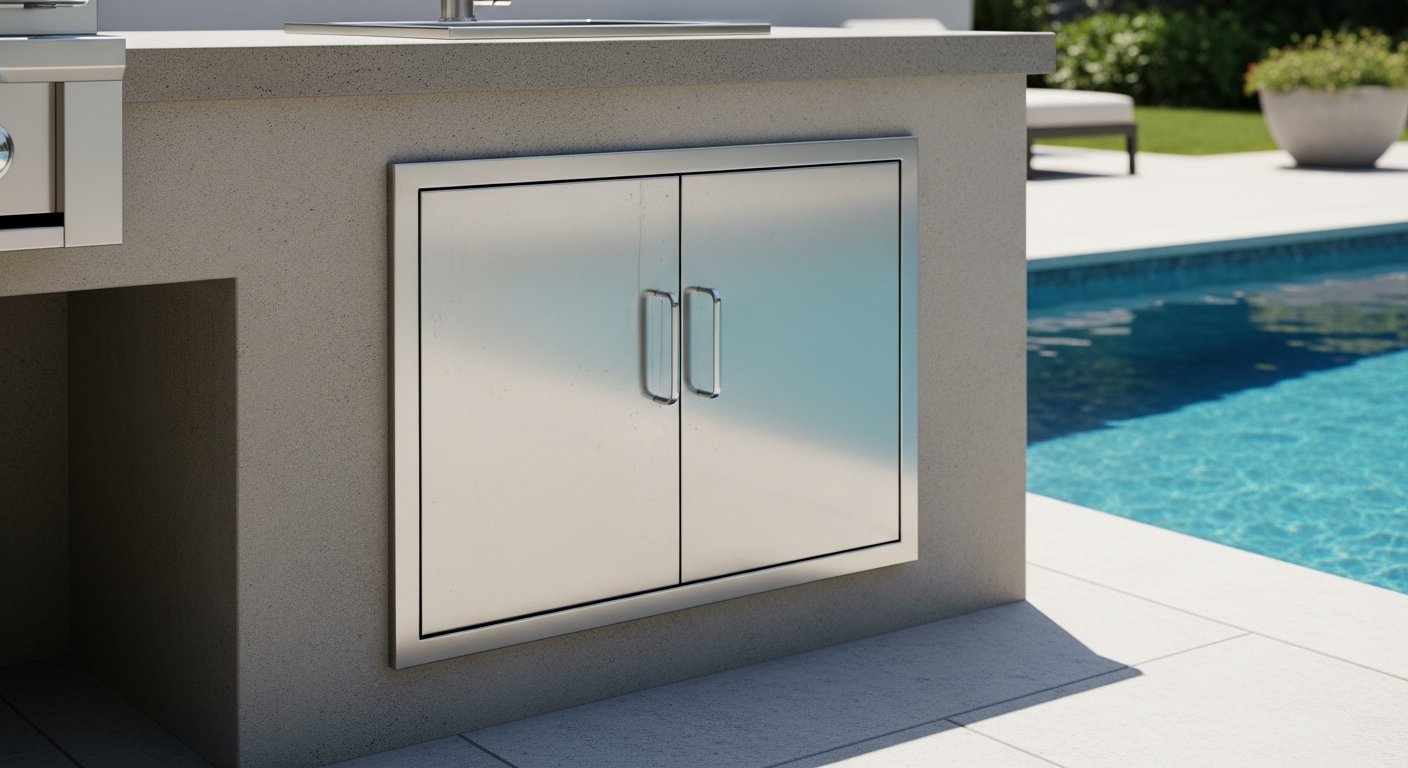
- Hardware Selection: All hinges, handles, and fasteners must also be 316-grade stainless steel. Using a lesser grade creates a point of weakness and invites failure.
Precision Adjustments for Coastal Longevity
Beyond the core fabrication, there are smaller details that make a significant difference. One common error I've had to correct on other installers' work is mismatched hardware. Using 304-grade handles on a 316L door creates a phenomenon called galvanic corrosion, where the less noble metal (the handle) corrodes at an accelerated rate. It’s a subtle but critical detail. Furthermore, I design doors with proper ventilation and drainage gaps to prevent stagnant, salty moisture from being trapped against the cabinet frame, a common issue during our humid summer months. The goal is to create a product that is not just resistant to the environment, but intelligently designed for it. Before you finalize your outdoor kitchen plans, have you asked your fabricator to specify the grade of their hinge pins and to provide proof of their post-weld passivation process?Written by

Tags
bbq cabinet outdoor
outdoor bbq cabinets
outdoor barbecue cabinets
exterior bbq cabinets
bbq outdoor cabinets