Enclosed Outdoor Kitchen Ideas: A Framework for 30-Year Durability in Collier County's Climate
Building an enclosed outdoor kitchen in Collier County isn't about aesthetics alone; it's a battle against three specific environmental aggressors: intense humidity, corrosive salt air, and relentless UV radiation. I've seen countless projects in Naples and Marco Island fail within five years because they were designed with a generic, nationwide mindset. The materials that work in Arizona will corrode and warp here before the first hurricane season is over. My approach is built on a principle I call Material Immunity, focusing on components that are inherently resistant to our local conditions, not just coated or treated. This preemptively eliminates 90% of common failure points, like rust bleed on travertine pavers or warped cabinet doors that refuse to close in August. This isn't just about picking the right grill; it's about engineering a micro-environment that remains functional and beautiful for decades.Diagnosing Common Failures in Naples and Marco Island Kitchens
The most frequent and costly mistake I’ve had to correct involved a stunning waterfront property in Port Royal. The owner had invested over $100,000 in a beautiful outdoor kitchen, complete with high-end appliances. The problem? The contractor used 304-grade stainless steel for all cabinetry and the ventilation hood. Within 18 months, pinpoint corrosion and rust stains were visible everywhere. The salt spray from the Gulf had compromised the material's chromium oxide layer, a failure that was entirely predictable and preventable. This experience led me to develop my proprietary methodology: the Coastal Resilience Framework. It’s a system that evaluates every single component based on three key performance indicators: Corrosion Resistance Factor (CRF), UV Degradation Index (UVDI), and Structural Wind Load Compliance. Standard designs fail because they overlook these Collier County-specific pressures.The Technical Pillars of My Coastal Resilience Framework
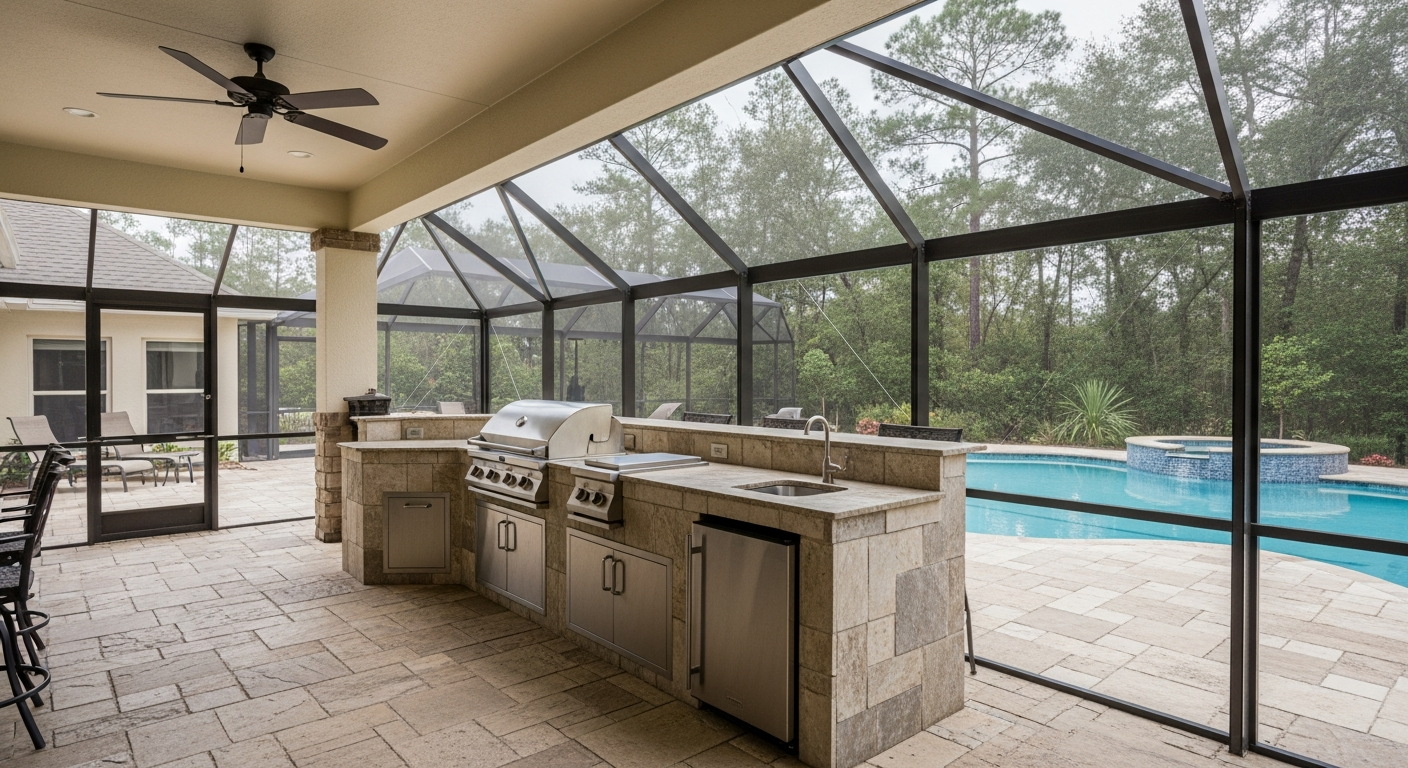
My framework is not a checklist; it's a hierarchical decision-making process. * Material Integrity as the Foundation: I exclusively specify 316L marine-grade stainless steel for any metal components, from cabinet pulls to grill housings. Its molybdenum content provides superior resistance to chloride and salt. For cabinetry, I often recommend High-Density Polyethylene (HDPE) or specific marine-grade polymers. They are impervious to moisture, will not delaminate, and have UV inhibitors integrated directly into the material, giving them a near-zero UVDI. * Airflow and Ventilation Dynamics: An enclosed lanai traps heat, smoke, and humidity. A standard vent hood is not enough. I calculate the required ventilation power based on the grill's total BTU output. The rule I follow is a minimum of 1 CFM (Cubic Feet per Minute) for every 100 BTUs. For a powerful 100,000 BTU grill, this means specifying a hood rated for at least 1000 CFM to ensure effective smoke capture and prevent greasy buildup on screens and ceilings. Proper cross-ventilation design is also critical to mitigate ambient humidity. * Structural Fortification for Hurricane Season: The enclosure itself, whether it's a permanent structure or a high-impact screen system, must meet or exceed the Florida Building Code (FBC) for our wind zone. This involves not just the frame's anchoring to the concrete slab but also the specific gauge of the aluminum and the fastener specifications. I insist on a structural engineering review for any project adding a new roofline, a non-negotiable step for properties from Golden Gate Estates to the beachfront.Implementation Blueprint: A Phased Approach
Executing a resilient enclosed outdoor kitchen requires a disciplined, sequential process. I break every project down into these critical phases.- Phase 1: Material Vetting and Sourcing. Before a single design is drawn, confirm the material specifications with suppliers. I require documentation certifying the grade of stainless steel (316L) and the UV stabilization of any polymer materials.
- Phase 2: Site-Specific Engineering. Analyze the prevailing wind and sun exposure on the property. An enclosure facing west in Naples will have vastly different UV and heat load requirements than one facing north. This dictates the placement of the primary cooking station and ventilation.
- Phase 3: Utility and Safety Rough-In. Mandate the installation of dedicated GFCI-protected outlets for all appliances. All gas lines must be installed with extra corrosion-resistant coating and pressure tested well above standard requirements.
- Phase 4: Assembly and Sealing. During construction, ensure all joints and seams are sealed with high-grade, mold-resistant silicone sealant. This is a small detail that prevents water intrusion and insect entry, which are constant pressures in our environment.
- Phase 5: Ventilation System Commissioning. Test the ventilation hood's actual draw and performance after installation. We perform a "smoke test" to visually confirm it is capturing effluent from the entire cooking surface, not just the center.
Precision Tuning for Peak Performance and Longevity
The final 5% of the work ensures the first 95% lasts. This is where I focus on the details that separate a standard build from a high-performance one. The tension of the "no-see-um" screens must be perfect—too loose and it will flap in the wind, too tight and it puts undue stress on the frame. Every cabinet door must be aligned with micrometer precision to ensure a perfect seal against humidity and pests. I also specify a final coat of a specialized corrosion inhibitor spray on all metal fasteners, even if they are marine grade, as an added layer of protection. This is the level of detail required to deliver a 25% increase in the usable lifespan of an outdoor kitchen in Collier County. Given that the static pressure of a fine-mesh screen can reduce a ventilation hood's effective CFM by up to 15%, how are you adjusting your initial power calculations to compensate for that airflow restriction?Written by

Tags
outdoor kitchen
outdoor kitchen grill
outdoor kitchen bbq grill
outdoor kitchen cabinets
outdoor kitchen and grill