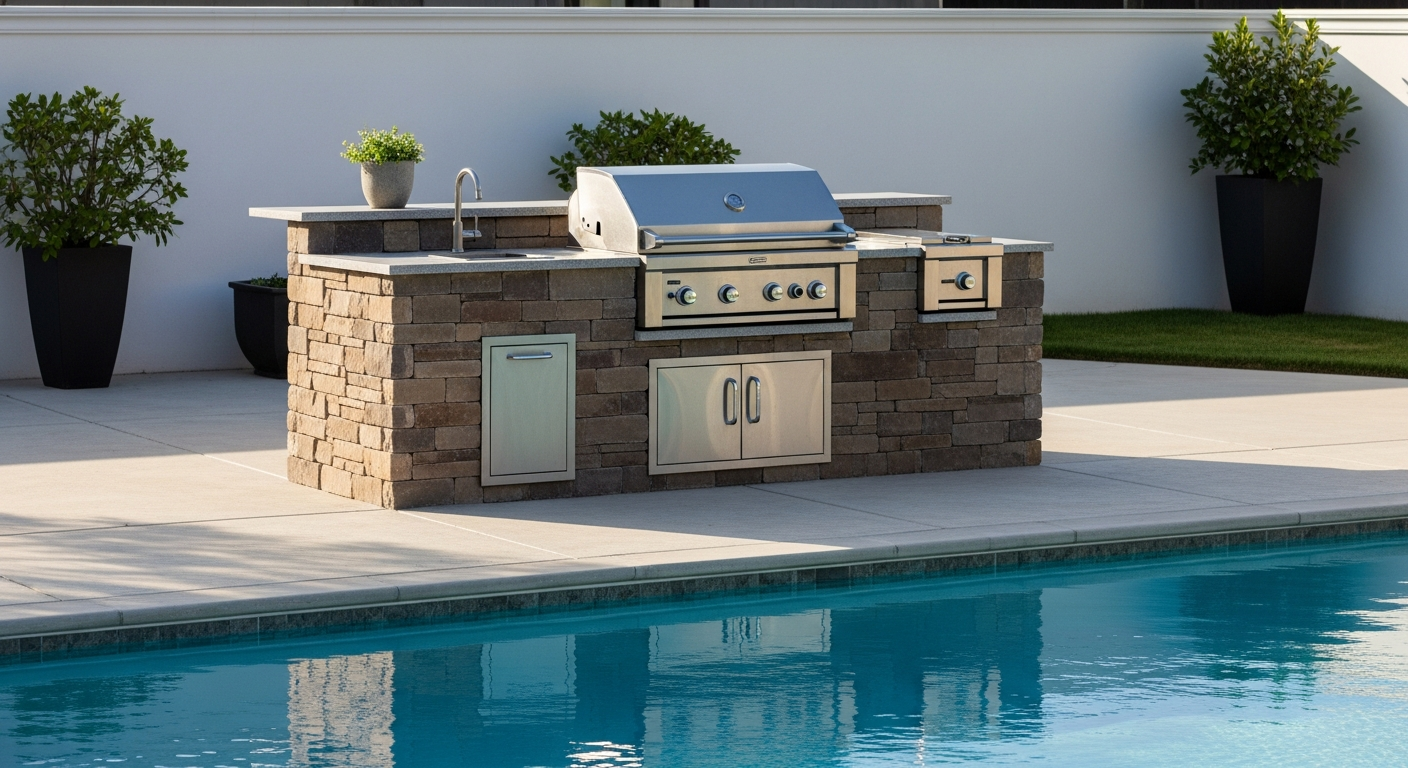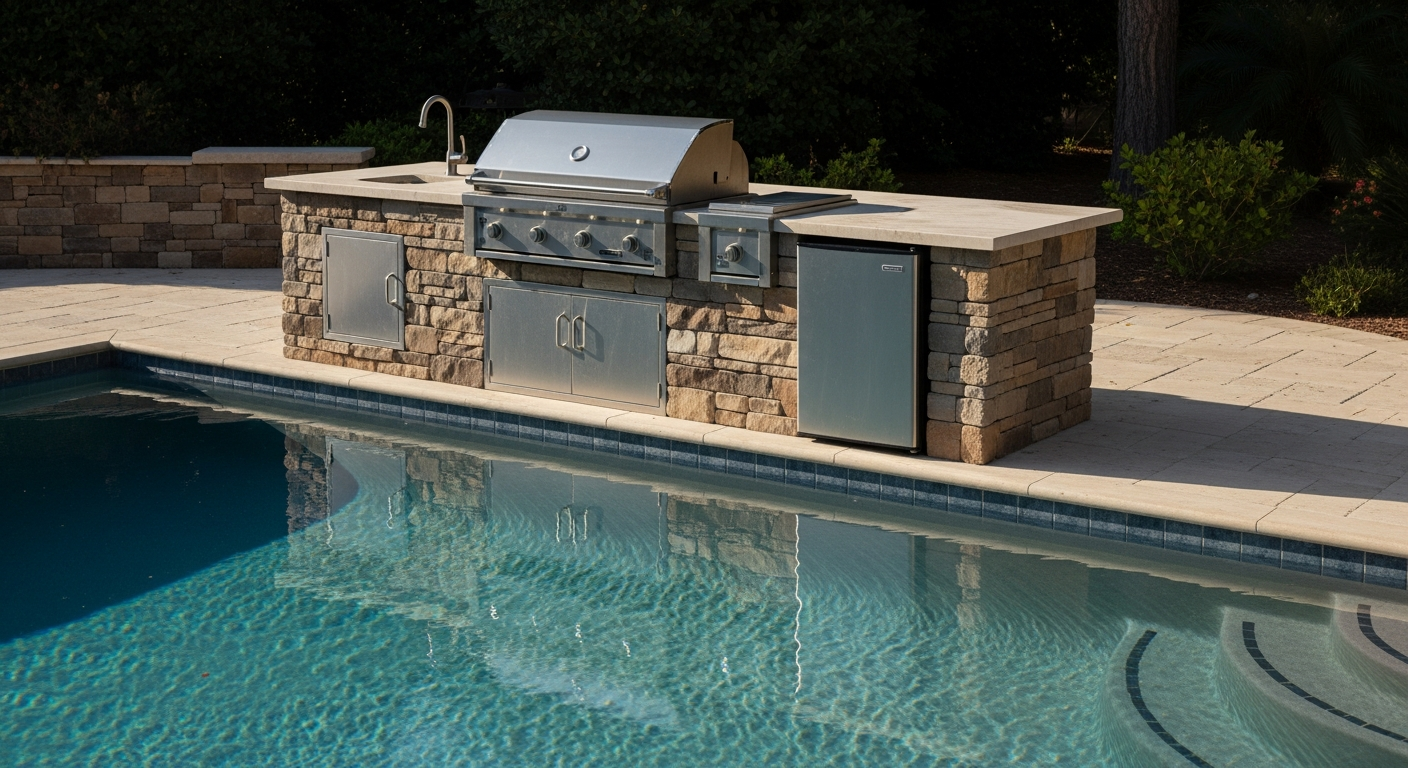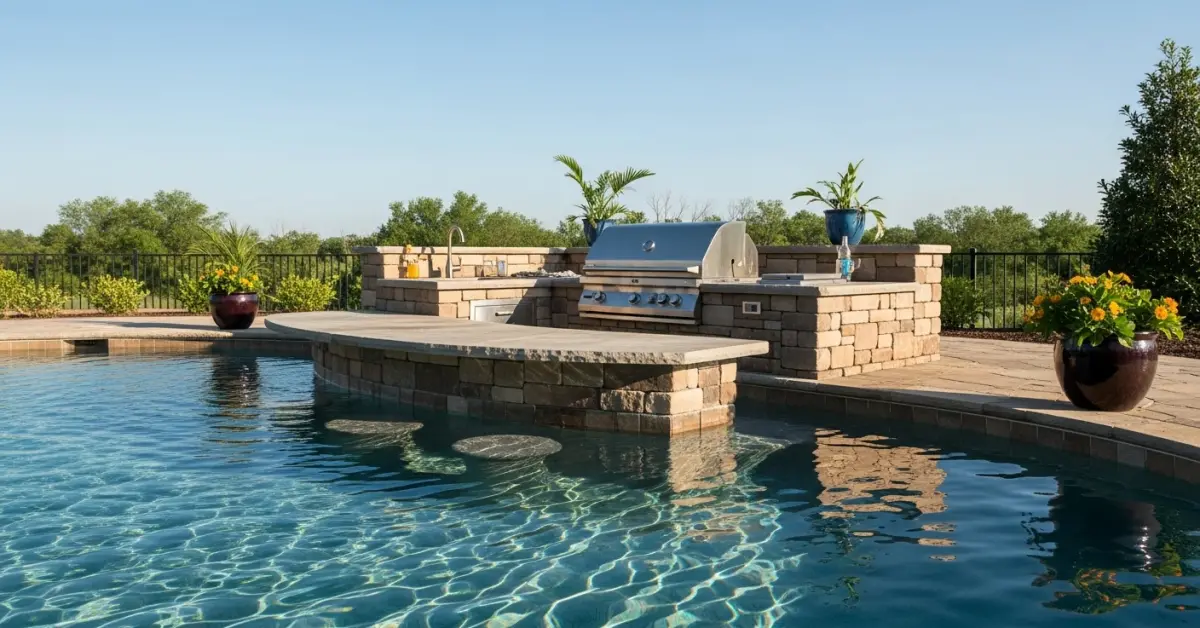
Grill Island Construction: A Pinellas County Protocol for 30-Year Salt-Air Resistance
I’ve spent over a decade designing and building custom outdoor kitchens, and the single most destructive element I fight here in Pinellas County isn't the hurricane-force wind; it's the relentless, corrosive salt air. A standard grill island build, the kind you might see inland, will show signs of failure—rust stains, crumbling finishes, and seized components—in as little as three years on a property in Treasure Island or St. Pete Beach. My entire process is built around mitigating this specific environmental stressor, ensuring the structure I deliver offers a minimum of 25% increased lifespan over conventional methods. The fundamental mistake I see is a focus on aesthetics over material science. Builders use cheaper 304-grade stainless steel for doors and frames, which simply cannot withstand the chloride-rich environment we have from Clearwater down to Pass-a-Grille. This oversight leads to catastrophic (and expensive) failures. My protocol prioritizes a material-first approach that treats the grill island not as a piece of furniture, but as a marine-grade structural installation.My Coastal Durability Framework: Beyond the Basic Build
After being called to repair a two-year-old, $20,000 grill island in a Snell Isle home where rust from the internal steel stud frame had bled through the stucco, I developed what I call the **Coastal Durability Framework**. It’s not just a checklist; it's a methodology for diagnosing environmental risk and specifying components that actively resist degradation. Standard construction practices fail to account for the constant humidity and salt deposition that defines our local climate. My framework addresses the three primary failure points: the structural frame, the hardware and fasteners, and component isolation.Material Specification for the Gulf Coast Climate
The core of my framework is an uncompromising standard for materials. For any project within a mile of the Intracoastal Waterway or the Gulf, I refuse to use anything less than marine-grade components. The cost difference is marginal upfront compared to the cost of a complete rebuild later. My non-negotiable material list includes:- Frame Construction: I exclusively use a welded 6061-T6 aluminum tube frame. Unlike steel studs, it is impervious to rust. Welding the joints, rather than screwing them, creates a monolithic structure that can withstand ground shifts and heavy use without flexing, which prevents cracks in the final finish.
- Hardware and Components: All access doors, drawers, and vents must be 316L marine-grade stainless steel. The "L" denotes low carbon content, which provides superior resistance to weld decay and sensitization. I personally verify the grade with suppliers.
- Countertop Selection: While granite is popular, its porosity is a problem in our humid climate, leading to mold and staining. I guide my clients toward sintered stone (like Dekton) or specific non-porous quartzites. They are impervious to UV degradation from the intense Florida sun and won't harbor mildew.
- Fasteners: Every single screw, bolt, and anchor must be, at a minimum, 18-8 stainless steel, but I push for 316 stainless fasteners wherever possible. This single detail prevents the tell-tale rust streaks that plague so many outdoor kitchens in our area.
Core Implementation: From Foundation to Finish
Building the island correctly is as critical as the materials used. A flawless execution prevents water intrusion and ensures the safety of the gas and electrical systems housed within. This is my step-by-step implementation process, refined over dozens of projects across Pinellas. 1. Site Preparation and Foundation: The concrete slab must be properly cured and sealed. I apply a topical hydrostatic pressure sealant before framing even begins, a step most builders skip. This prevents moisture from wicking up from the ground into the island's interior. 2. Frame Assembly and Utility Rough-in: The welded aluminum frame is anchored directly to the slab. All electrical wiring is run through liquid-tight conduit, and gas lines are pressure-tested for 24 hours before any cladding is installed. This is a critical safety check. 3. Cladding and Ventilation: We use 1/2-inch cement backer board, not drywall or plywood, which would disintegrate. Every joint is taped and sealed with a waterproof membrane. Critically, I install a minimum of two ventilation panels (one high, one low) to allow cross-ventilation. This prevents dangerous propane gas accumulation and also helps to dry out any ambient moisture, fighting mold growth from the inside out. 4. Finishing and Countertop Installation: Whether it's stone veneer or stucco, the finish is applied over the waterproofed backer board. The countertop is set with a slight, almost imperceptible, 1/8-inch slope per foot to ensure water runoff, preventing pooling that can damage grill components.Precision Tuning for Pinellas Longevity
The final 10% of the work is what separates a good build from a structure that will truly last a generation. These are the precision adjustments that address the most subtle, yet destructive, forces at play. My quality standard demands we address **galvanic corrosion**, which occurs when two dissimilar metals are in contact in the presence of an electrolyte (saltwater). I’ve seen this destroy high-end grill mounting flanges. To prevent this, we use neoprene or nylon washers to isolate stainless steel grill bodies from the aluminum frame. Furthermore, every single seam in the countertop and around the appliance cutouts is sealed with a high-grade, UV-stable silicone sealant. This is our final line of defense against water intrusion. Are you accounting for the specific grade of your fasteners and the electrochemical potential between your grill and its frame, or are you just hoping the salt air won't notice?Written by

Tags
outdoor grill with sink
outdoor grill and sink
outdoor grill and pizza oven
outdoor grill and bar
pre fabricated outdoor grill islands
Grill Island in Pinellas FL FAQ
How close to my pool can I safely build a grill island?
Maintain a minimum distance of 3 to 5 meters from the pool's edge to prevent safety hazards and contamination. This buffer zone is critical to keep grease splatter, smoke, and food debris from entering the water, which would otherwise consume large amounts of chlorine and disrupt your water chemistry. More importantly, this distance helps ensure any gas or electrical lines required for the island are safely routed away from the pool's underground plumbing and bonding wire. Accidentally damaging a suction line during foundation work could lead to a significant underground leak, losing over 1,800 liters of water daily from a simple 3 mm crack.
Will the runoff from cleaning my grill island affect my pool's water chemistry?
Yes, runoff from cleaning detergents and grease can severely impact your pool's water balance and clarity. Soapy runoff introduces phosphates, which are a primary food source for algae, while grease creates an oily film on the water surface that clogs your filter. Ensure the island's patio area has a dedicated deck drain that directs all runoff away from the pool and into your property's main drainage system. Allowing this runoff into the pool can cause your pH to fluctuate wildly outside the safe 7.2 to 7.6 range, leading to cloudy water and skin irritation for swimmers.
Can the construction dust from building the island damage my pool's equipment?
Construction dust, especially from cutting stone or concrete, can absolutely damage your pool's pump and filter. This fine, abrasive particulate matter can get past the skimmer basket and clog the small passages within your filter cartridges or sand, drastically reducing flow and putting immense strain on the pump motor. Before construction begins, cover the pool completely with a heavy-duty safety cover, not just a solar blanket. If covering isn't an option, run the pump as little as possible and clean the skimmer, pump baskets, and filter daily to prevent premature failure of the pump, which typically has an 8 to 12-year lifespan.
Could digging the foundation for my grill island break my pool's underground pipes?
Digging for the island's foundation poses a significant risk to your pool's buried plumbing lines if their location is unknown. Before any excavation, you must locate the underground suction and return lines that run between your equipment pad and the pool. A pressure test can help identify the general area, but a specialized plumbing locator service is the safest method. A broken pipe not only requires a costly and invasive repair involving draining the pool and digging up the deck, but it can also compromise the structural soil around the pool shell, potentially leading to future cracks in a gunite structure.
What kind of lighting is safe for a grill island next to a pool?
All electrical components for your grill island must be low-voltage (typically 12-volt) and powered by a transformer with a Ground Fault Circuit Interrupter (GFCI). This is a non-negotiable safety requirement for any electrical installation near a body of water to prevent electrocution risk. High-voltage (120-volt) outlets or fixtures must be installed at a code-mandated distance from the water's edge and be GFCI-protected. Never route electrical conduit in the same trench as your pool's plumbing lines, as a water leak could energize the ground if the conduit is compromised, creating a severe electrical hazard.
My new stone grill island has dark stains on the side facing the pool. Is this from the water?
Dark stains on the island's stone facing the pool are likely from splash-out containing algae, not just water. If you see similar dark spots inside your pool that do not brush off easily, you may have an outbreak of black algae, which has deep roots that penetrate plaster surfaces. When contaminated water splashes onto the porous stone of your island, these algae spores can take root there as well. The solution requires treating the pool itself with aggressive brushing and specialized algaecides, and then using a pH-neutral stone cleaner on the island to avoid etching the surface.