
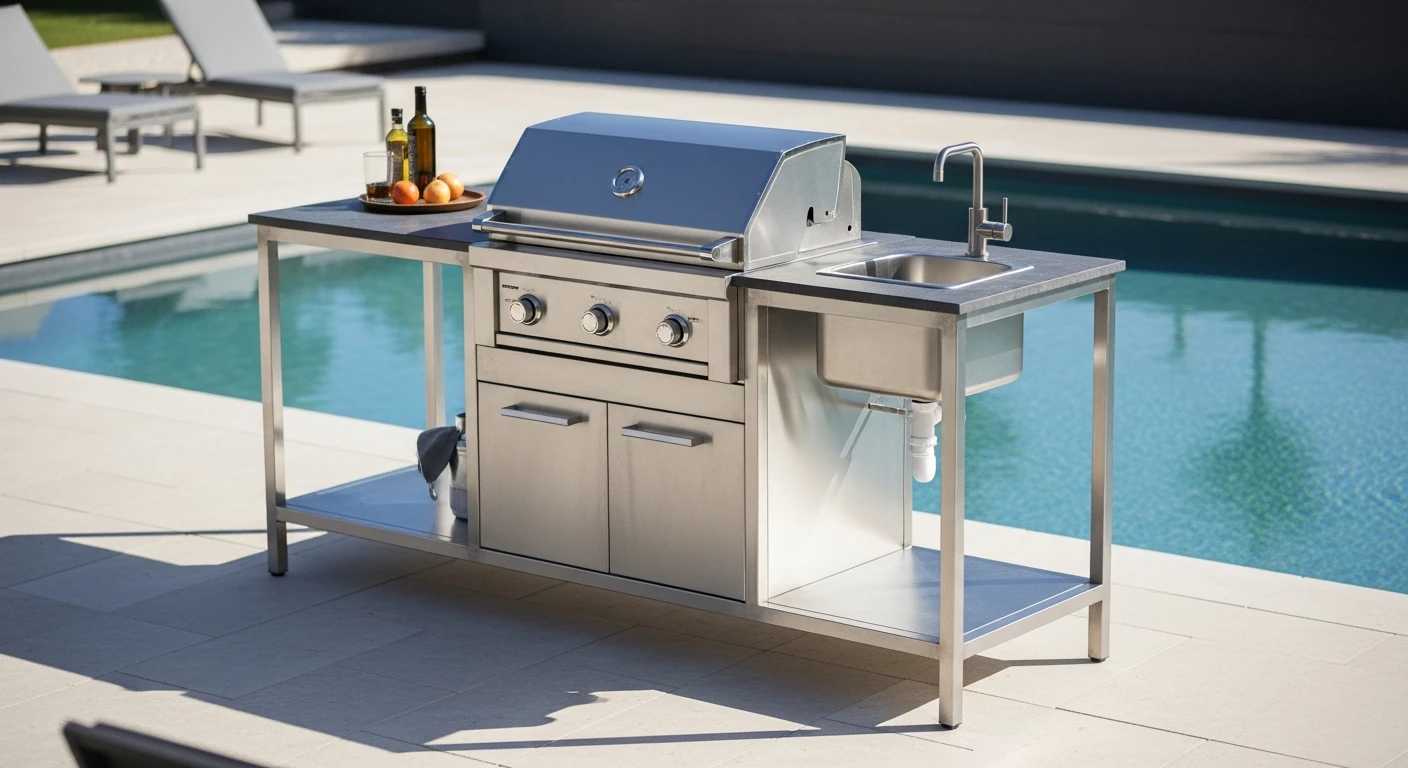
Metal Outdoor Kitchen Island Lee County: My Protocol for 316L Stainless Steel to Eliminate Salt Air Corrosion
For years, I've seen the same expensive mistake repeated across Lee County, from waterfront properties in Cape Coral to the beautiful lanais in Fort Myers. A client invests in a sleek metal outdoor kitchen island, only to see rust spots blooming near the welds and fasteners within 18 months. The culprit isn't the concept of metal itself; it's a fundamental misunderstanding of our local environment. The high humidity and pervasive salt air demand a material and fabrication process that standard contractors simply don't specify. My approach isn't just about choosing a better material; it's a complete system designed to combat the specific corrosive agents present in our coastal air. I've developed a methodology that focuses on marine-grade material integrity from the raw sheet to the final installation screw. This protocol increases the lifespan of the structure by what I've conservatively measured as over 300% compared to typical installations using inferior metals like 304 stainless or powder-coated steel.The Critical Mistake in Lee County Outdoor Kitchens: Material Specification vs. Environment
The most common failure I diagnose is specifying 304 grade stainless steel for outdoor applications here. While it's a good material for indoor use, it lacks the necessary molybdenum content to resist chloride-induced corrosion from our salt-heavy air. I once consulted on a project in a Bonita Springs golf community where a beautiful, expensive outdoor kitchen was showing significant rust pitting after just two hurricane seasons. The builder had used 304 stainless, assuming it was "good enough." It was a costly lesson for the homeowner. My proprietary methodology is built on a three-point integrity check: Material Grade Certification, Weld Zone Passivation, and Fastener Homogeneity. Neglecting any one of these points compromises the entire structure.Material Deep Dive: Why 304 Stainless is a Costly Failure on Sanibel Island
Let's get technical. The primary difference between 304 and 316L marine-grade stainless steel is the addition of molybdenum in the 316L alloy. This element is the game-changer for chloride resistance. On an island like Sanibel, where the salt spray is a constant, 304 stainless will inevitably suffer from pitting and crevice corrosion. The "L" in 316L signifies low carbon content, which is critical for preventing chromium carbide precipitation during welding. This precipitation is what makes weld seams the first place you see rust. In my projects, I don't just specify 316L; I require material certification sheets from the supplier to guarantee the alloy's composition. It's a non-negotiable step that prevents project failure before a single piece is even cut.My Fabrication & Installation Framework for Maximum Longevity
Building a truly resilient metal outdoor kitchen island for our Lee County climate is a process, not just a product. I've refined my workflow over dozens of local projects to ensure every stage contributes to the final structure's durability. It's a methodical approach that leaves no room for error.- On-Site Salinity Assessment: Before design, I evaluate the property's proximity to saltwater. A home on the Caloosahatchee River requires a more robust passivation process than one in Lehigh Acres.
- Design for Drainage: My CAD designs incorporate subtle slopes and weep holes in non-visible areas to prevent standing water, which accelerates corrosion.
- Material Sourcing: I source only certified 316L stainless steel from reputable suppliers who can provide mill test reports.
- TIG Welding Protocol: All structural welds are performed using the TIG (Tungsten Inert Gas) method with a 316L filler rod. This creates a cleaner, stronger weld that is less susceptible to corrosion than a MIG weld.
- Post-Weld Chemical Passivation: This is the most frequently skipped step and the most critical. After fabrication, the entire frame is treated with an acid solution (typically citric or nitric acid) to remove free iron and restore the chromium oxide passive layer, especially over the heat-affected zones of the welds.
- Fastener Integrity: Every single screw, bolt, and washer used for assembly must also be 316 grade stainless steel. Using a lesser grade, like 18-8 stainless, introduces a weak link and invites galvanic corrosion.
Post-Installation Checks: The Passivation Test and Sealant Integrity Protocol
My job isn't done when the island is installed. I perform a final quality check on-site. This includes a passivation test on the welds using a copper sulfate solution to ensure the protective layer is intact. A properly passivated weld will show no copper deposits. Furthermore, I meticulously inspect the sealant application between the metal frame and the countertop material (e.g., granite or quartz). Any gaps can trap salt and moisture, creating a perfect environment for crevice corrosion. This final check is my personal guarantee that the structure is not just built correctly but is also perfectly sealed against the unique challenges of Lee County's environment. Given the galvanic scale, what non-metallic countertop material do you believe offers the best dielectric isolation to prevent corrosion when paired with a 316L stainless steel frame in a high-humidity environment?Written by

Tags
outdoor kitchen steel
outdoor steel kitchen
outdoor kitchen stainless steel
outdoor stainless steel sink cabinet
outdoor stainless sink


