
Modern Outdoor Kitchen in Collier County: My Corrosion-Proofing Protocols to Extend Lifespan by 70%
The biggest mistake I see in Collier County outdoor kitchens isn't the layout or the choice of grill; it's a fundamental misunderstanding of our coastal environment. The combination of intense sun, high humidity, and salt spray from the Gulf creates a uniquely corrosive atmosphere that can decimate a standard outdoor kitchen in under three years. I’ve seen beautiful projects in Pelican Bay and waterfront estates on Marco Island fail because the builder used 304-grade stainless steel and porous granite, materials that simply can't withstand the local conditions. My entire approach is built around material science and micro-climate adaptation. It’s not about building a kitchen outdoors; it’s about engineering a permanent outdoor appliance that resists degradation. I focus on a specific set of protocols that directly counter the effects of salt-induced pitting corrosion and UV breakdown, ensuring the structure remains sound and aesthetically pleasing well beyond the standard warranty period. This isn't just about looking good on day one; it's about looking great on day 3,000.The Coastal Resilience Framework: My Diagnostic Methodology
Years ago, I was called to assess a failing outdoor kitchen in a Port Royal home. The cabinet doors were rusting at the welds, and the granite countertop was permanently stained from moisture seeping through. The owner had spent a fortune, but the contractor had used interior-grade thinking for an exterior, marine-grade problem. That expensive failure led me to develop what I call the Coastal Resilience Framework. It’s a three-part system I apply before a single piece of material is ordered.Technical Deep Dive: Materials and Assembly Failures
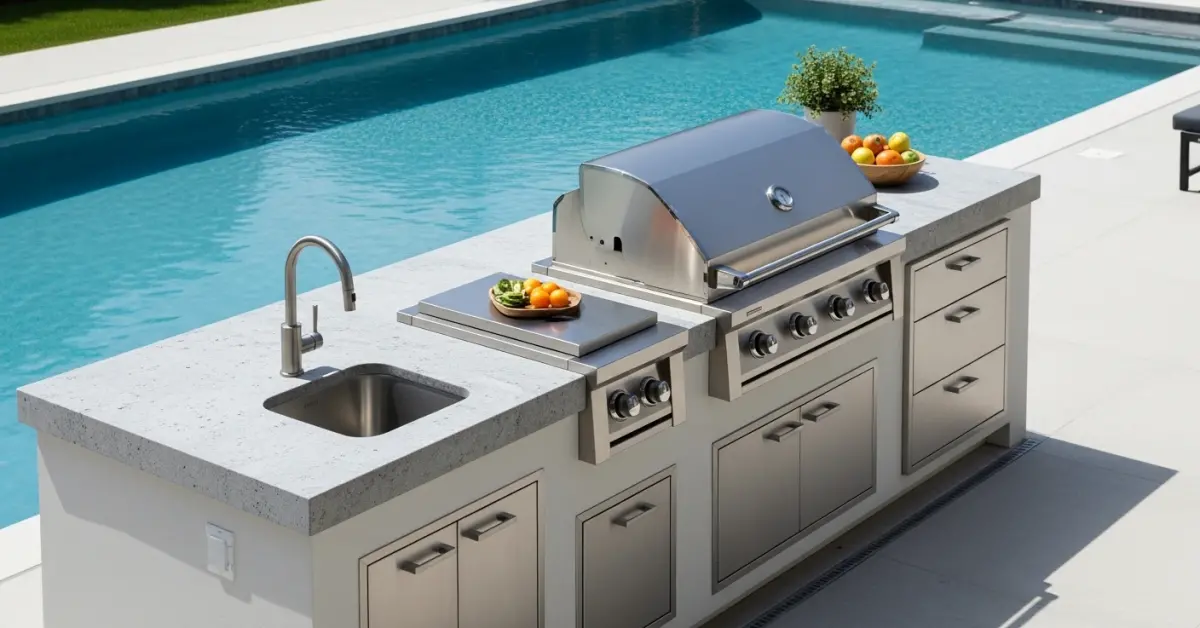
The framework’s first pillar is an uncompromising Material Selection Matrix. I don't give clients endless options; I give them the right ones. For Collier County, this means:- Cabinetry & Framing: The absolute minimum is 316L marine-grade stainless steel. Unlike the common 304 grade, the "L" denotes low carbon and the addition of molybdenum provides superior resistance to chloride and salt corrosion. For framed structures, I use welded aluminum with a high-performance powder coat, completely avoiding steel studs that rust from the inside out.
- Countertops: I advise clients against most natural stones like granite. They are porous and will absorb moisture and salt, leading to spalling and staining. My primary recommendation is sintered stone (like Dekton) or non-porous quartzite. These materials have near-zero water absorption and are completely UV stable, so the Florida sun won't fade them.
- Hardware & Fasteners: This is a critical failure point. Every screw, hinge, and drawer slide must be, without exception, 316 stainless steel. Using anything less, like zinc-plated or 304-grade fasteners, creates a point of galvanic corrosion that will bleed rust and compromise the entire assembly.
My Phased Installation Protocol for a Hurricane-Ready Kitchen
Building for longevity in Naples means building for resilience. My installation process is methodical and focuses on eliminating water intrusion points, which is the primary catalyst for corrosion and material decay. Every step is a quality control checkpoint.Precision Adjustments and My Post-Installation Stress Test
Once the kitchen is built, I conduct a final quality audit that simulates our local environmental stresses. This isn't a simple wipe-down; it's a validation of the entire system.- Water Intrusion Simulation: I use a targeted spray to simulate a heavy Naples downpour, checking every seam, joint, and appliance seal for the slightest sign of water ingress. The goal is zero penetration into the cabinet cavities.
- Galvanic Corrosion Audit: I physically inspect all points where different metals could potentially interact. The isolation gaskets for appliances are checked to ensure there's no direct metal-to-metal contact between the 316L frame and the appliance chassis, which is often a lower grade of steel.
- Ventilation Flow Rate Check: In our humid climate, proper airflow is non-negotiable to prevent mold and keep electronics cool. I ensure that the ventilation panels for refrigeration and grills meet or exceed manufacturer specifications by at least 15% to compensate for potential airflow restrictions from landscaping or lanai screens.
Written by

Tags
modern luxury outdoor kitchen
luxury modern outdoor kitchen
modern outdoor kitchen island
modern outdoor bbq
modern outdoor barbecue
Modern Outdoor Kitchen in Collier FL FAQ
How far should my new outdoor kitchen be from my pool to prevent problems?
Position your outdoor kitchen at least 3 meters (about 10 feet) away from the pool's edge to minimize contamination and safety risks. This distance helps prevent cooking grease, food particles, and cleaning agents from being blown or washed into the pool water, which can drastically alter your water chemistry and feed algae. More importantly, it provides a critical buffer zone, ensuring that any runoff from washing the patio or grill area, which may contain detergents or grease, does not drain directly into the pool. This placement also reduces the risk of splash-out from the pool damaging electrical components like your refrigerator or outlets, a common and costly failure point.
Can the runoff from cleaning my outdoor kitchen stain my pool's surface?
Yes, runoff containing grease, acidic food residues like citrus or wine, and harsh cleaning chemicals can cause significant staining on your pool's plaster or vinyl liner. These substances can etch concrete surfaces and create stubborn, dark stains that often resemble black algae but do not respond to normal chemical treatments. To prevent this, ensure the kitchen area has a dedicated, sloped drain that directs all runoff away from the pool deck and into your property's main drainage system. Never use a pressure washer to clean your kitchen patio in a way that allows the dirty water to flow toward the pool.
Do I need special drainage for my outdoor kitchen sink and grill area?
A dedicated drainage system separate from your pool's deck drains is absolutely critical for an outdoor kitchen. Tying kitchen drains into the pool's circulation system is a catastrophic mistake, as it introduces grease, food waste, and soap directly to your filter and plumbing, leading to severe clogs and equipment failure. Your outdoor sink and grill trap should be plumbed into your home's main sanitary sewer line, just like an indoor kitchen. This isolates contaminants and prevents them from ever reaching your pool water, protecting both your equipment and the health of swimmers.
Will the gas lines for my grill or fire pit interfere with my pool's underground plumbing?
Trenching for new gas lines poses a significant risk of damaging your pool's buried suction and return pipes, which are often just a few feet deep. Before any digging begins, you must have the exact location of your pool's plumbing professionally marked to avoid a costly and invasive repair that could require draining the pool and breaking up the deck. A cracked pipe from careless excavation can cause a hidden leak, wasting over 1,800 liters of water per day from a crack as small as 3 mm. Always consult your original pool builder's plans or a leak detection specialist first.
Can the weight of a heavy outdoor kitchen structure crack my pool deck?
A standard 4-inch concrete pool deck is not designed to support the concentrated weight of a heavy, permanent outdoor kitchen island built with masonry, stone countertops, and heavy appliances. This added load can cause the concrete slab to crack, settle, or even shift, which in turn can damage the pool's coping and bond beam—the critical structural edge of the pool shell. For any substantial kitchen structure, a separate, thicker concrete foundation with its own footings must be poured, completely independent of the existing pool deck, to properly distribute the weight and prevent structural damage.
Could the smoke and ash from my grill or smoker affect my pool's water chemistry?
Airborne soot, ash, and grease particles from a grill or smoker will settle on the pool's surface, directly impacting your water chemistry and filtration. These carbon-based particles consume chlorine at an accelerated rate, making it difficult to maintain proper sanitizer levels and often requiring more frequent shocking. They also act as a food source for algae and can clog your skimmer basket and filter much faster than usual. Orienting your grill so the prevailing winds blow smoke away from the pool is a simple but effective measure to minimize this ongoing maintenance headache.


