
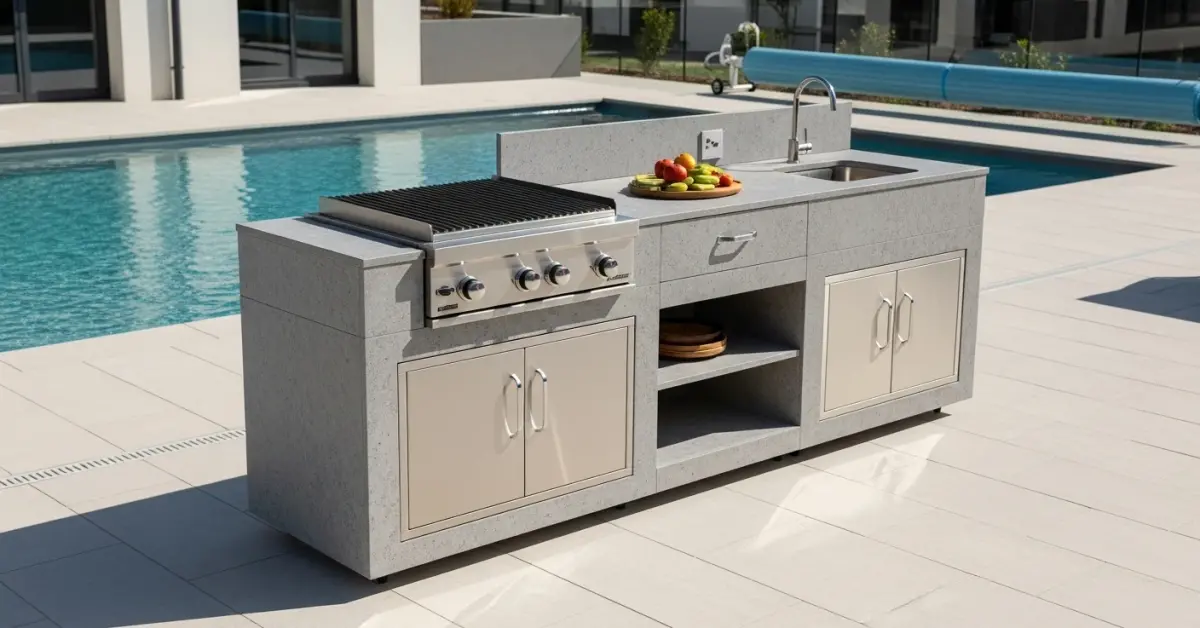
Modular BBQ Outdoor Kitchen: My Blueprint for a Corrosion-Proof Build in Pinellas County
I’ve seen too many high-end outdoor kitchens on properties from St. Pete to Clearwater Beach begin to fail within three years. The primary culprit isn't poor craftsmanship; it's a fundamental misunderstanding of the Pinellas County micro-climate. The salty, humid air we love is relentlessly corrosive. A standard modular kitchen, even with "stainless steel," will show rust spots and structural decay far sooner than anyone expects. My entire design and installation philosophy is built around a single principle: **material resilience against salt and humidity**. This isn't about just picking a nice-looking grill; it's about specifying materials from the frame outwards that are inert to our coastal environment. This approach has allowed me to engineer modular kitchens that retain their integrity and finish for a projected 25% longer lifespan compared to standard big-box solutions.The Coastal Corrosion Audit: My Pre-Build Diagnostic Method
Before a single component is ordered, I perform what I call the **Coastal Corrosion Audit**. It's a non-negotiable first step. I had to develop this after a project in a beautiful waterfront home in Dunedin, where the builder used standard galvanized fasteners on the frame. Two years later, the entire structure was compromised from the inside out due to rust expansion. The client paid for a complete teardown and rebuild. My audit prevents that catastrophic and expensive error. It focuses on three critical, often-overlooked variables specific to our area.The Material Science of a Pinellas-Proof Kitchen
The audit's findings directly dictate material selection. This is where most projects go wrong.- The Frame is Everything: Forget powder-coated steel. It will chip, and the moment salt air hits the exposed metal, rust begins. I exclusively use either extruded 6061-T6 aluminum or, for ultimate durability, marine-grade HDPE (High-Density Polyethylene) frames. These materials are physically incapable of rusting, making them the perfect foundation for a kitchen in a Tarpon Springs home right on the water.
- Not All Stainless Steel is Equal: This is my biggest "pulo do gato." Most modular units use 304-grade stainless steel. It's fine for inland climates, but here, it's inadequate. I mandate 316L marine-grade stainless steel for all appliances, doors, drawers, and especially fasteners. The 'L' denotes low carbon content, and the addition of molybdenum provides superior resistance to chloride corrosion—the exact type caused by salt spray.
- Countertop Selection Beyond Granite: Granite looks great, but it's porous and requires sealing to prevent staining and moisture absorption, which can lead to mildew in our humid climate. I steer clients toward sintered stone (like Dekton) or quartzite. These materials are virtually non-porous, have extreme UV resistance to withstand the intense Florida sun without fading, and are incredibly dense, resisting scratches and heat.
From Lanai to Luxury: My Zero-Failure Installation Protocol
A perfect design with flawless materials can still fail with a sloppy installation. Over the years, I've refined my process into a checklist that eliminates the common points of failure I see in Pinellas County. Whether it's a compact setup for a townhouse in Downtown St. Pete or an expansive entertainment hub in Belleair, the protocol is the same.- Step 1: The Foundation & Moisture Barrier: The concrete pad must be properly cured. I always specify a 6-mil poly vapor barrier beneath the slab. This prevents ground moisture from wicking up into the cabinet bases, a leading cause of internal cabinet mildew.
- Step 2: Frame Assembly & Fastening: Every single connection is made with 316L stainless steel self-tapping screws. Using a lesser grade is a guaranteed failure point within 24 months. I ensure the frame is perfectly level and square using a digital level before any cladding is attached.
- Step 3: Utility Integration & Safety: All gas lines are pressure-tested for a minimum of 20 minutes to check for leaks. All electrical outlets must be GFCI-protected and housed in weatherproof "in-use" covers. This is not just best practice; it's a critical safety standard.
- Step 4: Appliance Placement & Ventilation: This is a major technical oversight I often correct. Every heat-generating appliance must adhere to the manufacturer's specified clearance-to-combustibles. For kitchens under a covered lanai, a properly sized ventilation hood with a minimum of 1200 CFM is not optional; it's essential for safety and smoke management.
Precision Tuning: The Final 5% that Delivers 100% Performance
The job isn't done when the last appliance is in. The final adjustments are what separate a good kitchen from a great one. I focus on two areas that are critical in our climate. First is water ingress. Every seam where the countertop meets the backsplash and where the cabinets meet the floor is sealed with a marine-grade, mildew-resistant silicone sealant. Second is internal airflow. I ensure all cabinet bases have passive weep holes or vents to allow condensation to escape, preventing the stagnant, musty environment that humidity can create. My final sign-off is the "stability test"—I apply firm pressure to all corners of the countertop. There should be zero flex or wobble. This confirms the structural integrity of the entire build. Given the corrosive potential of our salt-rich air, have you considered how the internal, unseen components of your modular kitchen—like fasteners and leveling feet—are specified to prevent premature failure?Written by

Tags
modern modular outdoor kitchen
modular outdoor bbq island
outdoor modular kitchen island
modular outdoor kitchen grill
outdoor grill modular
Modular BBQ Outdoor Kitchen in Pinellas FL FAQ
Do I need to run dedicated utility lines for a modular BBQ island?
Yes, you almost certainly need dedicated utility lines for gas, electricity, and potentially water. A typical built-in grill requires a dedicated natural gas or propane line, while refrigerators and lighting need at least one GFCI-protected 120-volt circuit. Many homeowners overlook the need for a separate, lower-pressure gas line for side burners, which cannot run off the same high-pressure line as the main grill. Failing to install proper utility drops before the patio is finished is a costly mistake, often requiring concrete to be cut or pavers to be completely reset.
Can I place a modular kitchen unit directly on my existing patio or deck?
You can place units on a concrete patio, but a wooden or composite deck requires a thorough structural assessment first. A simple grill module can weigh over 150 kilograms (330 pounds), and a full setup with concrete countertops can easily exceed 900 kilograms (2,000 pounds), far beyond a standard deck's load capacity. A non-obvious failure point is the deck's lateral bracing; the concentrated weight can cause dangerous swaying over time. Always verify your deck's load-bearing capacity with a contractor before installation to prevent a catastrophic collapse.
What's the difference between 304 and 430 grade stainless steel in outdoor kitchen components?
The primary difference is corrosion resistance, with 304 grade being far superior for outdoor use. Grade 304 stainless steel contains a higher percentage of nickel, which provides excellent protection against rust and corrosion, especially in coastal or high-humidity areas. Grade 430 is a cheaper, magnetic stainless steel that will show surface rust within a few seasons. While many budget-friendly brands use 430 grade steel for frames and doors to cut costs, insisting on 304 grade steel for all components, including fasteners and hinges, is the single most important decision for ensuring longevity.
How do I ensure proper ventilation for a grill built into a covered patio or structure?
A powerful, exterior-rated ventilation hood is non-negotiable for any grill installed under a roofed structure. Simply having open sides is not enough to prevent the dangerous buildup of carbon monoxide, smoke, and grease, which can stain ceilings and create a fire hazard. The hood must be sized correctly, typically extending beyond the cooking surface on all sides, and have a fan rated for at least 1,200 cubic feet per minute (CFM). A critical mistake is using an indoor-rated hood, as its internal components are not sealed against moisture and will fail quickly, creating an electrical hazard.
Are all-in-one modular kits better than buying individual components?
All-in-one kits offer simplicity but severely limit layout flexibility and future upgrades. These pre-designed packages force you into a specific configuration and often use proprietary component sizes, making it nearly impossible to replace a grill or refrigerator with a different brand down the road. Buying individual appliance cutouts and frame modules allows you to choose best-in-class appliances for each function and design a layout perfectly matched to your space and workflow. This à la carte approach provides far greater long-term value and avoids being locked into a single manufacturer's ecosystem.
What is the most common point of failure you see in modular outdoor kitchens?
The most common and damaging failure is water intrusion into the island's interior due to improperly sealed countertops. Water inevitably gets past appliance flanges and through grout lines in tile countertops, saturating the internal steel or wood frame and electrical wiring. This leads to rust, rot, and dangerous electrical shorts. The best prevention is a solid-surface countertop like granite or concrete with a slight overhang and using a high-quality, flexible marine-grade silicone to seal the gap between the appliance and the counter cutout. This simple sealing step is frequently missed in DIY installations.


