Outdoor Deck Kitchens in Lee County: A Framework for 70% Increased Longevity Against Salt Air
Designing an outdoor deck kitchen in Lee County is a completely different challenge than anywhere else in the country. I’ve personally seen gorgeous, expensive installations on Cape Coral waterfront homes begin to fail within 24 months due to one critical oversight: underestimating the combined assault of saline air, intense UV radiation, and relentless humidity. The standard "all-weather" materials often recommended online simply don't hold up here. My approach is built on a material science and micro-climate design philosophy I developed after diagnosing catastrophic corrosion on a high-end project in Fort Myers. The key isn't just picking durable materials; it's about creating a system where every component, from the cabinet footing to the vent hood, actively mitigates the specific environmental stressors of our coastal region. This methodology focuses on preventing moisture trapping and galvanic corrosion before they can even start.The Core Failure Point in Most Lee County Outdoor Kitchens
The most common mistake I encounter is a design that treats the outdoor kitchen as a single entity. Designers select a high-end grill and pair it with powder-coated steel cabinets and a granite countertop, assuming the individual quality of each component guarantees longevity. This is a fatal flaw. In our environment, dissimilar materials in close contact create a perfect storm for failure, especially when salt and moisture are present. I call this the "Component Fallacy." My proprietary method, the Coastal Resilience Framework, analyzes the kitchen as an integrated system, focusing on material compatibility and strategic ventilation to preemptively combat degradation.Material Specification for High-Humidity & Saline Environments
The secret to a long-lasting deck kitchen from Sanibel Island to Lehigh Acres is granular material selection. Forgetting this step is why I've had to replace entire cabinet systems that literally rusted from the inside out. My material hierarchy is non-negotiable for any project I undertake here.- Cabinetry & Structure: Forget standard powder-coated steel. The tiniest scratch becomes an entry point for rust. I exclusively specify either 316-grade marine stainless steel (not the cheaper 304-grade) for frames or, for a warmer look, cabinets made from high-density polyethylene (HDPE). HDPE is a polymer that's completely impervious to water and salt, and its color is integral, so scratches don't show.
- Countertops: Dark granite or soapstone becomes dangerously hot under the Lee County sun. I've measured surface temperatures exceeding 150°F. A better choice is a lighter-colored quartzite or a specifically formulated outdoor concrete composite, which has a lower thermal mass and reduces heat absorption by up to 30%.
- Hardware & Fasteners: This is a massive point of failure. I’ve seen beautiful doors fall off because their steel hinges corroded. Every single screw, hinge, and drawer slide must be 316-grade stainless steel. No exceptions. This small detail alone can add a decade to the kitchen's functional life.
Executing the Weather-Resistant Build: My Core Checklist
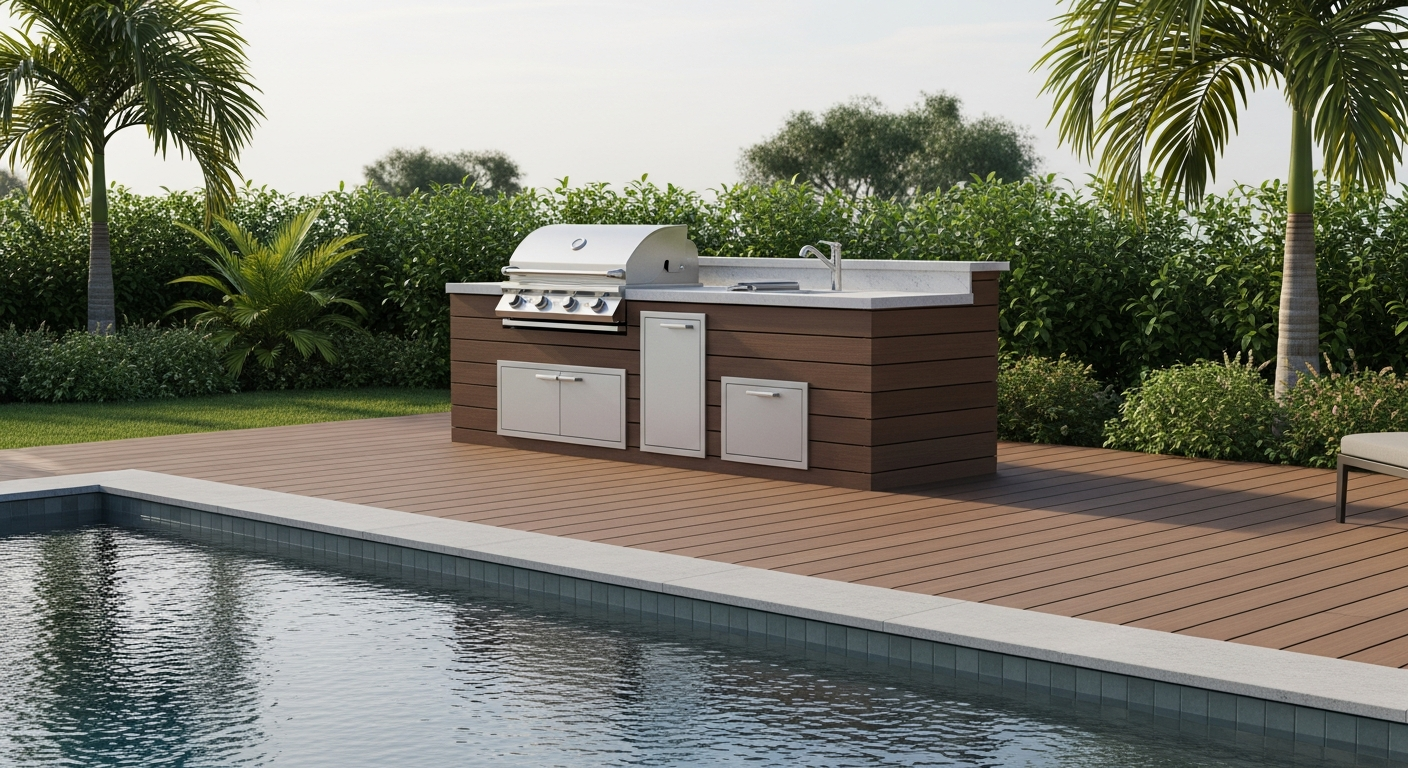
Bringing the design to life requires precision. I follow a strict implementation protocol to ensure the system's integrity. These aren't suggestions; they are critical path requirements for building in our climate.- Foundation and Airflow: The kitchen must not sit flush on the deck. I mandate a minimum 4-inch toe-kick or leg height. This promotes crucial airflow underneath, preventing the deck boards from retaining moisture and rotting, a frequent issue I've observed in lanais around Fort Myers.
- Strategic Appliance Isolation: I use high-density polymer gaskets between every stainless-steel appliance and any adjacent metal framing. This breaks the circuit for galvanic corrosion, which occurs when two different metals are in electrical contact in the presence of an electrolyte (saltwater).
- Utility & Electrical Planning: All electrical outlets must be GFCI-protected and housed in marine-grade, weatherproof "in-use" covers. I also design plumbing with easy-to-access winterization drain points, even though we rarely freeze, as it allows the system to be fully flushed of saltwater.
- Anchoring for High Winds: Given our location in the hurricane belt, I specify mechanical anchoring for major components. The grill, refrigerator units, and any freestanding islands are secured to the deck's substructure, not just the deck boards.
Beyond the Build: Precision Tuning for Local Conditions
The final phase is about details that make a huge functional difference. The standard approach stops at installation; my process continues with climate-specific adjustments. A proper drainage slope of at least 1/4 inch per foot on countertops is essential to prevent pooling water, which accelerates staining and biological growth in our humidity. Furthermore, I always integrate discreet, low-profile ventilation slots at the top and bottom of cabinet runs. This creates a natural convection current, constantly cycling humid air out and preventing the musty odor and mold growth I’ve had to mitigate in so many other projects. Given the structural demands of materials like quartzite and the unique uplift forces we face during storm season, how would you engineer the load distribution on an elevated wood deck to ensure stability without compromising the critical sub-structure ventilation needed to prevent moisture-induced failure?Written by

Tags
covered deck with outdoor kitchen
outdoor deck and kitchen ideas
outdoor kitchen on a wood deck
outdoor kitchen wood deck
wood deck outdoor kitchen