
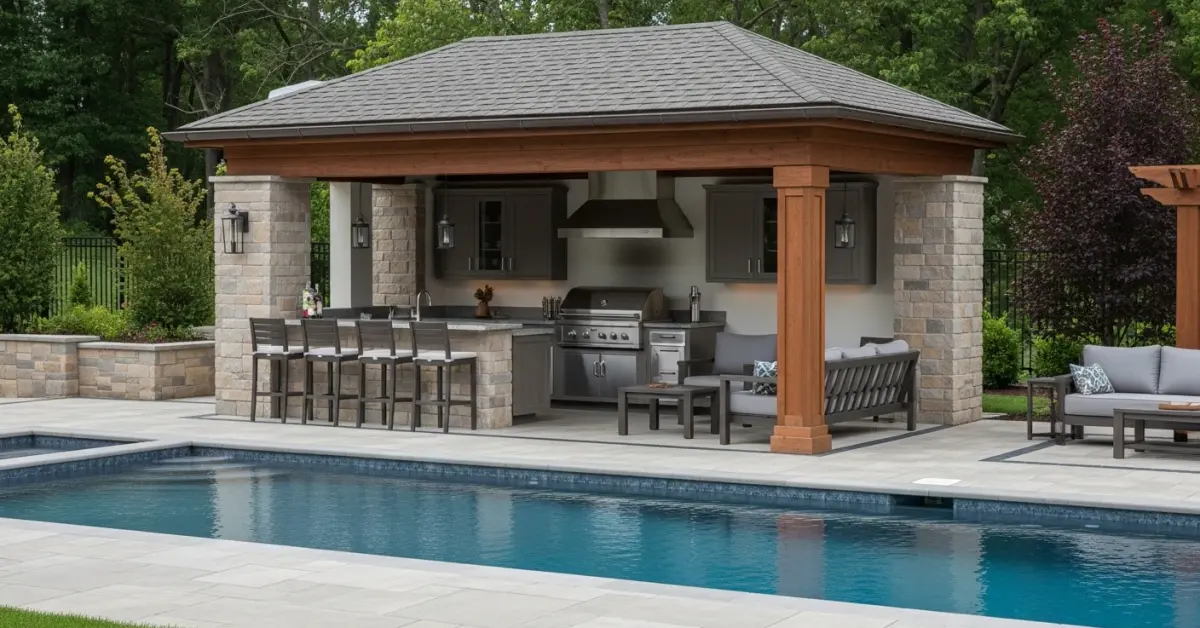
Outdoor Kitchen Pool House Lee County: A Framework for Mitigating Coastal Corrosion and UV Degradation by 35%
I’ve seen far too many outdoor kitchen pool house projects in Cape Coral and Sanibel fail within five years. The culprit isn't poor craftsmanship; it's a fundamental misunderstanding of our unique Lee County environment. Homeowners invest in beautiful designs only to see rust stains, warped cabinet doors, and faded countertops because the materials specified were fundamentally wrong for our high-humidity, salt-laden air and intense subtropical sun. My approach isn't about picking the most expensive option; it's about a precise material and engineering diagnosis from day one. I developed a methodology, the Coastal Durability Matrix, that cross-references a material’s technical specifications with its exact placement and exposure level. This ensures that every component, from the cabinet hinges to the countertop sealant, is engineered not just to survive, but to thrive for years, dramatically reducing long-term maintenance costs and preserving the initial investment.The Core Diagnostic: Beyond Aesthetics in Lee County's Climate
The most common error I encounter is a "one-size-fits-all" material selection. A builder might use standard 304-grade stainless steel for a project in an inland Estero community, and then use the exact same specification for a waterfront home on Fort Myers Beach. The result is catastrophic. Within 18 months, the Fort Myers Beach project shows pitting and surface rust, especially around welds and fasteners. This is a predictable failure, not bad luck. My Coastal Durability Matrix addresses this by first categorizing the project's micro-environment.- Zone A (Direct Exposure): Properties directly on the Gulf or a salt-water canal. Here, salt spray is a daily reality.
- Zone B (Indirect Exposure): Properties within a few miles of the coast, like much of Bonita Springs. The air is still corrosive but lacks direct spray.
- Zone C (Inland Humidity): Areas further inland where high humidity is the primary adversary, not salt.
Material Science Deep Dive: The 316L vs. 304 Stainless Steel Fallacy
The term "stainless steel" is dangerously vague in our climate. The key differentiator for Lee County is the grade. While 304 stainless steel is sufficient for many applications, it lacks the molybdenum content needed to resist chloride corrosion from salt. For any project in Zone A or B, I mandate the use of 316L marine-grade stainless steel for all metallic components, including grills, access doors, and especially fasteners. The 'L' signifies low carbon content, which further improves corrosion resistance after welding. This single detail is the most critical factor in the longevity of an outdoor kitchen here. For cabinetry, I steer clients away from wood or wood composites entirely. They simply cannot handle the moisture. The superior choice is a High-Density Polyethylene (HDPE) or a similar engineered polymer. These materials are non-porous, color-stable under UV radiation, and completely inert to moisture and salt. For countertops, I've found that some popular granites can become excessively hot and even fade under our relentless sun. I prioritize sintered stone or high-density porcelain slabs, as their manufacturing process makes them virtually non-porous and highly resistant to thermal shock and UV degradation.The Implementation Protocol: From Slab to Service
Executing a durable outdoor kitchen pool house requires precision at every stage. A great design with poor implementation will fail just as quickly. My protocol is a rigid, step-by-step process.- Step 1: Substrate and Drainage Assessment. The concrete slab must have a minimum slope of 1/4 inch per foot away from the structure to prevent standing water, a major issue during our summer downpours. All utility penetrations must be sealed with marine-grade silicone.
- Step 2: Utility Mapping and Rough-in. Every major appliance requires a dedicated 20-amp GFCI-protected circuit. I map these out to ensure the electrical panel can handle the load and to minimize visible conduit. Gas lines must be properly sized for the total BTU load of all appliances to avoid performance issues.
- Step 3: Cabinet and Frame Installation. This is a critical checkpoint. I personally inspect to ensure only 316L stainless steel fasteners are used to secure the frame and cabinets. Using a lesser grade creates a point of galvanic corrosion that will compromise the entire structure.
- Step 4: Appliance and Ventilation Integration. Proper ventilation is a non-negotiable safety requirement. For any grill placed under a solid roof structure, I specify a commercial-grade vent hood rated for a minimum of 1200 CFM (Cubic Feet per Minute) to effectively manage heat and smoke.
Precision Tuning for Longevity and Hurricane Readiness
The final 10% of the project is what ensures a 20+ year lifespan. After installation, all natural stone countertops are sealed with a nano-particle impregnating sealer, which penetrates deeper and offers superior stain and UV protection compared to standard topical sealers. I also work with the client on a simple hurricane readiness plan. This often involves designing easily removable cabinet doors or specifying appliances with simple quick-disconnects for gas and electricity, allowing them to be stored securely. A final post-installation inspection includes a comprehensive gas leak test using a digital manometer and an infrared camera check of all electrical connections to ensure there are no hot spots under load. This level of detail is what separates a standard installation from a genuine, long-term investment. Now that you understand the critical role of material science in our coastal environment, how will you account for the potential of galvanic corrosion between your 316L grill body and the 6061-T6 aluminum fasteners used in its assembly?Written by

Tags
pool pavilion with outdoor kitchen
pool house plans with outdoor kitchen
pool house with outdoor kitchen
outdoor kitchen and pool house
outdoor pool house kitchen
Outdoor Kitchen Pool House in Lee FL FAQ
Does grease and smoke from my outdoor kitchen grill affect my pool's water chemistry?
Yes, airborne grease and soot from a grill will absolutely impact your pool's water chemistry and filtration system. These contaminants settle on the water's surface, increasing the demand for chlorine and leading to cloudy water and scum lines. Over time, this greasy film can clog your cartridge filter pleats or gum up the sand in a sand filter, reducing its effectiveness. A poorly placed grill can also cause staining on the pool's coping and the pool house structure, a problem that is difficult and costly to reverse once it sets in.
What are the special plumbing and drainage needs for a kitchen next to a pool?
Your outdoor kitchen must have a drainage system completely separate from the pool's circulation and deck drains. Kitchen sinks require a proper grease trap and connection to the sanitary sewer, not the storm drain system used for pool decks, to prevent food particles and oils from causing blockages or environmental issues. Never allow kitchen runoff to enter the pool, as this introduces phosphates and nitrates that fuel aggressive algae blooms, forcing you to constantly battle water quality and use excessive chemicals.
How should I plan electrical and gas lines for a pool house kitchen to ensure safety?
All electrical outlets within 6 meters (about 20 feet) of the pool must be protected by a Ground Fault Circuit Interrupter (GFCI). This is a non-negotiable safety requirement to prevent electrocution. Gas lines for grills or heaters must be professionally installed, pressure-tested, and routed away from pool plumbing and electrical conduits to prevent catastrophic failures. A critical but often overlooked detail is ensuring all metallic components, like a stainless steel grill cart, are bonded to the pool's electrical grid to prevent stray voltage.
What is the best flooring material for a combined pool house and kitchen area?
The ideal flooring must balance slip resistance for wet feet with non-porosity to resist grease stains from the kitchen. Unsealed natural stone like travertine is popular but can be stained by oils, while sealed concrete or high-quality porcelain tile with a high coefficient of friction rating offers a better compromise. Avoid smooth, glazed tiles which become extremely hazardous when wet. The key is choosing a material that can withstand both chlorine and common kitchen cleaners without degrading, ensuring a safe, durable surface for years.
Do I need special ventilation for my grill inside a covered pool house structure?
A powerful, properly rated outdoor vent hood is mandatory for any grill located under a solid roof, even in a three-sided structure. Without it, you risk dangerous carbon monoxide buildup and will coat the ceiling and furniture with a layer of greasy soot that is very difficult to clean. This residue can also be washed into the pool by rain. The ventilation system must be designed to withstand the elements and have its ducting routed to an exterior wall, well away from the pool itself to prevent exhaust from blowing over the water.
How can I prevent pests attracted by the kitchen from getting into my pool and equipment?
Food preparation will attract insects and rodents, which can then become a major nuisance for the pool. Ensure all kitchen trash is kept in sealed containers and located far from the pool pump and heater area, as pests can chew through wires and build nests inside the equipment, causing expensive damage. Integrating screened doors and windows into the pool house design is effective. Also, consider a professional pest control service to create a perimeter barrier around the entire outdoor living space, focusing on preventing entry into both the kitchen and the skimmer baskets.


