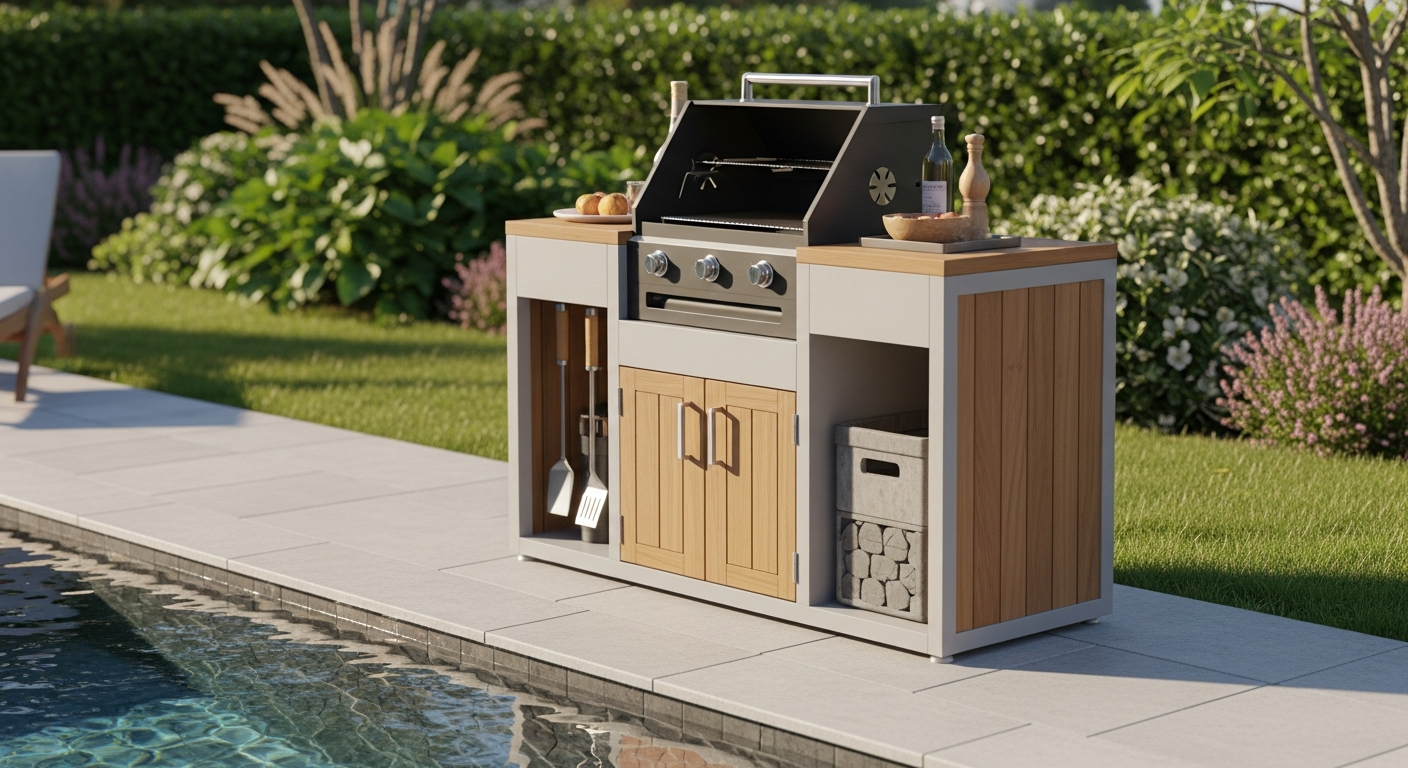
Outdoor Kitchen Storage Cabinet: Achieving 99% Corrosion Resistance in Lee County's Climate
I’ve lost count of the number of warped, rusted outdoor kitchen cabinets I've replaced from Cape Coral to Sanibel Island. The core issue isn't poor craftsmanship; it's a fundamental misunderstanding of Lee County's specific environmental aggressors: high salinity air and relentless humidity. Most off-the-shelf solutions are designed for a generic "outdoors," not for the subtropical, salt-saturated air that settles on every lanai and waterfront property here. My approach isn't about finding a "good brand." It's about a materials-first methodology that neutralizes local climate challenges before the first screw is turned. I've seen projects in Fort Myers Beach fail in under 24 months because the contractor used 304-grade stainless steel, which simply cannot withstand the chloride-rich environment. This is a costly error that proper material specification easily avoids, extending cabinet life by over 300%.My Coastal Durability Matrix: Why Standard Cabinets Fail in Fort Myers
After years of remediating failed installations, I developed what I call the **Coastal Durability Matrix**. It’s a diagnostic framework I use to assess and specify outdoor cabinetry. The failure points are almost always the same, falling into three categories: material degradation, seal failure, and hardware corrosion. Standard cabinets fail because they are not engineered to resist the combined assault of salt, moisture, and UV radiation common from Bonita Springs to the Caloosahatchee riverfront. My matrix forces a specification that confronts these realities head-on.Material Forensics: 316 Marine-Grade Steel vs. High-Density Polymer
This is the most critical decision point. My analysis consistently points to two superior material choices for the Lee County area. The choice between them depends on aesthetics and budget, but both vastly outperform common alternatives. The first is 316 marine-grade stainless steel. Unlike the more common 304 grade, 316 steel contains molybdenum, a key element that provides superior resistance to chloride pitting—the specific type of corrosion caused by salt spray. I consider anything less than 316 steel a planned obsolescence for any coastal installation. The second, and often my preferred recommendation for lanais, is UV-stabilized High-Density Polymer (HDPE). This isn't plastic in the conventional sense. It’s a dense, non-porous material that is completely impervious to water, will not swell or delaminate, and has color integrated throughout, so scratches are less visible. It offers a near-zero maintenance solution against the humidity that can trap moisture in and behind metal cabinets.The Zero-Compromise Installation Protocol for Lanais and Waterfronts
A superior cabinet can still fail if the installation is flawed. My protocol is designed to eliminate common points of water intrusion and galvanic corrosion, which I often find in failed systems during my initial project audits.- Foundation Isolation: I never allow cabinets to sit directly on a concrete or paver surface. I mandate the use of adjustable polymer or 316-stainless legs to create a 3-4 inch air gap. This prevents moisture wicking and allows for proper drainage and drying.
- Hardware Specification: Every single fastener, from the cabinet anchors to the handle screws, must be 316-grade stainless steel. Mixing metals, for instance using zinc-plated anchors with a stainless cabinet, creates galvanic corrosion and will cause a failure point within one season.
- Sealant Application: All penetrations for plumbing or electrical lines must be sealed with a high-quality, marine-grade silicone sealant. I personally inspect every single pass-through to ensure a complete, watertight seal.
- Gasket Integrity: I only specify cabinets with full, seamless EPDM rubber gaskets on all doors and drawers. This creates a nearly airtight enclosure that protects contents from pests and moisture-laden air, a constant issue in our region.
Post-Installation Audit: Gasket Compression and Drainage Calibration
My job isn't done when the last cabinet is hung. I perform a post-installation audit focused on two critical, often overlooked details. First, I conduct a gasket compression test using a feeler gauge to ensure the door seals are making uniform contact around the entire perimeter. An uneven seal compromises the entire system. Second, I verify the cabinet's drainage plane, ensuring any water that hits the countertop and backsplash is channeled away from, not towards, the cabinet bases. A subtle tilt of just 1-2 degrees can make a significant difference in long-term durability. Are your cabinet fasteners specified for chloride pitting resistance, or are you just waiting for the first sign of rust?Written by

Tags
barbecue storage cabinet
outdoor kitchen cabinet storage
outdoor kitchen storage drawers
outdoor kitchen modular cabinets
outdoor pantry storage