
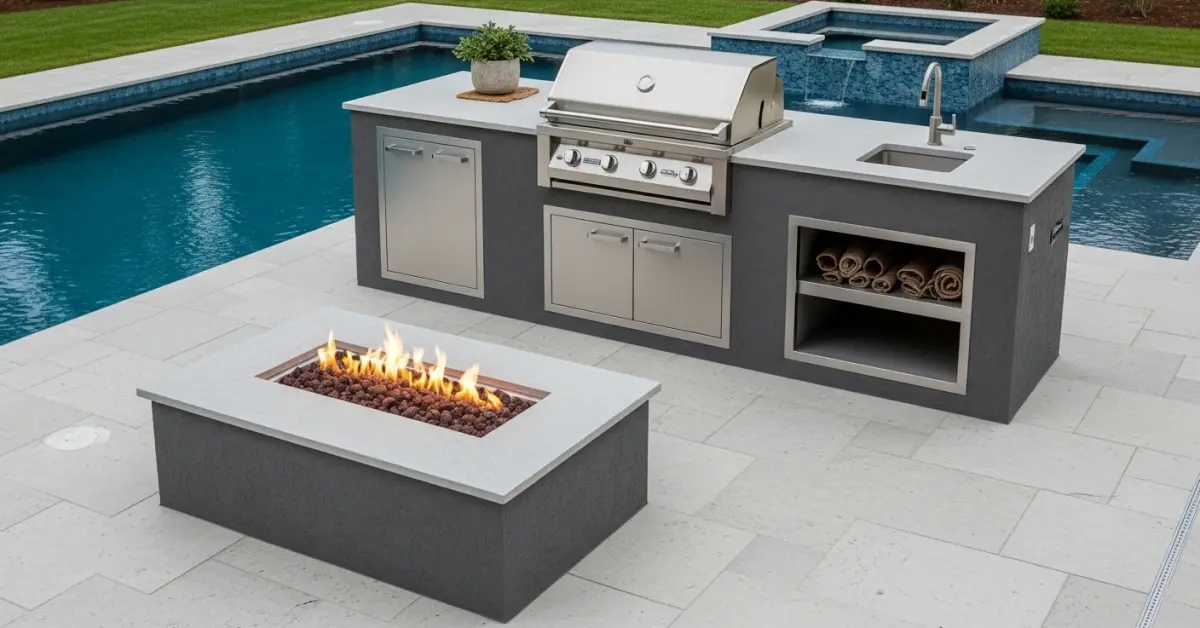
Outdoor Kitchen with Fire Pit in Collier County: My Protocols for a 20-Year Lifespan Against Salt & Humidity
Building an outdoor kitchen with a fire pit in Collier County isn't just about aesthetics; it's a battle against the elements. I've seen far too many gorgeous setups in Naples and Marco Island degrade in under five years due to one critical oversight: designing for a generic climate instead of our specific, salt-saturated, high-humidity environment. The rust, mildew, and warped materials are not a matter of 'if,' but 'when,' if the wrong choices are made from the foundation up. My entire approach is built on a material-first, climate-adapted methodology. It prioritizes airflow, drainage, and specific material grades to prevent the premature failure I’ve been called in to fix countless times. The goal isn't just a beautiful outdoor space for a season; it's an investment that performs reliably year-round, from the dry winter months to the intense summer rainy season.The Collier County Climate Failure Point: My Diagnostic Framework
The primary reason outdoor kitchens fail here is a fundamental misunderstanding of our environment. It's a triple threat: theDeconstructing the Coastal Durability Matrix
My matrix isn't a simple checklist; it's a system of technical specifications designed to preemptively solve Collier County's unique challenges. It breaks down into three core pillars:Material Selection Hierarchy: The foundation must be non-porous. I exclusively usehigh-psi concrete with corrosion-inhibiting admixtures for the base structure, avoiding standard CMU blocks which act like sponges for ground moisture. For all metal components, from screws and hinges to appliance facings,316L marine-grade stainless steel is non-negotiable. For countertops, I steer clients away from porous granites and toward ultra-compact surfaces likeDekton or certain quartzites that resist moisture staining and mildew.Engineered Airflow & Ventilation: Trapped, humid air is the silent killer. My designs incorporatededicated ventilation panels at the base and top of cabinet structures to create a passiveconvection airflow , keeping the interiors dry. For cooking areas, the vent hood'sCFM (Cubic Feet per Minute) rating must be increased by at least 20% compared to inland recommendations to effectively move our heavy, moisture-laden air.Moisture Mitigation System: Every horizontal surface, including the countertops and the base slab, is designed with a minimum1.5% drainage slope to prevent pooling water. Furthermore, I insist on acapillary break —a waterproof membrane—between the foundation and the ground to stop moisture from wicking up into the structure, a common problem in the soil conditions found from Golden Gate Estates to the coast.
The Implementation Blueprint: From Golden Gate Estates to Marco Island Waterfronts
Translating the matrix into a physical build requires a precise, non-negotiable sequence of actions. My process is standardized to ensure durability whether it's a sprawling estate kitchen or a compact coastal setup.Site & Foundation Analysis: First, I assess the property's specific microclimate. A waterfront lot on Marco Island has a much higher salt concentration in the air than a property east of I-75. We must pour a monolithic concrete slab with integrated footers and the aforementioned moisture barrier, ensuring it's cured correctly to achieve target strength.Structural Framing & Cladding: The kitchen's frame must be inert. I use eitherwelded aluminum framing or the specified reinforced concrete. Wood or standard galvanized steel studs are forbidden in my projects as they will fail. All cladding materials are then attached with a rainscreen gap to allow for drainage and drying.Appliance & Utility Integration: Every appliance must beUL-rated for outdoor use . This is a critical safety and longevity factor. All electrical connections are housed inweatherproof boxes with GFCIs , and plumbing lines are insulated to mitigate condensation.Fire Pit Placement & Safety Compliance: The fire pit is not an afterthought. It must adhere to strictCollier County setback codes from the main structure and any overhangs. I build the pit using the same durable concrete and line the interior withrefractory fire brick to ensure structural integrity through thousands of heating and cooling cycles. For gas units, the burner must be brass or 316L stainless steel.
Precision Tuning for Peak Performance & Longevity
The final 10% of the work is what guarantees the 20-year lifespan. This is where we lock in the resilience of the entire system. I useWritten by

Tags
fire pit outdoor kitchen
outdoor fire pit kitchen
outdoor kitchen and fire pit
l shaped outdoor kitchen
brick outdoor kitchen
Outdoor Kitchen with Fire Pit in Collier FL FAQ
How far does my fire pit need to be from my pool and house for safety?
Your fire pit must be a minimum of 3 meters (10 feet) away from your house, pool edge, and any combustible structures like a deck or fence. This distance is a standard fire code requirement to prevent radiant heat from damaging surfaces or igniting materials. A common mistake is placing it too close to the pool, which can cause thermal shock and crack the pool's coping or tile line, especially with concrete pools. Also, consider the prevailing wind direction to ensure smoke and embers are consistently blown away from your main seating areas and the house itself.
Can I use the same gas line for my pool heater and my new outdoor kitchen grill?
Tapping into your existing pool heater's gas line is often possible but requires a professional load calculation to ensure adequate gas volume and pressure. Your gas line must be sized to handle the simultaneous demand of all appliances; an undersized line will cause poor performance, like a weak flame on the grill when the heater kicks on. A critical, often overlooked detail is the need for a separate, accessible shut-off valve for each appliance, which is a non-negotiable safety requirement for emergency situations and routine maintenance.
What countertop material won't get ruined by pool water and direct sun?
For durability against both chlorinated water and UV rays, sealed granite or concrete are superior choices for outdoor kitchen countertops near a pool. While quartz is popular indoors, most are not warrantied for outdoor use as the resins can yellow and degrade in direct sunlight. A key factor people miss is thermal expansion; dark-colored granite can become extremely hot, posing a burn risk. Lighter-colored, properly sealed natural stone offers the best balance of longevity, stain resistance from food and pool chemicals, and manageable surface temperature.
Do I need special drainage for my outdoor kitchen sink and prep area?
Yes, you must install a dedicated drainage system for your outdoor kitchen that does not run off onto the pool deck or into the pool. Allowing grease, cleaning agents, and food waste to enter the pool will create a constant battle with water chemistry, leading to algae blooms and high chlorine demand. A proper installation involves tying into your home's main sewer line or installing a dry well. This prevents staining of your deck material and protects the pool's plaster from being etched by acidic food and drink spills.
What type of pavers or decking is best around a fire pit and kitchen area?
Concrete pavers or natural stone like travertine are the best choices for flooring around a fire pit and kitchen due to their high fire resistance and durability. Avoid using composite decking or wood immediately around a fire pit, as stray embers can easily melt or ignite the surface. A critical consideration often missed is the sealant; use a non-slip, matte-finish sealant instead of a high-gloss one. High-gloss sealants become extremely slippery when wet from pool splash-out or kitchen spills, creating a significant safety hazard.
Are there regulations for the electrical outlets in an outdoor kitchen near a pool?
All electrical outlets in your outdoor kitchen must be Ground Fault Circuit Interrupter (GFCI) protected and housed in weatherproof, in-use covers. National electrical codes mandate that any outlet within 6 meters (20 feet) of the water's edge must have GFCI protection to prevent electrocution risk. Homeowners often underestimate the need for multiple, dedicated circuits. Running a refrigerator, lighting, and a rotisserie on a single circuit can lead to frequent breaker trips, so plan for at least two separate 20-amp circuits for the kitchen area alone.


