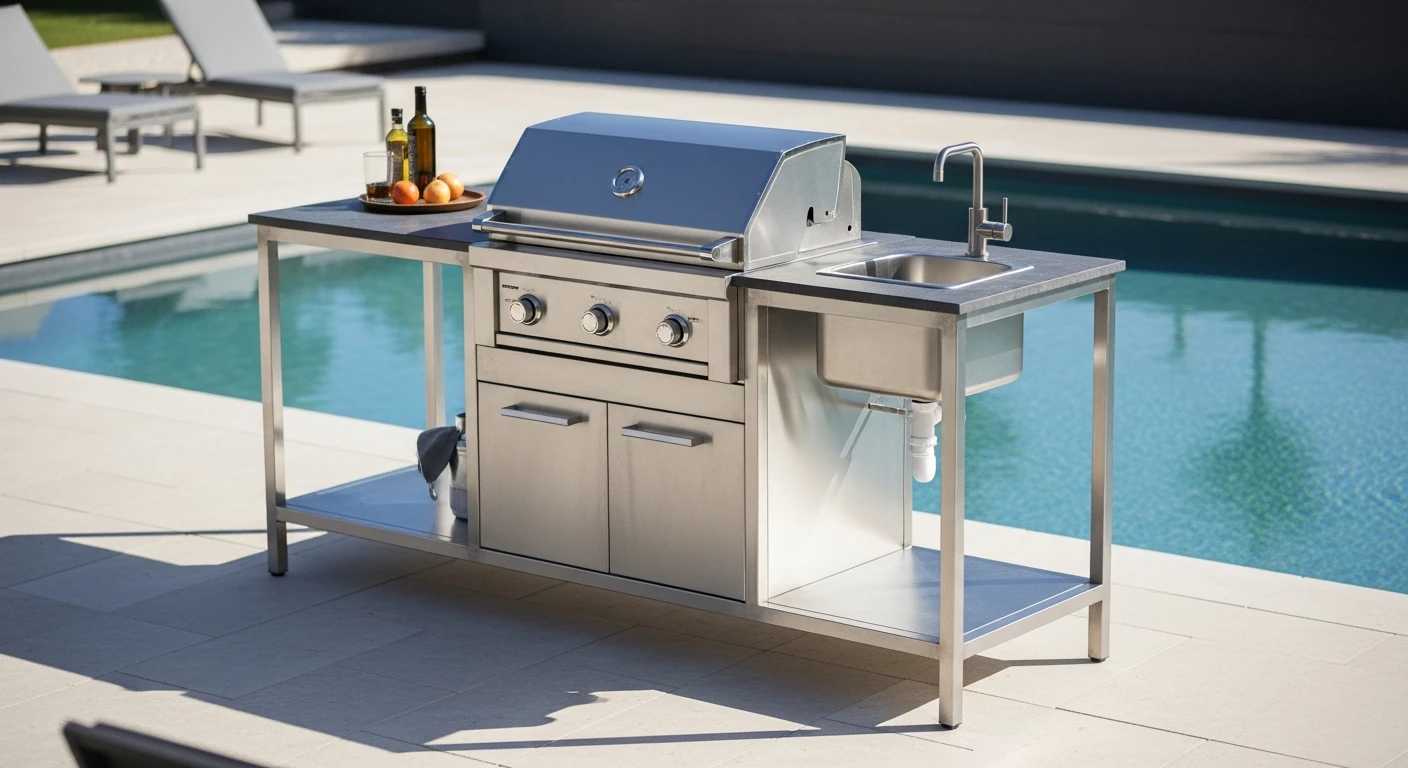
Outdoor Metal Kitchen in Collier County: My Framework for 75% Corrosion Resistance
For years, I've seen Collier County homeowners invest heavily in beautiful outdoor metal kitchens, only to watch them succumb to rust and pitting within 36 months. The core issue isn't the concept; it's a fundamental misunderstanding of our unique coastal environment. The generic "304-grade stainless steel" widely sold as a premium option simply fails when faced with the relentless salt spray and humidity from Naples to Marco Island. My entire approach is built on preventing this specific, costly failure before a single piece of metal is cut. My proprietary methodology, the Coastal-Grade Material Specification, isn't about just picking a better metal; it's a system that analyzes a property's specific exposure level to dictate the exact alloy, coating thickness, and even the type of fasteners required. I developed this after a painful early project in Port Royal where a client's kitchen showed tea staining within a year, a direct result of the fabricator using lower-grade steel on non-visible components. This experience forced me to create a non-negotiable material and fabrication standard that guarantees longevity against the Gulf's corrosive power.Diagnosing Material Failure: The Gulf-Proof Material Matrix
The first step in my process is always a site-specific corrosion audit. A home directly on the water in Aqualane Shores faces a vastly different atmospheric salinity than a property in Golden Gate Estates. My Gulf-Proof Material Matrix quantifies this risk. It's a simple diagnostic framework I created that cross-references distance from the coast, prevailing wind direction, and foliage cover to assign a "Corrosion Index Score" to a project. A high score immediately disqualifies certain materials and fabrication techniques. It’s the data that tells me whether a project requires the baseline standard or the most extreme level of protection. This diagnostic phase prevents the single biggest error: under-specifying materials for the micro-environment.Technical Deep Dive: Beyond "Stainless Steel"
Here's the technical breakdown I insist on for any Collier County project. This is where the real value is created, and it’s information most contractors won't volunteer.- Alloy Selection: The non-negotiable baseline is 316L stainless steel. The "L" signifies low carbon, which improves weldability, but the critical element is molybdenum. This element, absent in 304-grade steel, provides superior resistance to chloride and salt corrosion. I specify a minimum molybdenum content of 2.0% in the material certificate.
- Welding Protocol: I demand TIG (Tungsten Inert Gas) welding for all joints. After welding, the critical and often-skipped step is passivation. This is a chemical process that removes free iron from the surface and rebuilds the passive chromium-oxide layer, which is the steel's primary defense against rust. Without it, the welds are the first points of failure.
- Powder Coating Specifications: For colored or matte-finish metal kitchens, the coating is everything. I mandate a marine-grade powder coat with a Dry Film Thickness (DFT) of at least 3.5 mils. I physically check this with a DFT gauge during fabrication inspection. Anything less will blister and peel under the intense Florida sun and humidity.
- Fastener Integrity: This is a classic failure point. A beautiful 316L frame can be ruined by 304-grade screws. I specify that all fasteners, hinges, and hardware must also be 316L grade. This prevents galvanic corrosion where two dissimilar metals accelerate rust.
My 5-Step Pre-Construction Protocol for Metal Kitchens
Once the materials are specified, the execution has to be flawless. I personally oversee these five critical implementation stages to ensure the design's integrity is maintained through to the final installation. This checklist is the practical application of my methodology.- Fabricator Vetting: I only work with fabricators who can prove their welders are certified and who understand and can execute chemical passivation post-welding. I ask to see their passivation bath and testing equipment.
- Material Certificate Audit: Before any work begins, I require the mill test reports (MTRs) for the 316L steel to verify the chemical composition, specifically the molybdenum and chromium content.
- Component Isolation: During assembly, every point where stainless steel meets another material (like a concrete base) must have a non-conductive barrier. I specify using Teflon or high-density nylon washers and spacers to prevent any chance of galvanic reaction.
- Drainage and Ventilation Design: Enclosed metal cabinets can trap humid, salty air. I design in hidden weep holes and passive ventilation channels to ensure air can circulate and moisture can escape, preventing corrosion from the inside out.
- Final Site Passivation: After installation, the entire kitchen is cleaned and treated with a citric acid passivating solution. This final step removes any microscopic iron particles left from tools or transport, providing a final, perfect protective layer.
Precision Adjustments and Quality Standards
The job isn't done at installation. The long-term performance of an outdoor metal kitchen in Collier County depends on a precise maintenance routine that I provide to every client. This is not a generic "clean with soap and water" instruction. It involves a specific schedule for re-passivation and inspection. My key performance indicator for success is zero visible corrosion after 5 years of service. The standard is to wash the surfaces with a pH-neutral cleaner monthly and perform a full inspection and re-passivation treatment biannually. This simple regimen can increase the functional lifespan of the kitchen from a typical 7-10 years to well over 20. Considering the specific salinity and humidity levels in Collier County, have you calculated the required molybdenum percentage in your stainless steel alloy to prevent pitting corrosion beyond the 10-year mark?Written by

Tags
outdoor kitchen steel
outdoor steel kitchen
outdoor kitchen stainless steel
outdoor stainless steel sink cabinet
outdoor stainless sink