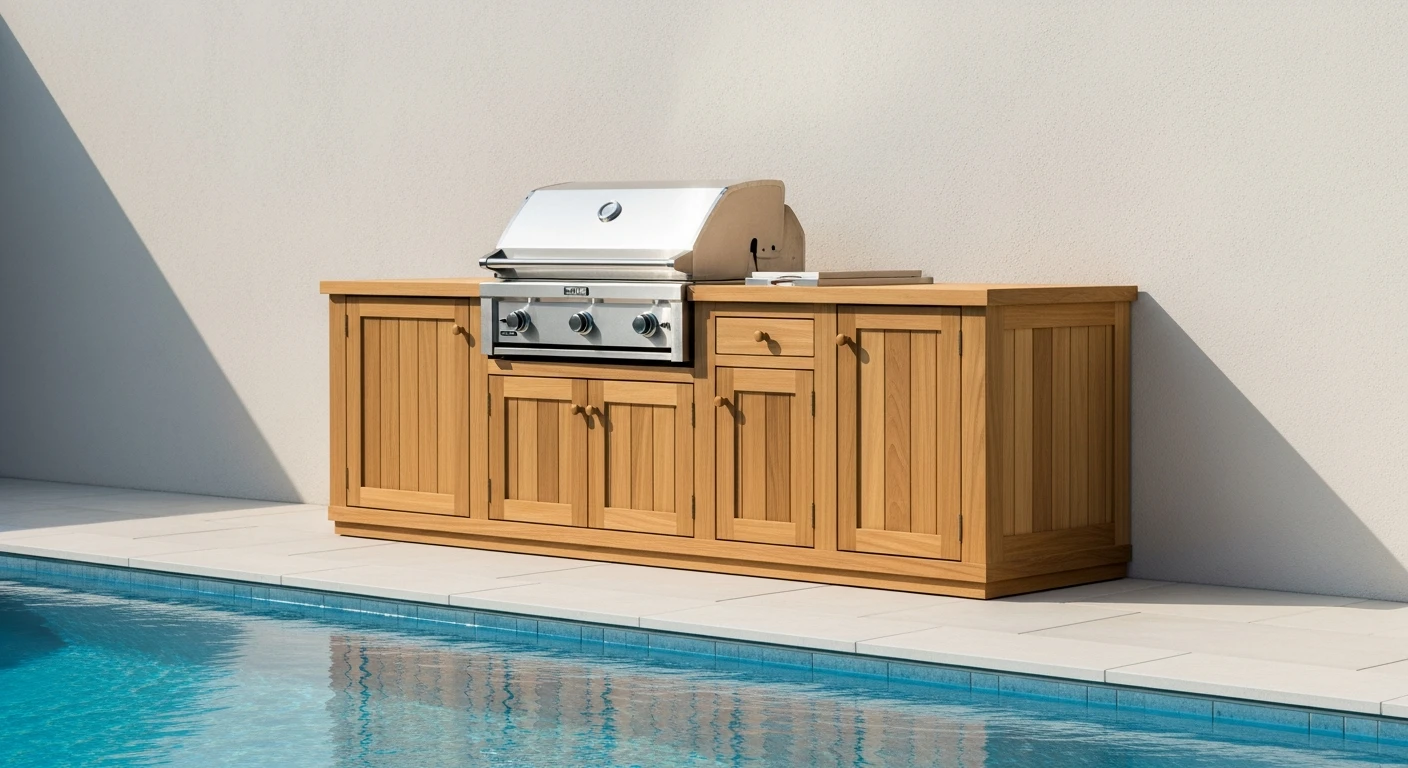
Outdoor Teak Kitchen Pinellas County: A Weatherproofing Protocol to Triple Lifespan Against Salt Spray
For years, I've seen countless outdoor teak kitchens in Pinellas County fail prematurely. From stunning waterfront homes in Tierra Verde to the more sheltered properties in Seminole, the core issue is almost never the teak itself. The failure point I consistently identify is a fundamental misunderstanding of how our specific coastal environment—with its intense UV exposure, high humidity, and pervasive salt air—aggressively attacks everything else: the fasteners, the sealants, and the sub-structures.
Most installations treat teak like a standard decking material, applying generic sealers that trap moisture and accelerate decay from within. My approach is different. It's a system I developed after salvaging a high-end project in Clearwater Beach that was showing signs of corrosion and wood graying in under 18 months. This protocol focuses on component-level fortification before assembly, a critical step that prevents the corrosive cocktail of salt and moisture from ever reaching the kitchen's structural weak points.
The Diagnosis: Why 90% of Teak Installations Underperform in Pinellas County
The primary error I see is a "surface-deep" weatherproofing strategy. A contractor will build a beautiful teak kitchen, then apply a topical sealer as a final step. This is a critical flaw. Here in Pinellas, the daily humidity cycle forces moisture deep into wood joints and fastener holes. When combined with the aerosolized salt from the Gulf, this creates a micro-environment for galvanic corrosion and wood rot that no surface coat can prevent. After observing this pattern repeatedly in areas like Tarpon Springs and along the intracoastal, I developed what I call the Coastal Teak Fortification (CTF) Method. It’s not about the final coat of oil; it’s about treating each component as a self-contained, weatherproof unit before the first screw is turned.
Technical Deep-Dive: Material Science vs. Salt Air
My CTF method is based on three non-negotiable material principles. First, the teak itself must be FEQ (First European Quality) Grade A Teak. This grade, harvested from the center of the tree, has the highest concentration of natural silica and oils, providing a baseline of defense. Second, all hardware—screws, hinges, drawer slides—must be 316L marine-grade stainless steel. I’ve seen projects where 304 stainless was used to cut costs, only to see rust streaks appear within a single season. The "L" in 316L signifies low carbon, which provides superior corrosion resistance, a must-have for our climate. Finally, the sealant is crucial. I abandoned film-forming varnishes years ago. They crack under the Florida sun, trapping water. The key is a multi-layer application of a tung oil-based penetrating sealer with a high-performance UV inhibitor, applied to every surface of every component *before* assembly.
Implementation: The 4-Stage Coastal Teak Fortification Protocol
Executing an outdoor kitchen that will last for decades in a location like St. Pete Beach requires a disciplined, phased approach. Deviating from this order is the most common mistake I've had to correct in my career. This is my exact workflow for ensuring a 25+ year operational lifespan for a teak installation.
- Stage 1: Component Isolation & Sanding. Every single piece of teak is individually sanded to 220-grit. This is not just for smoothness; it opens the wood's pores to maximize sealer absorption. I mandate a minimum absorption rate increase of 15% over non-sanded wood.
- Stage 2: Pre-Assembly Penetrating Seal. Each component receives three coats of the tung oil-based sealer on all six sides. This includes the inside of every screw hole and every cut end. We wait a full 24 hours between coats to ensure deep penetration, not just surface adhesion.
- Stage 3: Controlled Assembly. We use calibrated torque drivers for all 316L fasteners. Over-tightening can crack the wood and compromise the seal. A bead of marine-grade silicone sealant is applied to the threads of each screw for an extra layer of moisture defense.
- Stage 4: Final Cure & Polish. Once fully assembled on-site, the entire kitchen receives a final, light fourth coat of sealer. This is more of a polishing coat to unify the finish and provide an initial sacrificial layer. The structure is then left to cure for a minimum of 72 hours before any appliances are installed or used.
Precision Adjustments and Quality Assurance Metrics
To validate the integrity of my work, I use specific metrics. Before sealing, I use a digital moisture meter to ensure the teak's core moisture is below 12%. After assembly, I perform a simple water-bead test; if the water doesn't bead up into tight, perfect spheres on every surface, the final coat has not been applied correctly. The annual maintenance plan I provide clients is also specific: a gentle cleaning and one new coat of sealer in the spring, which is a non-negotiable to maintain the warranty. This simple action replenishes the UV inhibitors and oils lost to the intense Florida sun.
Given the specific challenges of our Pinellas County climate, are you still evaluating outdoor kitchen durability based on the brand of the grill, or are you starting to analyze the grade of the stainless steel fasteners holding it all together?