
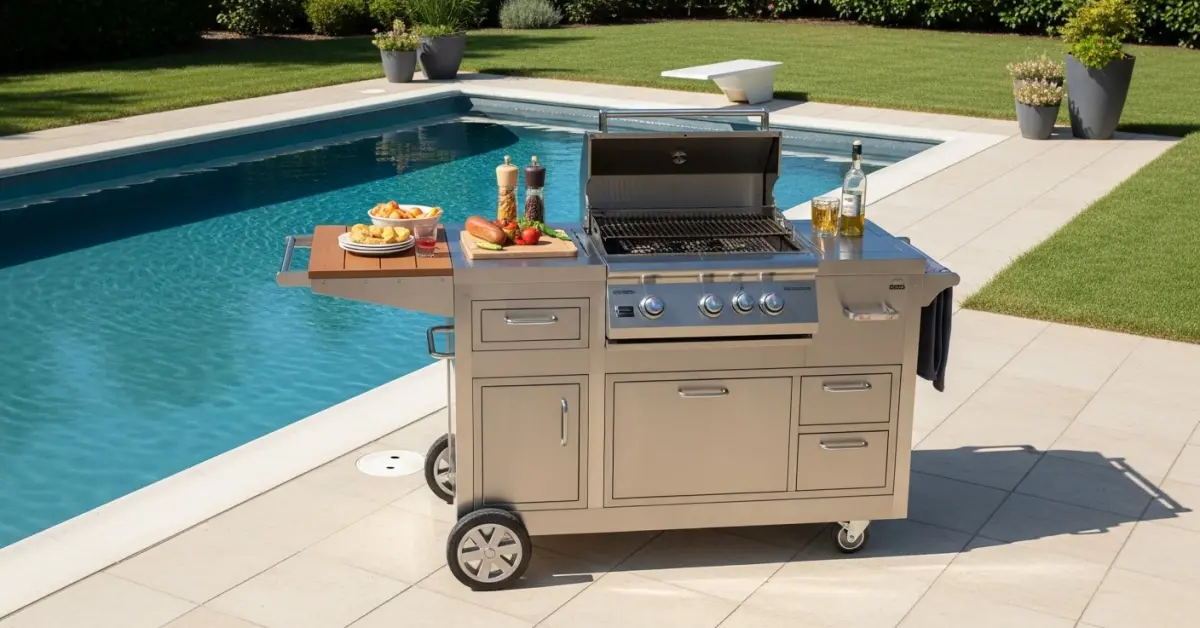
Rolling Outdoor Kitchen: My Framework for 15-Year Corrosion Resistance in Collier County
The biggest mistake I see in outdoor kitchen projects from Port Royal to Golden Gate is a fundamental misunderstanding of our coastal environment. Clients invest heavily in beautiful setups that begin showing pitting and rust within 24 months. The culprit is almost always the use of standard 304-grade stainless steel, which simply cannot withstand the persistent salt spray and high humidity we experience year-round in Collier County. A fixed installation magnifies this problem, offering no escape from the elements. My solution, developed after repairing dozens of these failed projects, is a rolling outdoor kitchen built not on convenience, but on a principle of strategic durability. This isn't about just putting wheels on a cabinet; it's a complete system designed for mobility, allowing the unit to be moved for entertaining on the lanai, positioned poolside, or stored securely during a tropical storm. This mobility is key to dramatically increasing its lifespan by reducing constant exposure.My Coastal Mobility Framework: Diagnosing Material Failure Before It Happens
Over the years, I've refined my approach into what I call the Coastal Mobility Framework. It’s a pre-construction methodology focused on three core pillars: Material Forensics, Chassis Engineering, and Component Shielding. The goal is to build a unit that thrives in the specific challenges of Collier County, from the salty air of Marco Island to the intense sun inland. This framework moves beyond aesthetics to focus entirely on quantifiable durability metrics. I developed this after a large-scale project in a Naples waterfront home where the architect specified a beautiful, but functionally flawed, outdoor kitchen. The powder-coated aluminum frame started bubbling within a year due to galvanic corrosion where it met the stainless steel fasteners. It was an expensive lesson that taught me that material compatibility is just as critical as the primary material itself.The Technical Specification: Why 304 Stainless Steel Fails in Naples
The technical "secret" is in the metallurgy. Standard 304 stainless steel lacks molybdenum, an element critical for resisting chloride-induced corrosion—the exact type caused by salt air. In my projects, I mandate the use of 316L marine-grade stainless steel for all structural and exterior components. The 'L' signifies low carbon content, which improves weldability and further reduces corrosion risk at the weld points, which are often the first to fail. For countertops, I steer clients away from porous materials like granite, which can harbor moisture and stain under the intense Florida sun. My preferred material is sintered stone (like Dekton), which is non-porous, UV-stable, and highly resistant to thermal shock. For fasteners—every single screw, nut, and bolt—they must also be 316L stainless. Using anything less creates a weak point that will compromise the entire structure.Implementation Protocol: Assembling a Weatherproof Rolling Kitchen
Building a truly mobile and durable outdoor kitchen requires a specific assembly protocol. Deviating from these steps is where I see most DIY or less-experienced fabricators fail, resulting in a wobbly, short-lived product.- Chassis and Frame Construction: The foundation must be a fully TIG-welded 316L stainless steel frame. TIG welding provides a cleaner, stronger, and more corrosion-resistant joint than the more common MIG welding. The frame must be engineered to handle the dynamic loads of movement, not just the static weight of the components.
- Caster Selection and Mounting: This is a critical failure point. I exclusively use heavy-duty, non-marking polyurethane casters with 316L stainless steel yokes and hardware. Each caster must have a load rating of at least 150% of the kitchen's fully-loaded corner weight to ensure smooth rolling on uneven paver patios.
- Component Integration: Appliances like grills and refrigerators must be installed with vibration-dampening EPDM rubber bushings. This prevents stress on the components and frame during movement. All electrical connections must be housed in IP65-rated weatherproof enclosures with marine-grade wiring.
- Utility Management: For propane models, I integrate a dedicated, secured cabinet and a commercial-grade quick-disconnect gas line for safety and ease of use. This is far superior to a loose tank sitting beside the unit.
Precision Tuning for Longevity: Post-Assembly Quality Control
Once assembled, the job isn't done. The final step is what ensures a 15+ year lifespan. I perform a chemical passivation on all weld points. This process uses a mild acid solution to remove any free iron particles left from the fabrication process, restoring the chromium-oxide passive layer that gives stainless steel its corrosion-resistant properties. Without this step, the welds will inevitably be the first points of failure. I also conduct a load and stability test on a simulated uneven surface to ensure there is no frame torsion. Finally, I provide the client with a simple maintenance schedule: a freshwater rinse every two weeks to remove salt deposits and a semi-annual check of all fasteners. This simple discipline is the difference between a pristine unit and a rusty disappointment. Before you approve your design, have you asked your fabricator to specify the passivation method for their weld points, or are you just hoping the 316L grade is enough to prevent rust?Written by

Tags
outdoor kitchen island on wheels
outdoor portable kitchen island
outdoor rolling island
rolling outdoor kitchen island
outdoor island on wheels
Rolling Outdoor Kitchen in Collier FL FAQ
How do I safely connect utilities like gas and water to a rolling outdoor kitchen?
Securely connect your rolling kitchen using a certified flexible gas hose with a quick-disconnect fitting and a food-grade water hose for the sink. For gas, ensure the connection is leak-tested with a soap solution after every hookup and that the propane tank is firmly secured to the cart to prevent tipping. Never use a standard garden hose for your water supply, as it can leach unsafe chemicals; a dedicated potable water hose is essential for any food preparation or hand washing. Always turn off the gas at the tank valve before disconnecting.
Can I leave my rolling outdoor kitchen outside in all weather conditions?
No, you should protect your rolling kitchen from harsh weather by using a heavy-duty, waterproof cover or moving it to a sheltered area like a garage or covered patio. While many units are built with weather-resistant materials like stainless steel and marine-grade polymers, prolonged exposure to rain can damage electrical components like igniters and outlets. More importantly, high winds can create a serious tipping hazard, especially if a heavy propane cylinder is attached, posing a significant safety risk.
What kind of surface is required to safely use and move a rolling outdoor kitchen?
A rolling outdoor kitchen requires a firm, level, and non-combustible surface like a concrete patio, stone pavers, or a solid deck for safe operation. Attempting to use the unit on soft ground like grass or uneven gravel can cause it to become unstable, making cooking hazardous and potentially leading to tipping. The casters, even heavy-duty ones, can sink into soft surfaces, making movement difficult and straining the frame; a minimum surface hardness comparable to asphalt is a good rule of thumb for both stability and mobility.
How much weight can the countertops and shelves on a mobile kitchen typically hold?
Most rolling kitchen countertops are designed to support typical cooking appliances and food prep, but you must check the manufacturer's specific weight limits before placing heavy items. A common failure point is overloading a side shelf, which often has a much lower capacity—sometimes as little as 15 pounds—than the main surface. Placing a heavy cooler or a stack of cast iron pans on an extended side shelf can cause the support bracket to bend or break, creating an immediate safety hazard during use.
What is the best way to clean and maintain the different materials on my rolling kitchen?
Clean stainless steel surfaces with a specialized stainless steel cleaner or a simple mixture of warm water and mild dish soap, always wiping in the direction of the grain to avoid scratches. For stone or composite countertops, avoid acidic cleaners like vinegar, which can etch the surface; use a pH-neutral cleaner instead. The most overlooked maintenance task is cleaning the caster wheels and axles, as debris, grease, and hair can build up, causing them to seize and making the unit extremely difficult to move.
Are there specific safety precautions for grilling on a rolling kitchen compared to a stationary one?
Yes, the primary safety precaution is to always lock the caster wheels before you begin cooking to prevent the unit from moving unexpectedly. Ensure the kitchen is positioned at least 10 feet away from your house siding, deck railings, and any overhanging branches, as its mobility can make it easy to forget standard clearance rules. Before lighting the grill, confirm that the flexible gas hose is not kinked or resting against any hot surfaces of the grill body, a common oversight that can lead to the hose melting and causing a dangerous gas leak.


