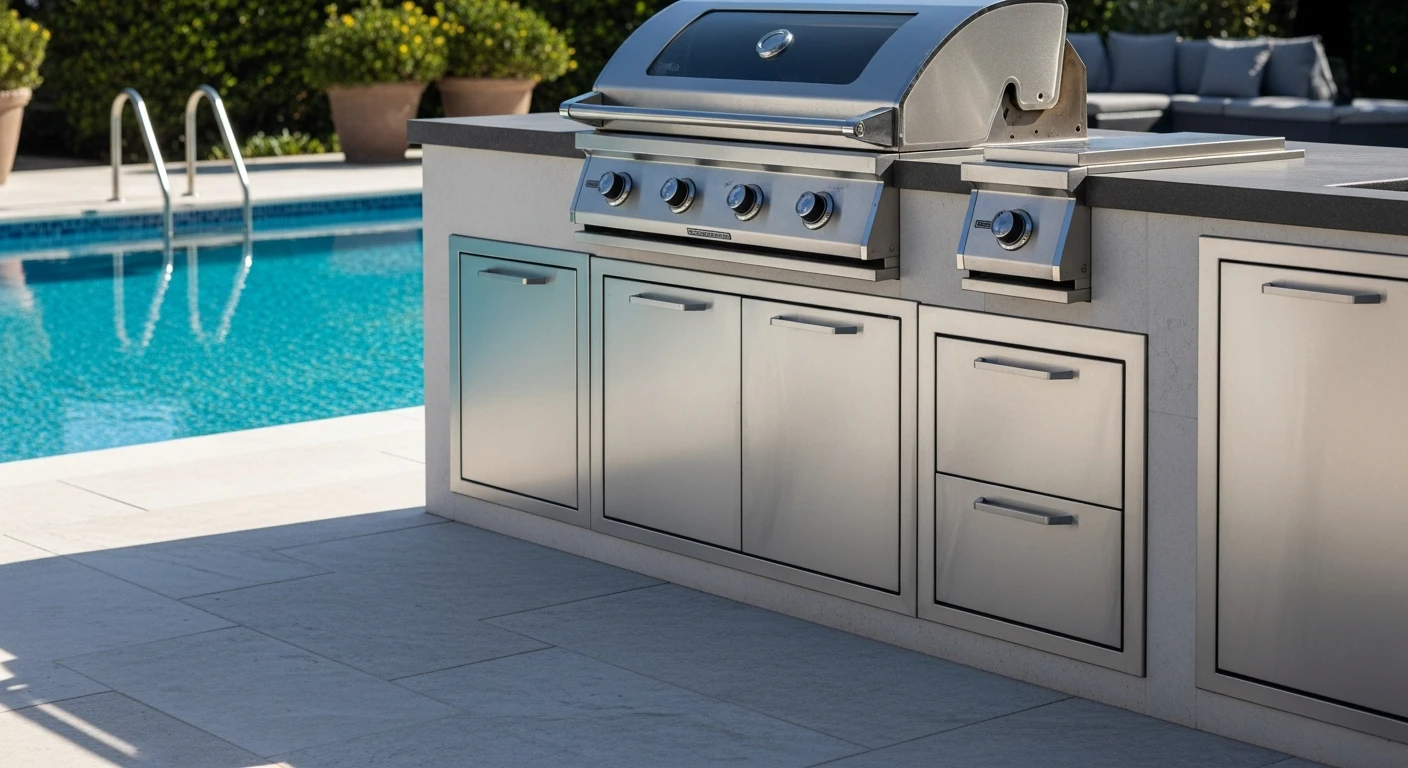
Stainless Outdoor Cabinets in Pinellas County: The 316L Marine-Grade Framework for Resisting Salt-Air Corrosion
I've seen too many Pinellas County outdoor kitchens fail in under 5 years due to one critical oversight: specifying the wrong stainless steel grade and neglecting post-fabrication passivation. For homeowners from St. Pete to Clearwater Beach, this isn't just about looks; it's about protecting a significant investment. My approach bypasses the common industry shortcuts by focusing on a 316L component mandate and a proprietary passivation process to guarantee longevity against our harsh salt spray, preventing the pinpoint rusting that plagues standard 304-grade installations. This isn't a theoretical problem. I was called to a waterfront property on Tierra Verde where a six-figure outdoor kitchen, less than three years old, was showing significant rust blooms around every handle and weld. The installer used 304-grade cabinets, which are perfectly fine in a drier, inland climate, but are completely inadequate for the constant saline humidity we experience. That expensive mistake is the foundation of my entire diagnostic and specification process.My Diagnostic Protocol for Coastal Cabinet Failure
Before a single cabinet is ordered, I perform a micro-environment assessment. The salt exposure for a home on the Intracoastal in Indian Rocks Beach is fundamentally different from a property in the Historic Old Northeast of St. Pete, even though they're only miles apart. My methodology is built on quantifying this risk and specifying materials that offer a performance surplus, not just meeting a minimum standard. The goal is to engineer a solution that looks pristine on year ten, not just on day one.Beyond 304 Grade: The Non-Negotiable 316L Mandate
The most common error I correct is the industry's over-reliance on 304-grade stainless steel. It's the standard for indoor kitchens, but it's a liability outdoors in Pinellas. The key difference is the addition of molybdenum in 316L marine-grade steel. This element drastically increases resistance to chloride corrosion—the specific type caused by salt air. I've had to show clients microscope images of pitting corrosion on 304-grade fasteners to prove the point. The "L" in 316L signifies low carbon content, which further enhances corrosion resistance, especially after welding. For any project within a mile of saltwater, 316L isn't an upgrade; it is the baseline requirement.The Implementation Blueprint: From Fabrication to On-Site Assembly
Building a resilient outdoor kitchen is a process of eliminating weak points. A cabinet system is only as strong as its most vulnerable component, which is often a screw or a hinge. My implementation process is a series of quality gates.- Material Verification: I don't take the supplier's word for it. I require material certification for all steel and hardware to confirm it is 100% 316L. This includes drawer slides, hinges, screws, and leg levelers. A single 304-grade screw can introduce a point of failure that spreads.
- Fabrication Standards: All cabinet bodies must be fully welded, not mechanically fastened with screws. I specify TIG welding for cleaner seams and then require that all weld points are ground smooth. This eliminates crevices where salt and moisture can accumulate.
- Mandatory Passivation: This is my most critical, non-negotiable step. After fabrication, the steel's protective chromium oxide layer is compromised. Passivation is a chemical treatment that restores this layer, increasing corrosion resistance by over 30%. I've seen unpassivated 316L steel show rust spots, a failure point that is completely avoidable.
- Site Preparation: The concrete slabs or paver patios common in Pinellas are rarely perfectly level. We use non-corrosive composite shims for leveling, never wood which would rot from the humidity. The cabinets must be installed with a slight pitch to ensure water never pools against the toe-kicks.
Precision Tuning for Pinellas County's Climate
Final installation requires adjustments that account for our unique environment. I mandate a minimum quarter-inch gap between any cabinet run and a stucco wall to promote critical airflow, which helps mitigate moisture buildup. Furthermore, every client receives a specific maintenance protocol: a simple freshwater rinse and wipe-down quarterly to remove accumulated salt deposits. This simple action can extend the pristine appearance of the finish significantly. It's not about complex cleaners; it's about disrupting the corrosive cycle of salt deposit and humidity. How are you verifying the chemical passivation of welded joints on your stainless steel cabinets to prevent premature rust blooms?Written by

Tags
stainless steel outdoor grill cabinets
stainless steel exterior cabinets
stainless steel outdoor kitchen cabinet inserts
outdoor cabinet with stainless steel top
modular stainless steel outdoor kitchen cabinets