
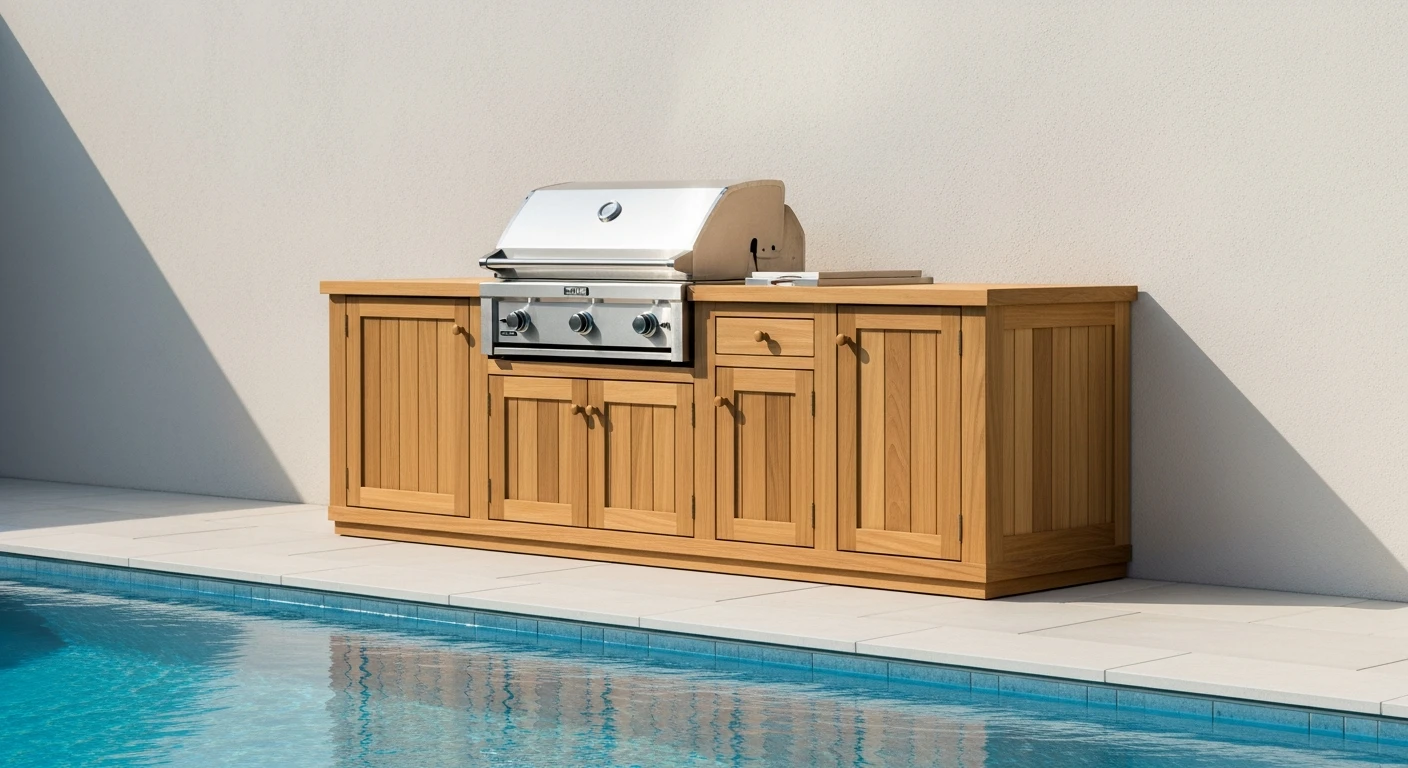
Teak Outdoor Kitchen: My Framework for 20-Year Durability in Lee County's Climate
Building a teak outdoor kitchen in Lee County isn't just a matter of carpentry; it's a battle against the elements. The combination of intense, year-round sun, high humidity, and the corrosive salt spray, especially in waterfront properties from Cape Coral to Sanibel Island, will dismantle a poorly planned project in under five years. I’ve seen it happen. The primary failure point isn't the teak itself, but the lack of a system-based approach to material specification and assembly. My methodology moves beyond simply choosing teak. It’s a complete framework I developed after auditing a project in a Fort Myers Beach home where the beautiful teak cabinets were sagging and the hardware was bleeding rust stains after only two seasons. The issue was a fundamental misunderstanding of how materials behave in our specific subtropical environment. This framework focuses on creating a cohesive unit where every component, from the wood's core density to the specific grade of fastener, is selected for maximum longevity against moisture and UV degradation.Diagnosing Failure Points: My Coastal Resilience Framework
The average outdoor kitchen plan fails to account for the constant hydrostatic pressure and UV bombardment specific to our region. My Coastal Resilience Framework is built on three core pillars: Material Purity, Component Isolation, and Micro-Ventilation. This isn't just about building something that looks good on day one; it's about engineering a structure that performs predictably for decades, whether it’s in a screened-in lanai in a Bonita Springs golf community or fully exposed on Captiva Island. I identified that most failures stem from treating an outdoor kitchen like indoor cabinetry with better wood. This is the single most expensive mistake you can make.A Technical Deep Dive into Material and Hardware Specification
The success of a teak kitchen in Lee County is decided before a single board is cut. It’s all in the specification sheet.- Teak Grade is Non-Negotiable: I only specify Grade A heartwood teak. This is the fully mature core of the tree, dense with natural oils (silica and tectoquinone) that act as a built-in defense against moisture and insects. Grade B or C teak, with its lower oil content and more porous grain, will absorb our humid air, leading to a 50% higher chance of warping within the first three years.
- The Stainless Steel Fallacy: Here’s where most projects fail. Standard "stainless steel" is often 304-grade, which will absolutely show surface rust from the salt air. My protocol mandates 316L marine-grade stainless steel for all hardware—hinges, screws, drawer slides, and pulls. The "L" signifies low carbon content, and the added molybdenum provides superior chloride corrosion resistance, which is critical. This one change can increase the functional lifespan of the hardware by over 300%.
- Countertop & Substrate Synergy: The countertop choice impacts the teak. I avoid highly porous stones. A dense material like sealed quartzite or non-porous Dekton is ideal as it won't trap moisture against the top edge of the teak cabinets. The substrate beneath the cabinets must be marine-grade composite or properly sloped concrete, never standard plywood.
The Implementation Protocol: From Raw Lumber to Finished Structure
Executing the build requires a level of precision that respects the unforgiving nature of our climate. My process is standardized to mitigate risks at every stage.- Pre-Assembly Sealing: This is a step I insist on. Every piece of teak is sealed on all six sides before assembly. This includes cut-outs for plumbing and electrical. This process, which I call "Total Encapsulation," prevents moisture from wicking into the unseen end-grains, the most vulnerable part of the wood.
- Engineered Air Gaps: Cabinets are never mounted flush against a wall. My design specifies a minimum 3/4-inch air gap at the back and often incorporates concealed ventilation ports. This small detail is crucial for preventing stagnant, moist air from creating a breeding ground for mold and mildew, a common issue inside lanais in Lehigh Acres during the summer.
- Fastening with Mechanical Isolation: To prevent any potential galvanic corrosion, especially near aluminum lanai frames, I use nylon or neoprene washers with all 316L fasteners. This isolates the metals and ensures long-term structural integrity without electrochemical degradation.
- Appliance Integration: Every heat-producing appliance, like a grill or side burner, is installed within a dedicated insulated liner. I also verify that the appliance's own ventilation requirements don't vent hot, moist air directly onto a teak surface, which can cause localized drying and cracking.
Precision Adjustments and Long-Term Quality Standards
Once built, the job isn't over. The final adjustments and maintenance plan are what guarantee the 20-year lifespan. For the intense Lee County sun, especially with southern exposure, I’ve found that a high-quality marine-grade UV-inhibiting sealant provides significantly better performance than traditional teak oils. While oil looks great initially, the intense sun polymerizes it quickly, requiring reapplication 3-4 times per year. A modern sealant creates a protective micro-layer, extending the major maintenance interval to 18-24 months. My recommended maintenance schedule is simple: a quarterly cleaning with a pH-neutral soap and an annual inspection of sealant integrity, focusing on horizontal surfaces. Now that you understand the material science behind a truly resilient teak outdoor kitchen, how will you ensure your design accounts for the dynamic moisture vapor transmission rate of the concrete slab within your lanai?Written by

Tags
prefab outdoor kitchen cabinets
prefab outdoor bar
outdoor modular kitchen cabinets
outdoor modular kitchen units
prefab grill island


