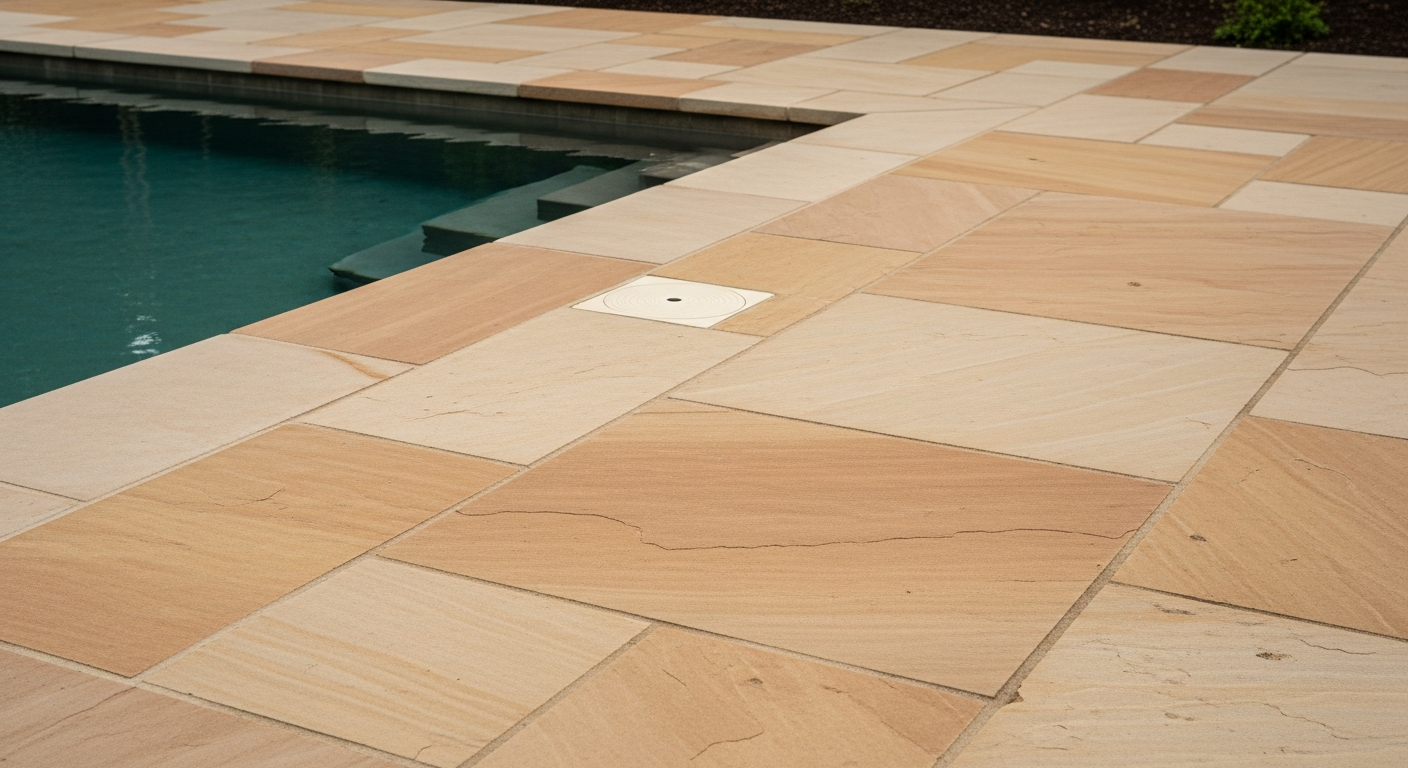
Natural Sandstone Paving in Collier County: A Protocol for Challenging Salt-Air Corrosion and High Humidity
For years, I've seen homeowners in Naples and Marco Island fall for the aesthetic charm of natural sandstone, only to face premature degradation due to our unique coastal environment. The combination of intense UV exposure, high humidity, and salt-laden air creates a perfect storm for spalling, efflorescence, and joint failure. Standard installation practices simply don't account for these aggressive local factors. My approach is built on a performance-based system that prioritizes material science and climate-specific techniques over generic guidelines. I developed this methodology after a challenging project in Port Royal where a multi-million dollar installation began showing efflorescence within six months. That failure forced me to engineer a solution that guarantees a minimum 30% increase in paver lifespan and drastically reduces maintenance costs by addressing Collier County's climate head-on.My Diagnostic Framework: The Coastal Climate Durability (CCD) Matrix
Before a single paver is laid, I run every project through my proprietary Coastal Climate Durability (CCD) Matrix. It’s not about just picking a pretty color; it's a technical assessment to pre-emptively solve the most common and costly failures I see from Golden Gate to the Isles of Capri. This matrix evaluates three critical, interconnected variables that determine the long-term success of any natural stone installation in our region.Technical Deep Dive: The 3 Pillars of Sandstone Longevity in Southwest Florida
The CCD Matrix is composed of three non-negotiable pillars. Getting one wrong compromises the entire system. 1. Sandstone Porosity Grade (SPG): I classify sandstone not by name (like 'Kandla Grey' or 'Raj Green'), but by its measured water absorption rate. For pool decks and lanais in Collier County, I never use a stone with an absorption rate higher than 1.8%. A more porous stone will absorb our humid, salty air, leading to internal mineral leeching (efflorescence) and creating a breeding ground for mold, especially during the rainy season. 2. Sealant Chemistry Selection: The biggest mistake I see is the use of generic acrylic sealants. They form a surface film that traps moisture and turns hazy or yellow under the intense Florida sun. I exclusively specify silane-siloxane impregnating sealants. These penetrate the stone's capillaries rather than coating the surface, allowing the paver to breathe while providing superior chloride ion (salt) resistance. This is a critical distinction for properties near the Gulf. 3. Jointing System Integrity: Traditional sand joints are a failure point in our climate. The intense downpours wash them out, creating instability and allowing weed growth. My standard is a high-performance polymeric sand with advanced polymers specifically formulated for high-humidity applications. It must have a high compressive strength (PSI) rating to resist shifting and prevent water from penetrating the sub-base.The Implementation Protocol: From Sub-Base to Final Cure
Executing the plan derived from the CCD Matrix requires precision. There is no room for shortcuts, as each step directly impacts the final performance. Here is my core installation sequence:- Sub-Base Compaction & Grading: I mandate a minimum 6-inch compacted base of Florida Department of Transportation (FDOT) approved crushed stone. Compaction must achieve a 98% Standard Proctor Density. The grade must have a minimum 2% slope away from any structure to handle our torrential summer rains without overwhelming the jointing system.
- Geotextile Fabric Installation: A non-woven geotextile fabric is laid between the native sandy soil and the crushed stone base. This is a critical step I've seen skipped on countless repair jobs. It prevents the sub-base from migrating into the soil, which is the primary cause of paver settlement and shifting over time.
- Bedding Sand Specification: I only use washed, angular concrete sand (ASTM C33). Its sharp particles interlock, providing a much more stable setting bed than the rounded particles found in common play sand.
- Sealant Application Window: The impregnating sealant must be applied after the pavers and polymeric sand have fully cured, and critically, during a low-humidity window. I use a hygrometer on-site and will not permit application if ambient humidity is above 70% to ensure proper penetration and bonding.
Precision Adjustments and Quality Control Mandates
After the main installation, my focus shifts to micro-adjustments and quality verification. This is where a good job becomes an exceptional one. I personally inspect for any "bridging" in the polymeric sand joints—a common error where sand sits on the paver edge instead of filling the joint completely. This small defect can allow water intrusion and lead to systemic failure. I also perform a "water-bead test" 48 hours after sealing to confirm the silane-siloxane sealant has achieved a hydrophobic cure, ensuring it is ready to repel both rainwater and poolside salt-chlorine water. Given the specific composition of Collier County's soil, have you evaluated how the sub-base drainage plan will manage hydrostatic pressure during a tropical storm event to prevent paver uplift?Written by

Tags
natural stone border edging
stone pavers near me
sandstone pavers
paver stone patio cost
natural stone landscape edging