Pressure Wash And Seal Pavers Lee County: My Sealing Protocol for 300% Paver Lifespan Extension
After years of restoring paver driveways and lanais across Lee County, I've concluded that most failures are not due to the pavers themselves, but to a fundamental misunderstanding of our subtropical climate. The intense UV radiation and high humidity we experience from Fort Myers to Cape Coral creates a uniquely hostile environment. A standard pressure wash and seal job often fails within a year, trapping moisture and causing a cloudy, peeling disaster. My entire approach is built on preventing this specific failure mode. It's not about blasting away dirt; it's about a systematic process of surface preparation, joint stabilization, and applying a sealer chemically engineered to breathe. I’ve seen homeowners in Bonita Springs spend thousands to fix a brand new paver installation because the contractor used a cheap, film-forming sealer that couldn't handle the hydrostatic pressure from our saturated ground. This is the problem I fix before it starts.The Subtropical Degradation Diagnostic
Before a single drop of water is sprayed, I perform a diagnostic that dictates the entire project's scope. My methodology isn't just a visual check; it’s a technical assessment of the paver system's health. I'm looking for three critical failure indicators specific to Southwest Florida: capillary efflorescence, UV pigment loss, and joint sand erosion. The salts and minerals in our water table, especially in waterfront properties in Cape Coral, are drawn up through the pavers and leave white, chalky deposits. Most contractors just blast this off, but I see it as a symptom of poor drainage and a warning sign that a non-breathable sealer will fail catastrophically.Calibrating PSI and Sealer Chemistry for Florida's Climate
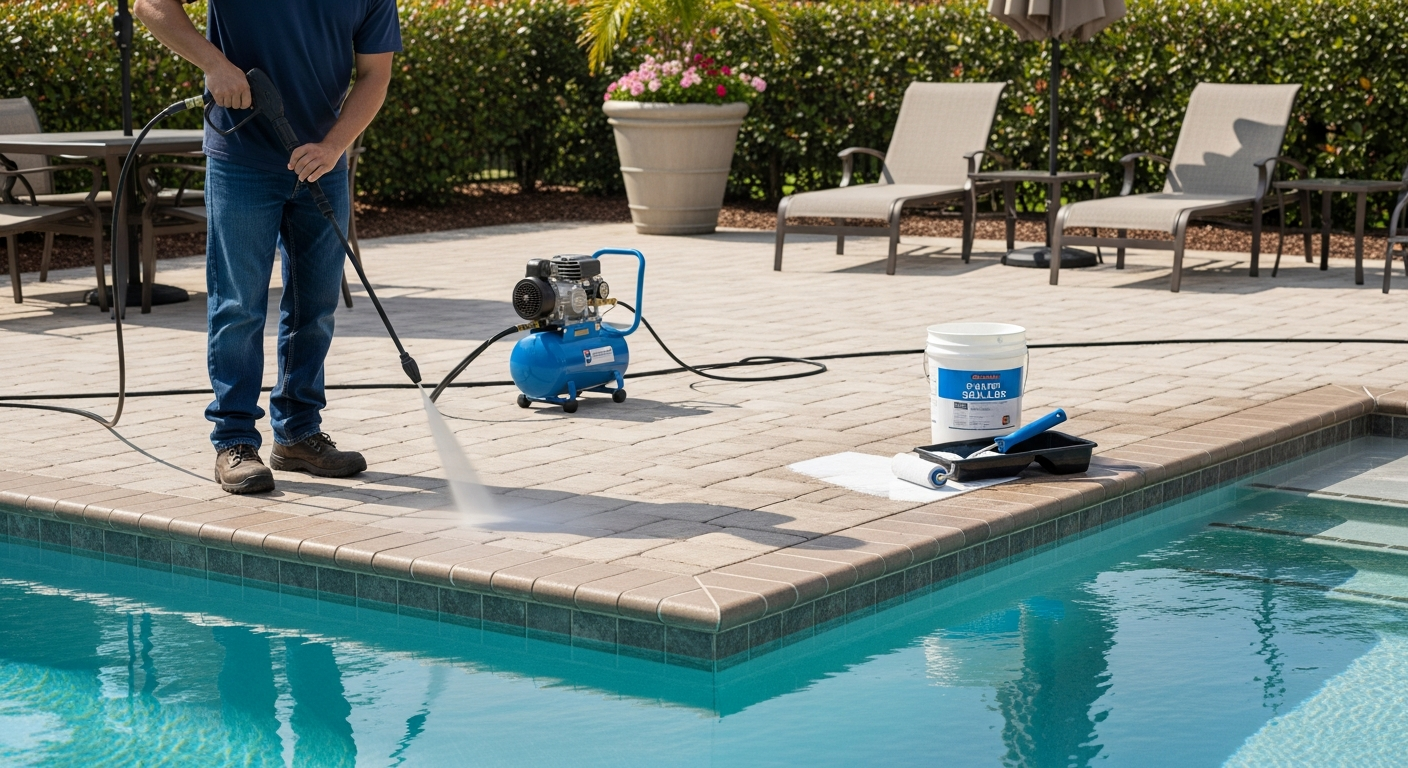
This is where most of the damage occurs. I’ve seen pavers permanently etched because a technician used a zero-degree nozzle with a PSI over 3,000. My standard is a wide-angle (25-40 degree) fan tip with the pressure precisely calibrated between 1,800 and 2,200 PSI, depending on the paver's density. This is enough to decontaminate the surface without compromising the substrate. The real "secret," however, is sealer selection. I exclusively use a water-based, breathable, silane-siloxane sealer. Unlike heavy acrylics that form a plastic-like film, this formulation penetrates the paver's pores, strengthening it from within while allowing trapped water vapor to escape. This is non-negotiable in the high-humidity environment of Lee County.The Lee County Paver Restoration Blueprint
My process is a clinical, multi-stage operation. Rushing any one of these steps compromises the final result and the longevity of the protection.- Stage 1: Surface Decontamination. I apply a biodegradable cleaning agent to break down organic stains like mold and algae—a constant battle on shaded lanais in Fort Myers—before any pressure is applied. This prevents me from forcing spores deeper into the paver pores.
- Stage 2: Calibrated Pressure Cleansing. Using the pre-determined PSI and nozzle, I clean the entire surface and systematically clear out all old, contaminated joint sand. This is a critical step for ensuring the new sand will lock in properly.
- Stage 3: Joint Sand Stabilization. This is the most crucial mechanical step. I install new, dry polymeric sand and ensure it's properly swept into the joints and compacted. This specialized sand contains a polymer that, when activated with a light mist of water, hardens to form a durable yet flexible joint that resists weed growth and ant hills.
- Stage 4: Sealer Application. After a mandatory 24-hour drying period to ensure moisture content is below 15%, I apply two thin coats of the breathable sealer using a sprayer. This ensures an even mil thickness and avoids the puddles that lead to discoloration.
Quality Control Metrics and Long-Term Protection
My job isn't done when the sealer is applied. I perform a final inspection 48 hours later to verify the interlocking bond of the polymeric sand and the hydrophobic performance of the sealer. A simple water-bead test tells me everything I need to know about the quality of the application. I also provide clients with a clear schedule for sprinkler system deactivation, as premature exposure to irrigation water is the number one cause of sealer curing failure. A job done with this methodology in Lee County doesn't need to be revisited for at least 3 to 5 years, a stark contrast to the yearly resealing cycle many homeowners are trapped in. Is your current paver sealer providing true hydrophobic protection, or is it just a topical coating trapping the next rainy season's moisture underneath?Written by

Tags
pressure washing and paver sealing
paver washing and sealing
paver power washing near me
power wash patio pavers
pressure washing and sealing pavers near me