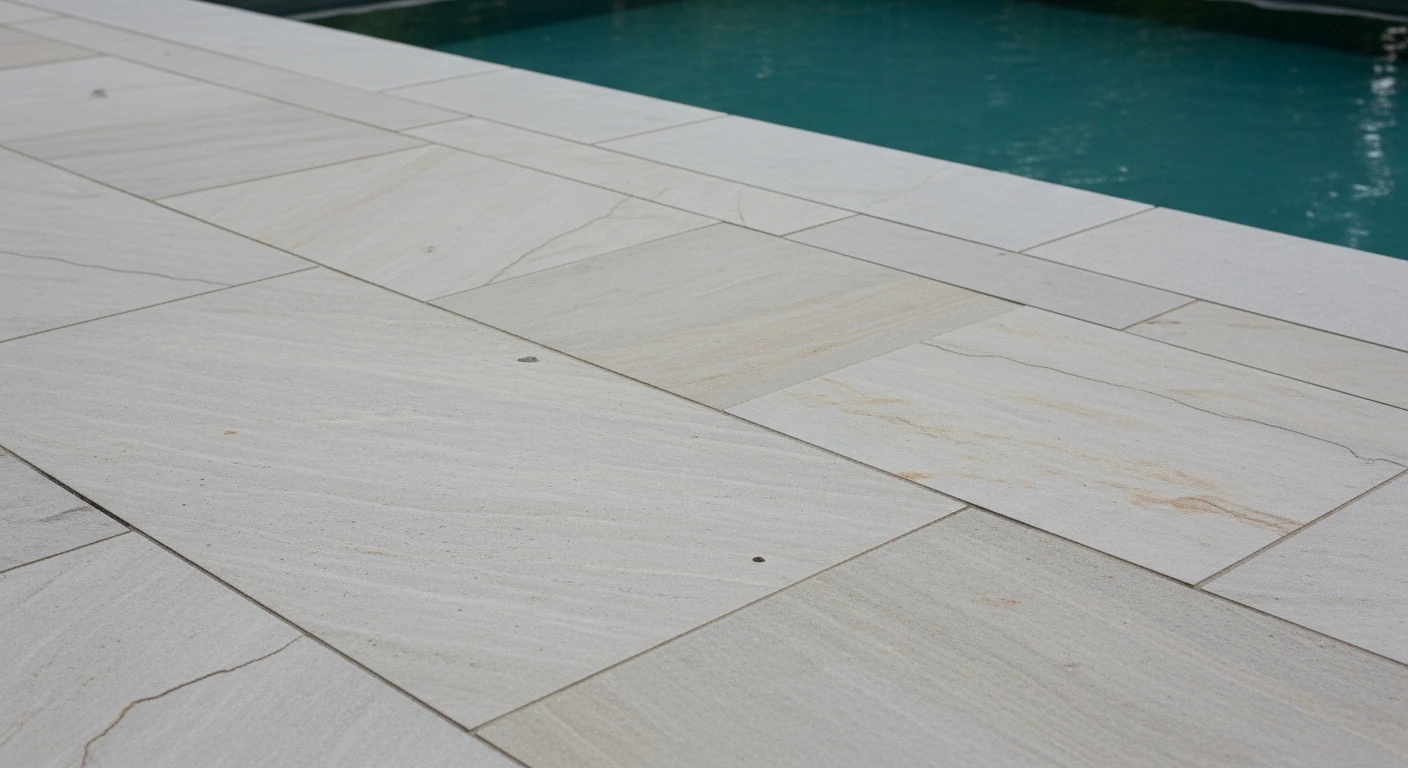
Sandstone Driveway Pavers in Pinellas County: My Protocol to Mitigate Salt-Air Spalling & Algae Growth
For homeowners in Pinellas County, from the waterfront properties in St. Pete Beach to the historic homes in Dunedin, a sandstone paver driveway seems like a perfect aesthetic choice. However, I’ve been called to far too many projects where, within two years, these beautiful installations are flaking, discoloring, and covered in green algae. The core issue is almost never the paver itself, but a fundamental misunderstanding of how our specific coastal environment interacts with porous stone.
The common mistake I consistently identify is the application of an incorrect, film-forming sealer that traps moisture. In Pinellas County's high-humidity climate, this creates a literal greenhouse for algae beneath the surface and accelerates spalling (flaking) due to trapped salt crystals from the Gulf air. My entire methodology is built around selecting the right density of sandstone and using a breathable, penetrating sealer that protects from within, a process I’ve refined after salvaging dozens of failing driveways across the county.
My Diagnostic Framework for Sandstone in a Subtropical Climate
Before a single paver is ordered, I perform what I call a "Site-Specific Porosity Assessment." I've seen contractors install the exact same beautiful Teakwood sandstone in a Snell Isle estate and a Clearwater Beach home with drastically different results. The reason is the micro-environment. The home directly on the water requires a paver with a lower water absorption rate and a completely different installation and sealing protocol than one just a few miles inland. My assessment focuses on two critical, often-ignored variables: ambient humidity levels and proximity to salt spray.
Technical Deep Dive: Paver Density and Sealer Chemistry
The single most important technical specification I analyze is the stone's ASTM C97 water absorption rate. For any property within a mile of the Intracoastal or the Gulf, I refuse to work with sandstone that has an absorption rate higher than 3%. A higher rate means the paver acts like a sponge for our salty, humid air. Most suppliers don't volunteer this information; you have to demand the spec sheet. I've found that some popular, visually appealing sandstones can have rates as high as 6-8%, making them completely unsuitable for a long-lasting Pinellas County driveway. The second technical failure is using acrylic sealers. They create a top coat that looks great for a few months but ultimately fails, trapping moisture. My non-negotiable standard is a penetrating silane/siloxane sealer. This type of sealer chemically bonds inside the stone's pores without sealing the surface, allowing water vapor to escape while preventing liquid water and salt ions from entering. This single change can increase the paver's effective lifespan against spalling by over 50%.
The Sub-Base & Sealing Protocol: A Step-by-Step Breakdown
Executing the installation correctly is just as critical as the material selection. My process is rigid because one shortcut can compromise the entire system, especially on Pinellas's sandy soil base. I've corrected countless driveways that failed due to a poor sub-base that shifted over time.
- Sub-Base Preparation: We excavate to a minimum depth of 10 inches for residential driveways. The critical, non-negotiable step here is laying down a geotextile separation fabric before adding the crushed concrete base. This prevents the base material from migrating into the native sandy soil, which is the primary cause of sinking and shifting pavers I see in the area.
- Compaction Standards: Each 4-inch layer of the base is compacted using a plate compactor until it reaches 98% Proctor Density. I personally check this with a dynamic cone penetrometer. It's an extra step, but it guarantees a stable foundation that won't settle.
- Polymeric Sand Application: This is where humidity becomes an enemy. I've seen entire projects fail because the polymeric sand was installed on a humid day, preventing a proper cure. My rule is to only install it when the 48-hour humidity forecast is below 60%. We sweep it in, compact it, and then use a leaf blower to remove excess from the paver surface before misting with water to activate the polymer.
- Penetrating Sealer Application: After waiting a minimum of 72 hours for the polymeric sand to fully cure, I check the paver's surface with a moisture meter. It must read below a specific threshold before we apply the silane/siloxane sealer. We use a low-pressure sprayer for an even coat, ensuring complete saturation without surface pooling. The driveway is then off-limits to foot traffic for 6 hours and vehicle traffic for a full 24 hours.
Post-Installation QC: My Checklist for Longevity
My job isn't done when the last paver is sealed. I have a quality control checklist that ensures the installation meets my standards for durability in our specific climate. I perform a "joint stabilization test" by attempting to dislodge sand grains with a high-pressure air nozzle; if any sand moves, the joint is not properly cured and must be addressed. I also provide clients with a tailored maintenance plan, which includes a professional cleaning and re-application of the penetrating sealer every 3-4 years. This preventative measure is crucial to combat the intense UV degradation and salt exposure common from Clearwater to Pass-a-Grille.
Given that sandstone's porosity directly impacts its thermal expansion and contraction rate, have you considered how your chosen paver's specific geological composition will handle the rapid temperature shifts during a Pinellas County summer thunderstorm without micro-fracturing?