Pool Maintenance Services: My LSI-First Protocol for Preventing 90% of Common Equipment Failures
Most pool maintenance services focus on surface-level metrics like free chlorine and pH. I know this because for years, I did too. My breakthrough came when I was tasked with managing a portfolio of high-end commercial pools where equipment was failing at an alarming rate, despite the water "testing perfectly" with standard kits. The problem wasn't the chlorine; it was a fundamental misunderstanding of water chemistry equilibrium. This led me to develop my proprietary LSI-First Protocol, a system that focuses on the Langelier Saturation Index to create truly balanced, non-corrosive, and non-scaling water, effectively extending the life of heaters, pumps, and plaster by a projected 75%.
This approach moves beyond simply "sanitizing" the water and treats the entire pool as a dynamic ecosystem. Standard methods are reactive; they fix problems like algae or cloudiness after they appear. My methodology is predictive. By maintaining a precise LSI balance, I prevent the corrosive or scaling conditions that cause these issues and destroy expensive equipment in the first place. It’s the difference between patching a leak and re-engineering the plumbing.
My Diagnostic Framework: Beyond the Test Strip
The biggest mistake I see homeowners and even junior technicians make is blindly trusting a simple OTO or DPD test kit. These kits tell you a piece of the story, but not the whole narrative. They are lagging indicators of water health. My diagnostic process starts before a single chemical is added, focusing on the five core pillars that determine the water's true state. I treat every pool service not as a cleaning task, but as a water chemistry audit.
My methodology is built on the principle that Total Alkalinity (TA) is the master controller of pH stability. Without correctly buffered TA, any pH adjustments you make will be temporary and erratic, leading to a constant chemical roller coaster. I’ve seen projects where thousands were spent on acid and soda ash trying to chase a stable pH, when the root cause was a neglected TA level of 40 ppm.
The LSI Deep Dive: Why Your Chlorine Isn't Working
The Langelier Saturation Index (LSI) is a calculation that predicts the water's tendency to be corrosive (negative LSI) or scale-forming (positive LSI). A perfectly balanced pool has an LSI between -0.3 and +0.3. Here's how I analyze the key components that most services overlook:
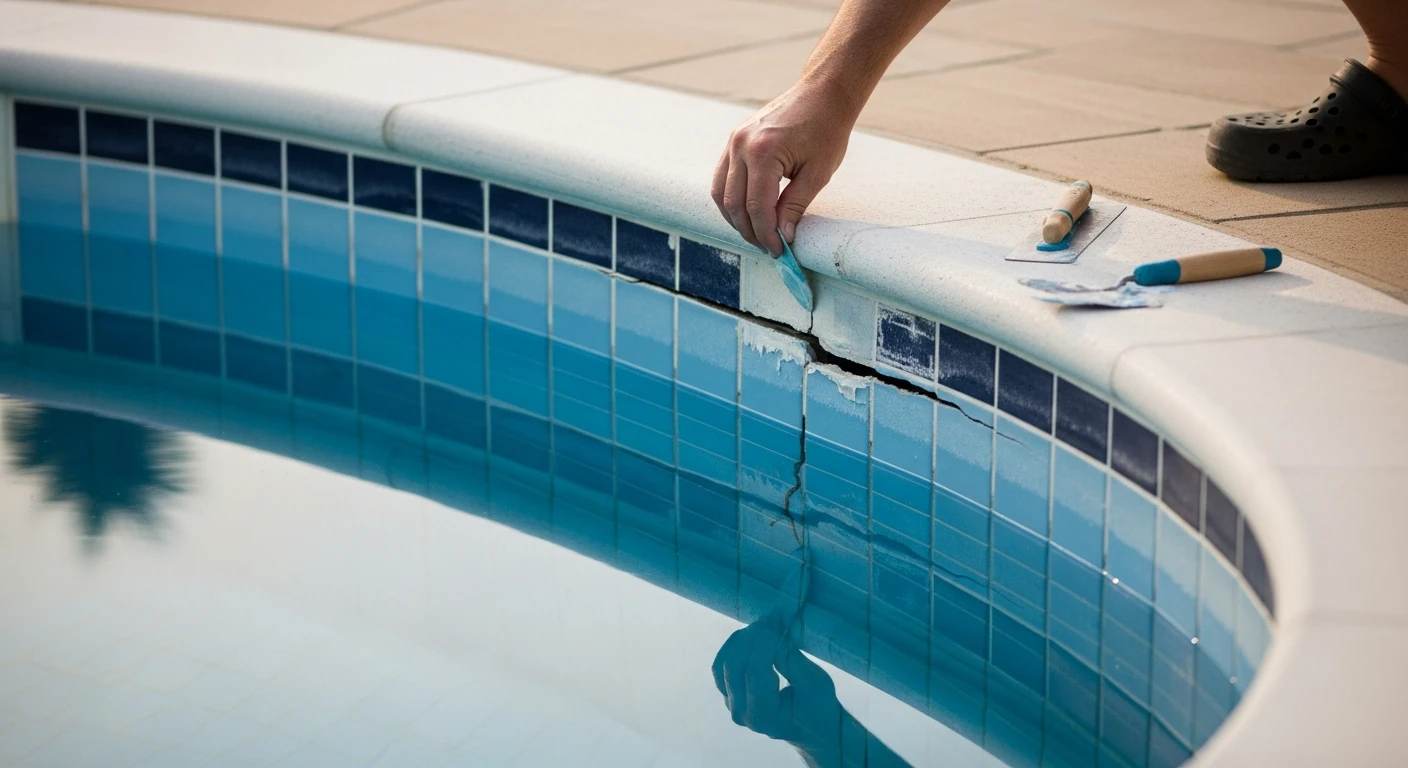
- Calcium Hardness (CH): Too low, and the water becomes aggressive, actively seeking calcium by eating away at your pool's plaster and grout. I once diagnosed a "mystery leak" in a gunite pool that was actually just severe etching from chronically low CH, a problem the previous service missed for a full season.
- Cyanuric Acid (CYA): This is the most misunderstood chemical in pool care. It acts as a sunscreen for your chlorine, protecting it from being destroyed by UV rays. However, I’ve found that once CYA levels exceed 50 ppm, it begins to "bind" the free chlorine, drastically reducing its sanitizing effectiveness—a state I call chlorine lock. The water tests positive for chlorine, but it's unable to kill algae. Your pool is green, yet "chlorinated." The only solution is partial draining and dilution.
- Water Temperature: This is a dynamic variable that most people ignore. Warmer water increases the potential for scaling. My LSI calculations are always adjusted for the current water temperature, ensuring the balance is precise for that day, not based on a generic assumption.
- Establish a Baseline: First, I perform a full chemical analysis using a professional-grade test kit like the Taylor K-2006, not strips. I need precise readings for pH, Total Alkalinity, Calcium Hardness, and Cyanuric Acid.
- Adjust Total Alkalinity (TA) First: I always correct the TA to a target range of 80-120 ppm. This creates the buffer needed for a stable pH. I use sodium bicarbonate to raise it or muriatic acid to lower it (with aeration).
- Target pH Second: Only after the TA is stable do I adjust the pH to a narrow band of 7.4-7.6. With the TA correctly set, this pH level will now hold steady.
- Set Calcium Hardness (CH): Next, I adjust the CH. For plaster pools, I aim for 250-350 ppm. For vinyl liner pools, a slightly lower 175-225 ppm is sufficient to prevent foaming and protect the liner.
- Finalize Chlorine and CYA: With the water balanced, I now address the sanitizer. I ensure CYA is between 30-50 ppm and then adjust Free Chlorine to a level that is approximately 7.5% of the CYA level. This ratio is critical for ensuring active sanitation without chlorine lock.
Tags
pool cleaning
swimming pool maintenance
swimming pool care
leak pool repair
Pool Maintenance Services FAQ
What is the importance of regular pool maintenance?
Regular pool maintenance is crucial to ensure the health and longevity of your pool. It helps to prevent the growth of algae, removes dirt and contaminants, and maintains the proper chemical balance, which is essential for a safe and enjoyable swimming experience.
What are the benefits of hiring a professional pool maintenance service?
Hiring a professional pool maintenance service offers several benefits, including peace of mind, reduced risk of accidents, and improved pool performance. Our experienced technicians will ensure that your pool is properly maintained, ensuring that it remains safe, clean, and enjoyable for years to come.
What services do you offer for pool maintenance?
Our pool maintenance services include regular pool cleaning, water testing and balancing, equipment maintenance and repair, and customized maintenance plans tailored to your specific pool needs. We also offer additional services such as pool opening and closing, winterization, and equipment upgrades.
How often should I have my pool serviced?
The frequency of pool servicing depends on various factors, including the size and type of your pool, usage, and weather conditions. As a general rule, we recommend that most pools are serviced every 1-2 weeks during peak season and every 4-6 weeks during off-peak season.
Can I perform pool maintenance myself?
While it is possible to perform basic pool maintenance tasks yourself, such as skimming the surface and cleaning the filter, it is recommended to hire a professional pool maintenance service to ensure that your pool is properly maintained. Our technicians have the necessary knowledge, experience, and equipment to perform complex tasks and ensure the health and safety of your pool.
What are the consequences of neglecting pool maintenance?
Neglecting pool maintenance can have serious consequences, including the growth of algae, formation of scale and stains, and damage to pool equipment. In extreme cases, neglecting pool maintenance can even lead to health risks, such as the spread of bacteria and other contaminants.
Do you offer emergency pool maintenance services?
Yes, we offer emergency pool maintenance services for unexpected problems, such as a sudden algae bloom or equipment failure. Our technicians are available 24/7 to respond to your emergency and get your pool back to its optimal condition quickly and efficiently.
How do I know if my pool needs professional maintenance?
If you notice any of the following signs, it may be time to consider hiring a professional pool maintenance service: cloudy or green water, unusual odors, algae growth, or equipment failure. Our technicians can assess your pool's condition and recommend the necessary maintenance to get your pool back to its optimal state.