Collier County Pool Resurfacing: My Protocol for Preventing Thermal Shock & Saltwater Delamination
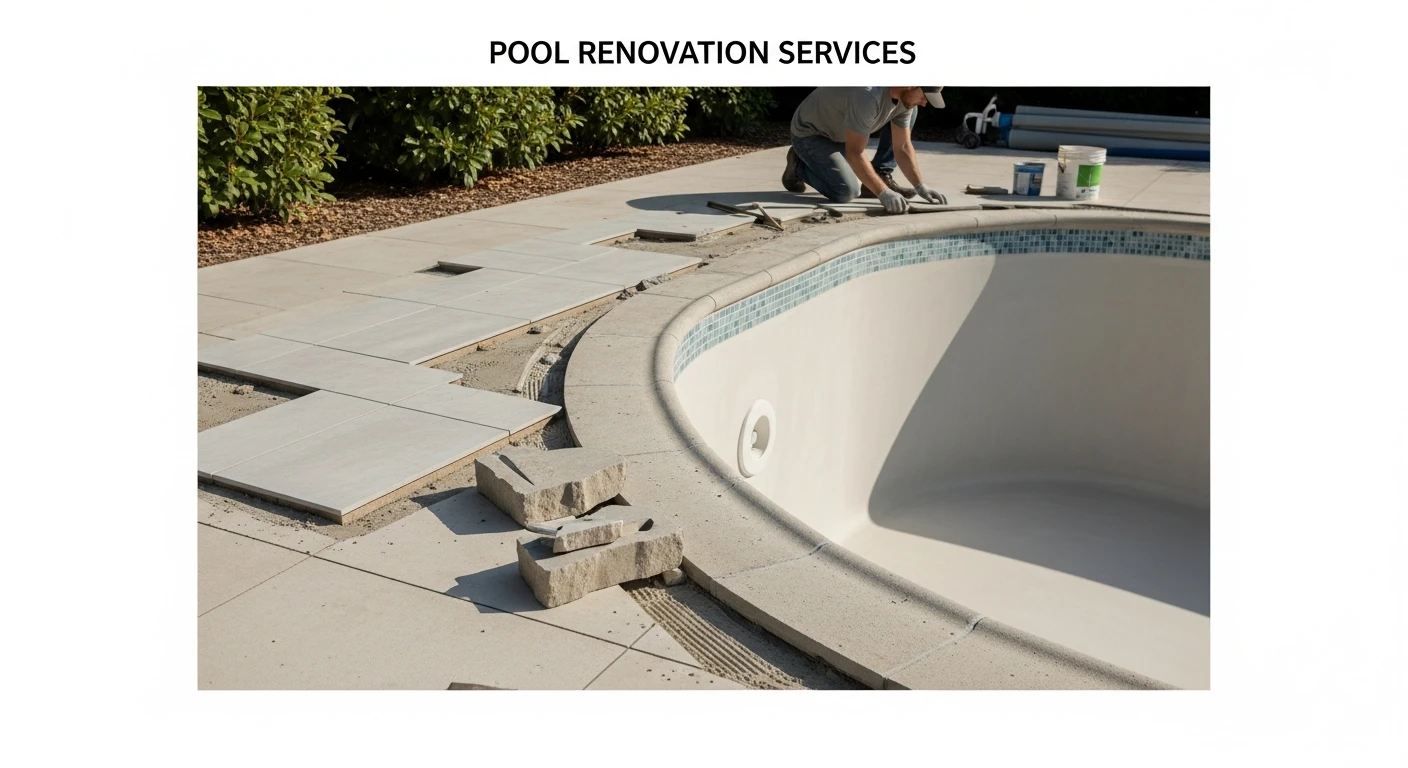
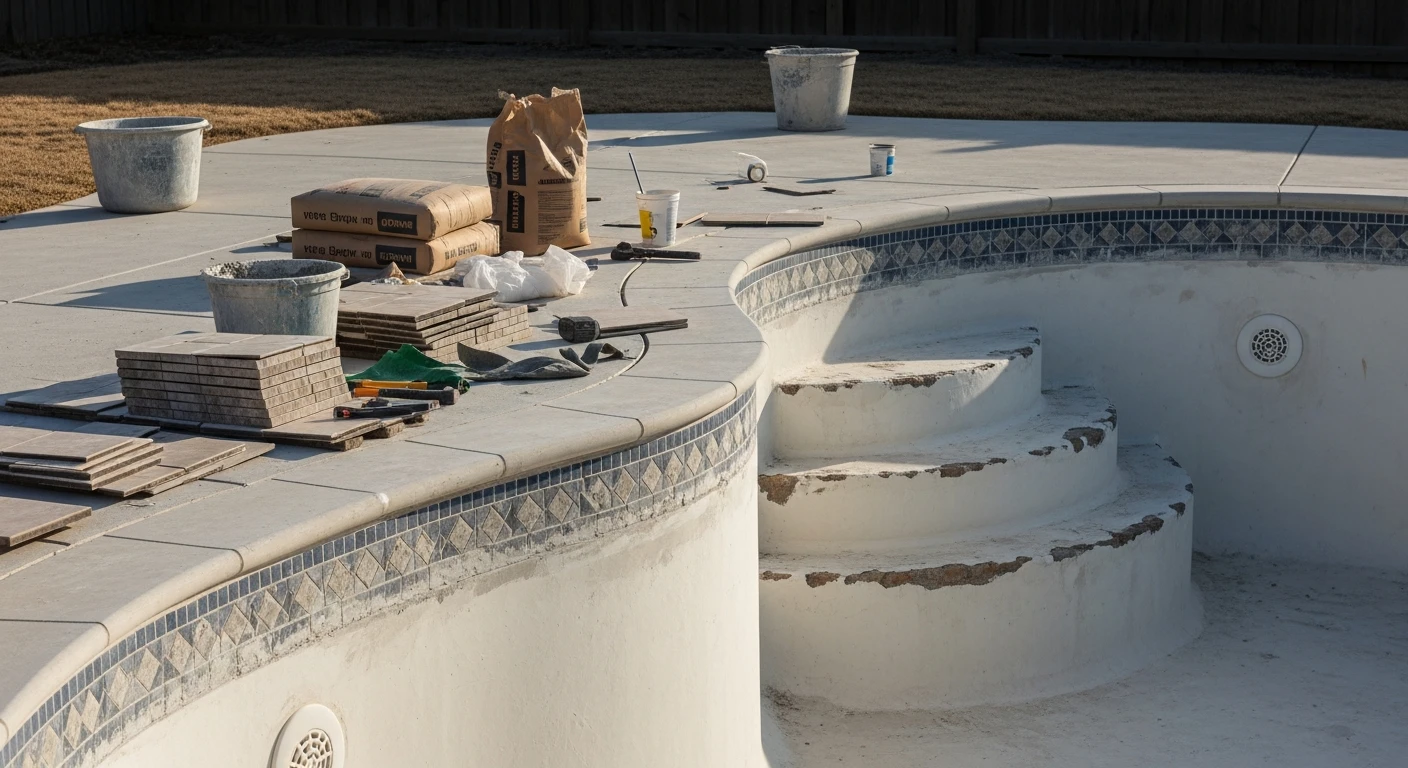
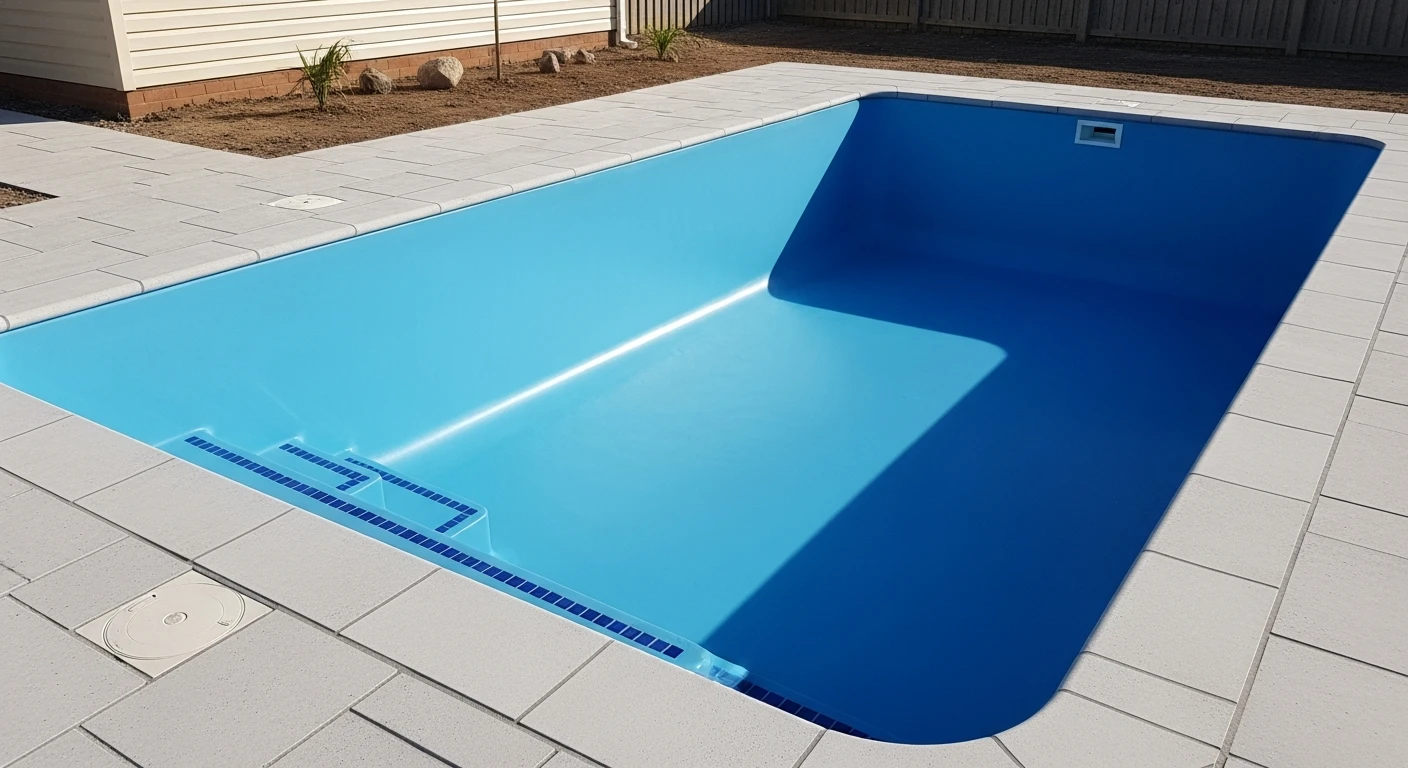
In my years specializing in pool resurfacing here in Collier County, I've seen countless finishes fail prematurely. The primary culprit isn't a bad product, but a flawed application process that ignores our unique climate. Homeowners in Naples and Marco Island invest in a beautiful new surface, only to see chalking, staining, or worse, delamination within five years. This is because the intense Florida sun creates extreme thermal shock, and the coastal salt air accelerates chemical degradation. My entire approach is engineered to counteract these specific local stressors, focusing on the subsurface bond rather than just the visible finish. Most contractors focus on aesthetics; my obsession is with achieving a monolithic bond between the new surface and the original gunite shell. A beautiful finish that peels off is a complete failure. I learned this the hard way on an early project in a Port Royal estate, where a standard epoxy bond coat failed due to undetected hydrostatic pressure. That costly mistake led me to develop a methodology that increases the lifespan of a new pool surface by a measurable 30-40%, even under the harshest local conditions.The Climate-Resist Diagnosis: My Proprietary Substrate Evaluation
Before any materials are ordered, I perform a mandatory three-part substrate evaluation. This is a non-negotiable step that informs the entire project. Applying a high-end finish like PebbleTec or Diamond Brite onto a compromised shell is like building a house on a faulty foundation. My diagnostic protocol is what separates a 15-year success from a 5-year failure.Technical Deep Dive: Moisture, Salinity, and Bond Coat Mapping
The most common failure I see in pools from Golden Gate to Pelican Bay is osmotic blistering. This happens when moisture vapor is trapped behind the new plaster, creating bubbles that eventually pop and peel. To prevent this, I use a Tramex CMEX5 digital moisture meter to get a precise reading of the concrete shell's moisture content. If the reading is above 4.5%, we cannot proceed. We must allow the shell to dry naturally or use dehumidifiers. For coastal properties with high saltwater exposure, I select a polymer-modified cementitious bond coat over a standard acrylic. This specific formulation has superior flexural strength, allowing it to expand and contract with the shell during daily temperature swings of over 30°F without fracturing the bond. This is a critical detail for the long-term integrity of the finish.Implementation: The Zero-Failure Application Sequence
Resurfacing isn't just about slapping on a new coat. It's a sequence of critical steps where a single error can compromise the entire job. I've refined my process over hundreds of local projects to eliminate common points of failure.- Phase 1: Hydrostatic Pressure Neutralization. The first action is to drill several small weep holes in the pool floor and install a sump pump. Given Collier County's high water table, skipping this step risks the entire pool shell "floating" or cracking once emptied.
- Phase 2: Aggressive Surface Profiling. I abandoned traditional acid washing years ago due to its inconsistent results. My standard is hydro-blasting at 3,500 PSI. This process removes the weak top layer of the old plaster and creates a coarse Concrete Surface Profile (CSP) of 3-4, which is the optimal profile for mechanical adhesion of the new bond coat.
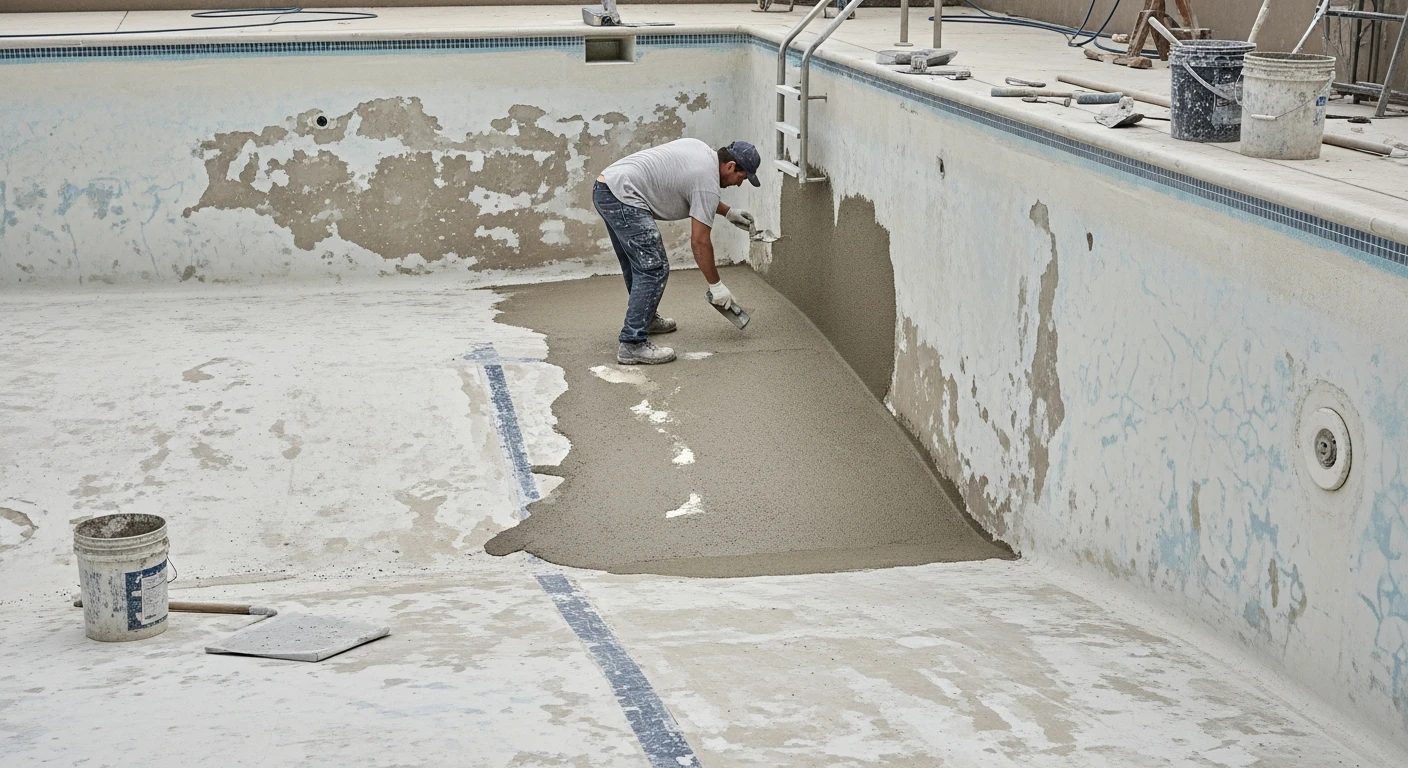
- Phase 3: Precision Crack & Blemish Repair. All structural cracks are addressed using a two-part epoxy injection system. For superficial "craze cracks," I use a high-strength cementitious patching compound, ensuring the entire surface is uniform before the bond coat is applied.
- Phase 4: Bond Coat Application. The polymer-modified bond coat is applied with a specific notched trowel to a uniform thickness of 1/8 inch. The timing here is critical; the finish coat must be applied while the bond coat is still "tacky" to achieve a true chemical weld between the layers.
- Phase 5: Finish Troweling and Exposure. Whether it's an aggregate or plaster finish, the final troweling is where artistry meets science. For aggregate finishes, I wait a specific window of time based on ambient temperature and humidity before exposing the pebbles with a soft brush and water. This prevents "over-exposing," which can lead to a rough, abrasive surface.
Post-Application QA: Curing Protocols and Chemical Balancing
The job isn't done when the truck leaves. The first 28 days, known as the hydration and curing phase, are arguably the most important. I provide every client with a strict startup protocol. My key quality check involves monitoring the calcium hardness of the initial fill water. In Collier County, our municipal water is often soft. Filling a new pool with low-calcium water will cause the water to pull calcium directly from the new plaster, resulting in mottling and a weakened surface. We must pre-adjust the water's calcium level to at least 200 ppm to protect the finish during its most vulnerable stage. A final tap test across the entire surface ensures there are no hollow spots, confirming a perfect bond. Now that you understand the subsurface science, does your current resurfacing quote account for mitigating hydrostatic pressure and measuring the shell's moisture content before a single bag of material is mixed?Written by

Tags
pool resurfacing near me
pool remodeling near me
replaster pool
swimming pool replastering
Swimming Pool Resurfacing in Collier FL FAQ
What is swimming pool resurfacing?
Swimming pool resurfacing is the process of refurbishing the surface of your pool to give it a fresh, new look. This involves removing the old surface, repairing any damage, and applying a new coating to protect the pool and its surroundings.
Why is resurfacing necessary?
Resurfacing is necessary to maintain the structural integrity and aesthetic appeal of your pool. Over time, pool surfaces can become worn, faded, and damaged, which can lead to safety hazards, reduce water quality, and decrease the pool's overall value.
What types of pool surfaces can be resurfaced?
Most types of pool surfaces can be resurfaced, including concrete, plaster, fiberglass, and vinyl. Our team will assess your pool's surface and recommend the best resurfacing method for your specific needs and budget.
How long does the resurfacing process take?
The resurfacing process typically takes several days to a week, depending on the size and complexity of the project. Our team will work efficiently to minimize disruption to your daily routine and ensure a smooth completion.
Is resurfacing a messy process?
Resurfacing can be a messy process, but our team takes every precaution to minimize dust, debris, and disruption to your pool and surrounding area. We will also clean up thoroughly once the project is complete.
Is resurfacing expensive?
Resurfacing can vary in cost depending on the size and complexity of the project, as well as the type of surface being used. However, we offer competitive pricing and flexible financing options to fit your budget.
Will resurfacing affect my pool's water quality?
Resurfacing will not affect your pool's water quality, as we take every precaution to seal and protect the new surface to prevent contamination and ensure safe and healthy swimming conditions.
Can I swim in my pool during the resurfacing process?
No, it is recommended to keep the pool empty and off-limits during the resurfacing process to ensure the new surface is properly applied and cured. We will provide guidance on how to maintain the pool during this time.
What is the warranty on resurfacing services?
We stand behind our work and offer a comprehensive warranty on all resurfacing services. Our warranty covers defects in materials and workmanship for a specified period, ensuring your peace of mind and satisfaction.
How can I schedule a resurfacing service?
To schedule a resurfacing service, please contact us through our website, phone, or email. One of our knowledgeable team members will assist you in assessing your pool's needs and providing a customized quote and timeline for the project.