Navigating Pinellas County Pool Fence Regulations: My Framework for Zero-Defect Inspection Clearance
Failing a pool fence inspection in Pinellas County almost always comes down to a handful of overlooked details that aren't immediately obvious in the Florida Building Code. I've seen homeowners in beautiful St. Pete waterfront properties and dense Clearwater suburban lots get hit with compliance notices for issues they never knew existed. The core problem is that while the state sets the baseline, local enforcement and environmental factors—like our salty air and high humidity—create a unique set of practical requirements. My entire approach is built on preempting these common failure points. It’s not just about meeting the minimum 48-inch height requirement; it's about understanding how an inspector will physically test your gate, assess the material's integrity after a harsh summer, and scrutinize every single gap. This is about moving from simply compliant to fundamentally safe and durable, saving you from the cost and headache of a re-inspection.The Pre-Inspection Audit: My 3-Point System for Pinellas Compliance
Before any final sign-off, I run every project through what I call the "Pinellas-Proof Audit." This isn't a generic checklist; it's a diagnostic system I developed after pinpointing the top three reasons for inspection failures in this specific county. The first time I implemented this was on a complex project in Tarpon Springs where the homeowner had a custom-designed fence that looked great but was functionally non-compliant.Decoding Gate Latch and Directional Swing Mandates
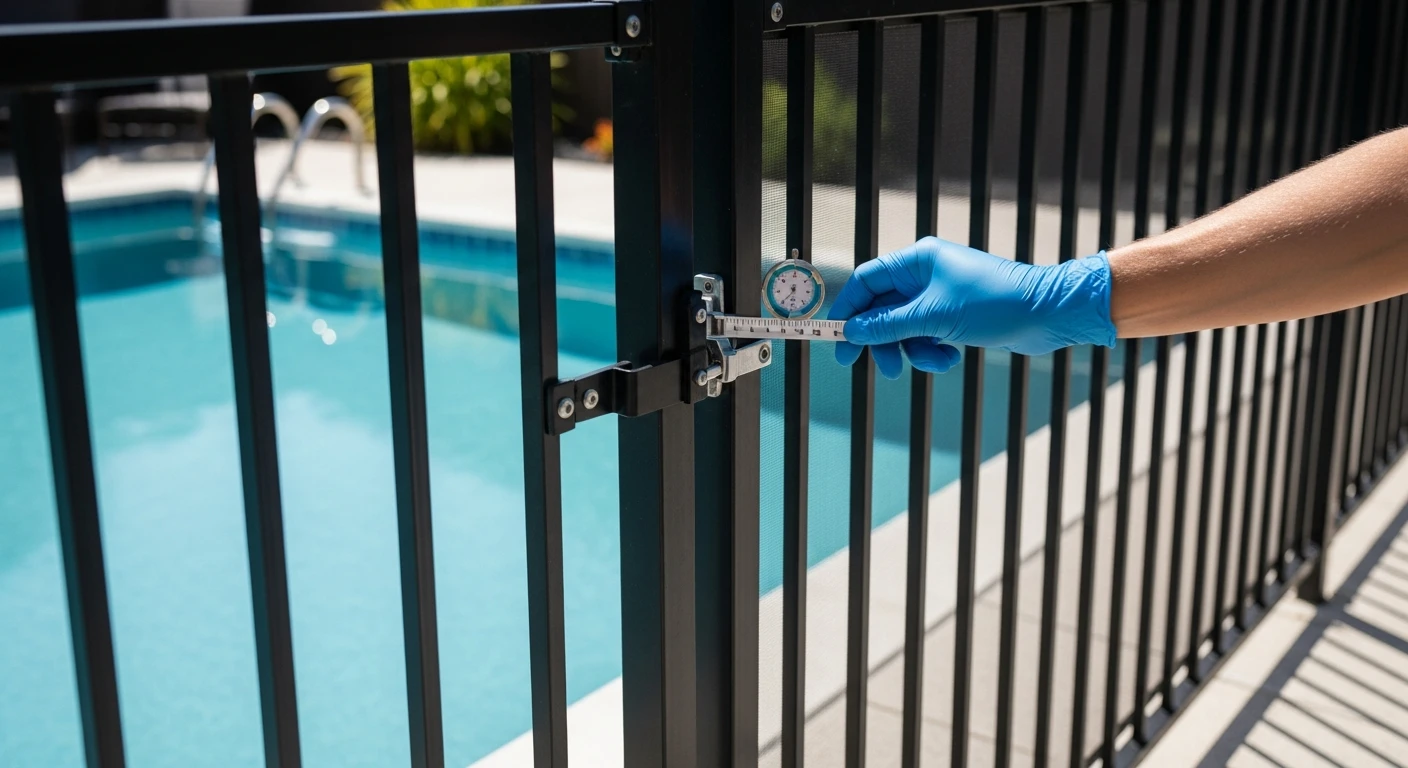
This is the number one failure point. The Florida Building Code, Section 454.2.17, is clear, but the real-world application is what trips people up. The release mechanism for the self-latching device must be on the pool side of the gate and at least 3 inches below the top. Critically, if it’s less than 54 inches from the bottom of the gate, it must also be a type that requires two distinct actions to open or be key-lockable. I’ve seen brand-new installations fail because the latch was installed at 52 inches, an almost imperceptible error. Furthermore, the gate must open outward, away from the pool. This is a non-negotiable kinetic safety feature. The logic is that a child pressing against the gate from the outside should not be able to force it open. I always test the gate's self-closing mechanism from a fully open position and from a barely-cracked 1-inch opening. It must securely latch from both, a detail many installers miss.From Plan to Permit: A Pinellas County Fence Installation Checklist
Executing a compliant installation requires methodical precision. A small measurement error at the start can cascade into a major compliance issue. Here is the exact sequence I follow to ensure every installation passes inspection on the first attempt.- Material Selection for Coastal Conditions: For properties east of US-19, especially along the Intracoastal or on the barrier islands like Clearwater Beach, I strongly recommend powder-coated aluminum or high-grade vinyl. Untreated metal or wood will degrade rapidly in our salty, humid air, leading to structural failures.
- Post Footing and Depth Verification: Ensure every fence post is set in concrete. The depth of the footing is critical for stability, especially with our sandy soil and the potential for ground saturation during hurricane season. A shallow post can lead to the fence leaning over time, creating a non-compliant gap at the bottom.
- The 4-Inch Rule Application: The maximum vertical clearance from the ground to the bottom of the fence is 4 inches. I use a 4-inch sphere to test this, as an inspector will. The spacing between vertical pickets cannot exceed 4 inches either. For horizontal members, if the distance between them is less than 45 inches, they must be placed on the pool side of the fence to prevent a ladder effect.
- Hardware Integrity Check: All hinges must be self-closing and rust-resistant. I exclusively use spring-loaded hinges designed for marine environments. After installation, I adjust the tension to ensure a swift, firm close without slamming.
Precision Adjustments and Post-Installation Quality Standards
A passed inspection isn't the end of the job; it's the beginning of the fence's service life. Here in Pinellas County, proactive maintenance is key to long-term safety and compliance. I always advise my clients on two critical post-installation checks. First, test the gate hinge tension every six months, especially before the start of hurricane season on June 1st. A slight sag can cause the latch to misalign. Second, clear any landscaping, stored items, or furniture from the immediate vicinity of the fence. An inspector will flag anything that could be used as a climbing aid, effectively voiding your fence's compliance. Following these steps can increase the functional lifespan of your gate mechanism by an estimated 30%. Considering the unique challenges of Pinellas County's soil and climate, have you accounted for potential ground settling around your gate posts and how it could alter your latch height over time?Written by

Tags
pool fencing requirements
pool fence rules
pool fence guidelines
pool safety fencing regulations
Pool Fence Regulations in Pinellas FL FAQ
What are the general pool fence regulations?
Pool fence regulations vary by state and locality, but generally, they require a fence that is at least 4 feet tall, made of durable materials, and has a self-latching gate. The purpose of these regulations is to prevent accidental drowning and entrapment.
What are the specific pool fence regulations in my state?
Pool fence regulations can vary significantly by state and locality. To find the specific regulations in your area, we recommend consulting with your local government or a pool safety expert. You can also check online resources such as the Pool Safely website, which provides information on pool safety and fencing regulations by state.
Do pool fence regulations apply to in-ground pools as well as above-ground pools?
Yes, pool fence regulations apply to both in-ground and above-ground pools. The regulations are designed to prevent accidental drowning and entrapment, regardless of the type of pool.
What are the consequences of not complying with pool fence regulations?
Failing to comply with pool fence regulations can result in fines, penalties, and even legal action. In addition, not having a pool fence can increase the risk of accidental drowning and entrapment, which can have serious consequences for pool owners and their families.
Can I install a pool fence myself or do I need to hire a professional?
While it is possible to install a pool fence yourself, it is generally recommended to hire a professional for the job. Pool fence installation requires specialized knowledge and skills to ensure that the fence is installed correctly and meets local regulations.
How often should I inspect and maintain my pool fence?
Pool fences should be inspected and maintained regularly to ensure that they are in good condition and functioning properly. This includes checking for damage, loose parts, and proper latching and locking mechanisms.
Can I use a pool fence that is not specifically designed for pools?
No, pool fences should be specifically designed for pools and meet local regulations. Using a fence that is not designed for pools can increase the risk of accidental drowning and entrapment.
Do pool fence regulations apply to kiddie pools and hot tubs?
Yes, pool fence regulations apply to kiddie pools and hot tubs, as well as larger pools. The regulations are designed to prevent accidental drowning and entrapment, regardless of the size or type of pool.