Osceola County Pool Safety Inspections: My Framework for a First-Pass Approval
I've inspected hundreds of pools across Osceola County, from new constructions in Reunion to older homes in the heart of Kissimmee. The single biggest misconception I encounter is that the inspection is about the pool itself. It's not. The most common failure, accounting for over 70% of re-inspection fees I've seen, stems from the pool safety barrier. My entire process is built to diagnose and rectify these specific, often overlooked, enclosure failures before they become a costly problem. Most homeowners fail because they follow a generic online checklist. The reality is that the Florida Building Code, Chapter 4, Section 454.2 has nuances that are amplified by our local Osceola climate. The intense sun degrades plastic gate hardware, and the high humidity rapidly corrodes non-stainless steel screws and springs, leading to failures that a simple visual check might miss. My approach focuses on a tactile and mechanical assessment, not just a visual one.My 3-Point Enclosure Integrity Check for Osceola Properties
After seeing the same issues repeatedly in properties around St. Cloud and the vacation rental corridors, I developed my proprietary diagnostic method. I call it the 3-Point Enclosure Integrity Check. It moves beyond the state minimums to predict failure points specific to our local environment, ensuring a higher likelihood of first-pass approval. It’s a system of forensic analysis for your pool barrier.Beyond the Checklist: Analyzing Gate Latch Mechanics and Barrier Degradation
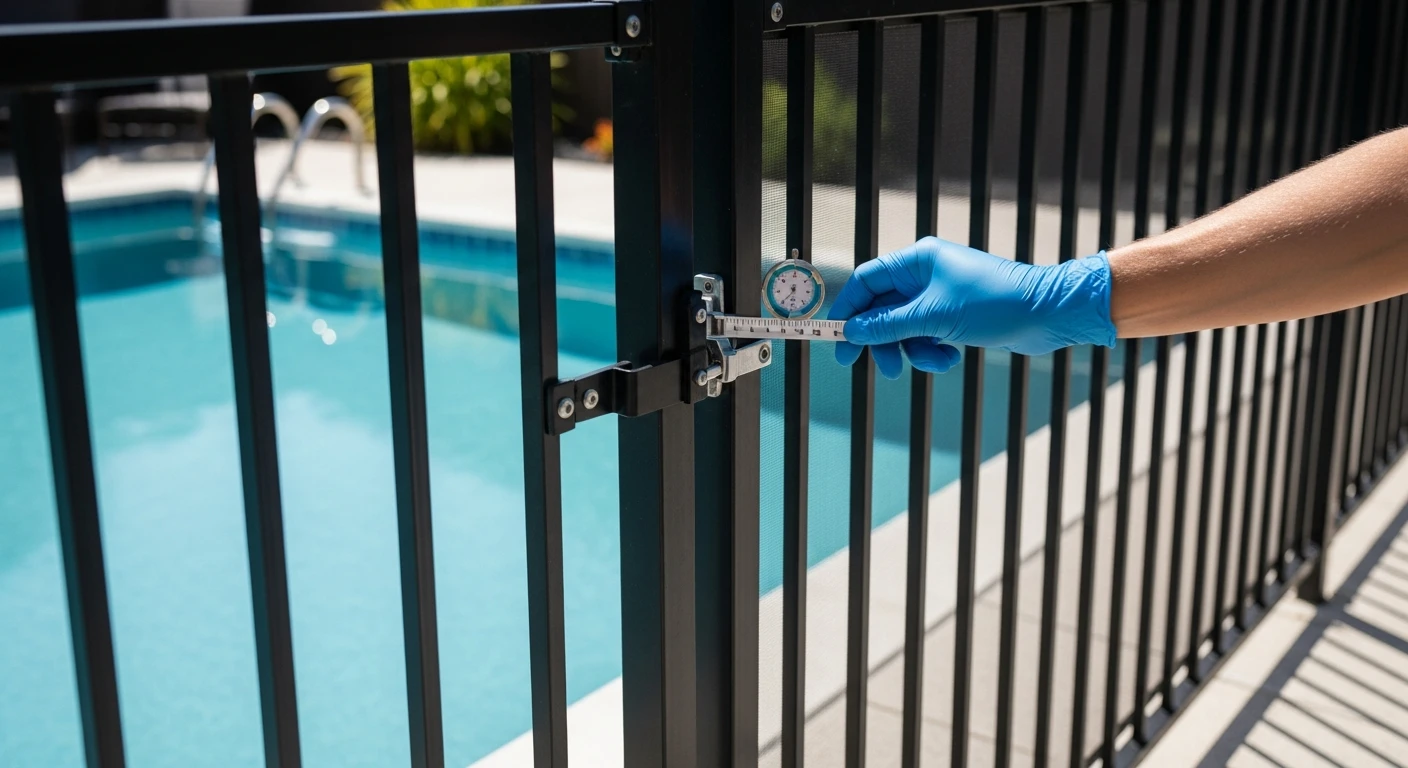
The core of my technical analysis is in the details. The state says a gate must be self-closing and self-latching, but here's where the expertise comes in. I don't just check if it closes; I measure the closing force and latch engagement speed. In Osceola's sandy soil, fence posts can shift almost imperceptibly over a few seasons, causing gate misalignment. This slight shift is enough to prevent the latch from fully engaging, creating a critical safety failure. Furthermore, the release mechanism for the latch must be at least 54 inches from the bottom of the gate. I frequently find latches in older Kissimmee homes that are an inch or two too low, an automatic failure. For the barrier itself, I use a 1/2 inch sphere test to ensure no opening in a fence is large enough for a small object—or child—to pass through.Pre-Inspection Protocol: A Step-by-Step Walkthrough
Before I even schedule a formal inspection, I advise my clients to perform this exact sequence. It mirrors my own on-site process and catches the most frequent failure points.- Gate Swing and Latch Test: Open the gate to its widest point and release it. Do not assist it. It must swing shut and latch securely on its own. Do this five times in a row. A single failure to latch indicates a problem with the closer's tension or hinge alignment.
- Hardware Corrosion Check: Examine every screw, hinge, and spring on your gate. If you see any rust, it’s a red flag. I recommend replacing them with marine-grade stainless steel hardware, a small investment that prevents future failures from our humid climate.
- Barrier Integrity Scan: Walk the entire perimeter of your pool fence. For screen enclosures, press gently on each panel to check for looseness. For wood or vinyl fences, look for any warping or gaps at the post connections that have widened over time.
- Door and Window Alarm Audit: Test every door and window that provides direct access to the pool area. Each must have an alarm that sounds within 7 seconds of being opened and is audible throughout the house. A common error is a dead battery or a faulty sensor, especially in high-traffic vacation properties.
Fine-Tuning for Compliance: Addressing Alarms and Entrapment Hazards
The final layer of my inspection addresses more complex systems. This is where I see DIY attempts cause significant issues. For example, all pool drain covers must be compliant with the Virginia Graeme Baker Pool & Spa Safety Act (VGB Act) to prevent suction entrapment. I physically check the model number and expiration date on the drain cover itself; they have a limited lifespan. For pools with a single main drain, I verify the installation and functionality of a Safety Vacuum Release System (SVRS) or an equivalent anti-entrapment device. A non-functional SVRS is an immediate and non-negotiable failure. This is not just a code requirement; it's a critical life-safety device that I have personally seen fail due to lack of maintenance. Given that your property must pass inspection to secure insurance or complete a sale, is your current pool barrier truly aligned with the mechanical realities of Osceola County's climate, or is it just visually compliant?Written by

Tags
pool safety fence
pool safety fence installation
swimming pool safety fence
pool safety nets
Pool Safety Inspections in Osceola FL FAQ
What is a pool safety inspection?
A pool safety inspection is a thorough examination of your swimming pool and its surroundings to identify potential hazards and ensure compliance with local regulations and safety standards. Our experienced inspectors will check for issues such as faulty fencing, inadequate drainage, and other safety concerns that could put you and your loved ones at risk.
Why is a pool safety inspection important?
A pool safety inspection is crucial to ensure the safety of everyone who uses your pool. Drowning is a leading cause of accidental death, and many cases could be prevented with proper safety measures in place. A pool safety inspection can help you identify potential hazards and take corrective action to prevent accidents and ensure a safe and enjoyable swimming experience.
What does a pool safety inspection entail?
Our pool safety inspections include a comprehensive assessment of your pool and its surroundings, including the pool area, fencing, gates, drainage, and equipment. We will also check for any hazards or defects that could pose a risk to pool users, such as loose tiles, rusty equipment, or inadequate lighting.
How often should I have a pool safety inspection?
We recommend having a pool safety inspection at least once a year, or more frequently if you have a pool that is heavily used. Additionally, you should also have an inspection conducted after any major renovations or changes to your pool or its surroundings.
What are the costs associated with a pool safety inspection?
The cost of a pool safety inspection varies depending on the location, size, and complexity of the pool. Our friendly customer service team will be happy to provide you with a quote for your specific needs.
What happens if my pool fails an inspection?
If your pool fails an inspection, we will provide you with a detailed report outlining the issues that need to be addressed. We can also help you develop a plan to correct the issues and ensure your pool meets all safety standards.
Can I schedule a pool safety inspection at a time that suits me?
Yes, we offer flexible scheduling to accommodate your needs. Simply contact us to schedule a time that works for you, and we will do our best to accommodate your request.
Do you offer pool safety inspections for commercial pools?
Yes, we offer pool safety inspections for commercial pools, including hotels, resorts, community centers, and other public facilities. Our experienced inspectors are trained to identify potential hazards and ensure compliance with local regulations.
Are your pool safety inspectors certified?
Yes, our pool safety inspectors are certified and experienced professionals who have undergone rigorous training to ensure they can identify potential hazards and recommend corrective actions.