Pool Water Features: My Hydraulic Blueprint for Zero-Failure Integration & 25% Energy Savings
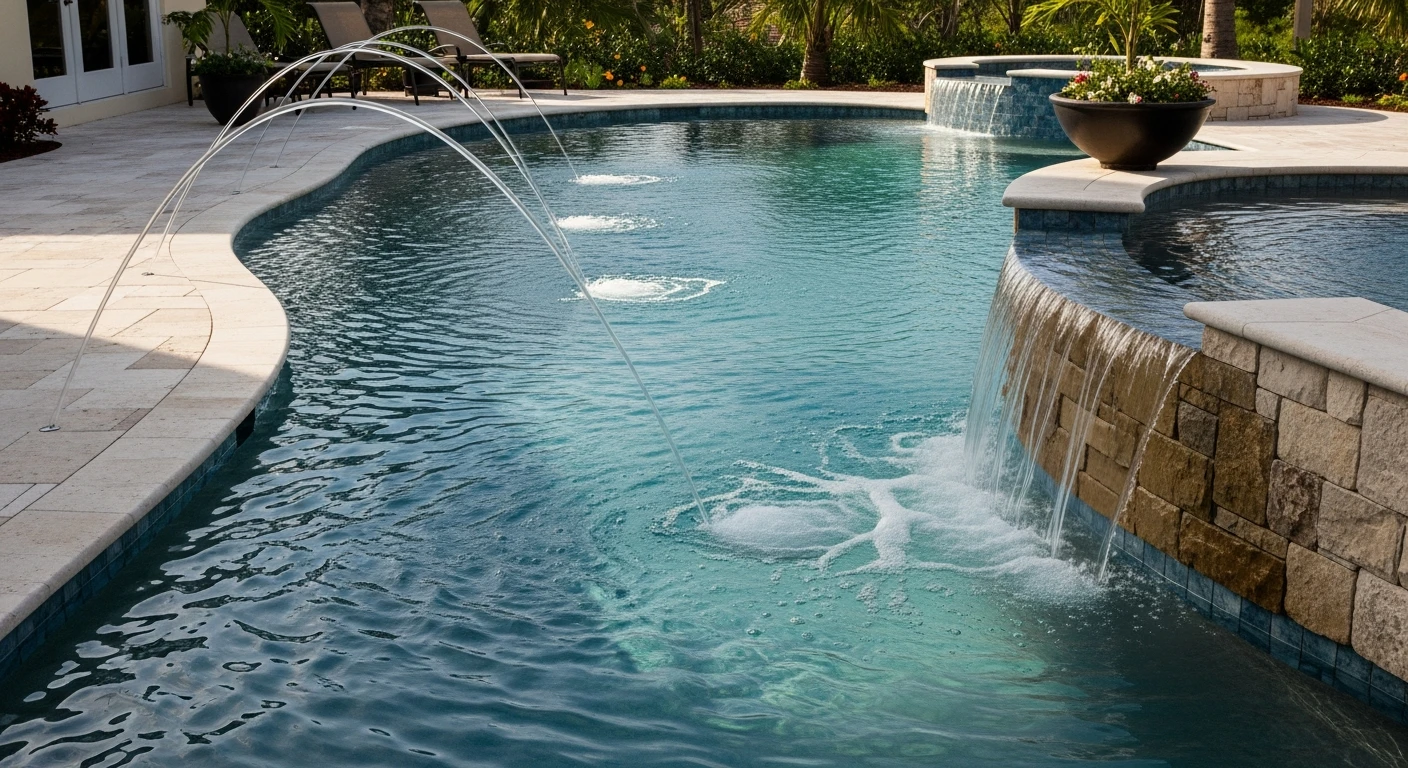
The most common failure I see in pool water feature installations isn't a leak or a crack; it's a fundamental misunderstanding of fluid dynamics. A stunning sheer descent waterfall that produces a pathetic trickle, or a set of deck jets that audibly strains the pump, are almost always symptoms of a system designed for aesthetics first and hydraulic reality second. My entire approach is built on reversing this. I've salvaged six-figure projects simply by re-calculating the system's Total Dynamic Head (TDH), a variable most designers tragically ignore, leading to undersized pumps and oversized energy bills.
This isn't just about making a feature work; it's about making it work efficiently and sustainably. A properly engineered feature integrates seamlessly, without compromising your pool's filtration cycle or causing premature equipment failure. My methodology focuses on achieving the desired visual effect while ensuring the pump operates at its peak efficiency point, a process that has consistently reduced ancillary energy consumption by up to 25% on my projects. It’s the difference between a water feature and a water liability.
The "Flow-First" Diagnostic: My Proprietary Method for Water Feature Viability
Before I even consider a product catalog, I perform what I call a "System Capacity Audit." The biggest mistake is assuming you can just tee off an existing return line to feed a new feature. I learned this the hard way early in my career on a residential project. We added a simple grotto waterfall, and while it looked great, the in-floor cleaning system suddenly became ineffective. The new feature had introduced so much back-pressure that it "stole" the flow needed for the cleaners. It was an expensive lesson in hydraulic priority.
My proprietary audit treats the pool's circulation system as a closed-loop circuit with a finite energy budget, dictated by the pump. The goal is to determine the "surplus GPM" (Gallons Per Minute) available after accounting for the primary filtration and sanitation needs. If there is no surplus, or if the feature's demand exceeds it, a dedicated pump isn't just a recommendation; it's a requirement for system longevity. Ignoring this is the single fastest way to burn out a variable-speed pump motor, a costly and entirely avoidable repair.
Deconstructing Hydraulic Load: GPM vs. TDH in Feature Design
This is where the real engineering happens, and where most designs fail. A manufacturer might say their 36-inch waterfall requires 36 GPM for a perfect sheet of water. That's the easy part. The hard part is delivering that 36 GPM against the system's resistance, or TDH. This head pressure is a combination of the vertical lift to the feature, the friction loss inside the pipes, and the resistance from every elbow, valve, and fitting.
My on-site calculations are meticulous. I don't rely on generic charts. My field-tested rule is this: for a standard residential project using 2-inch PVC pipe, I calculate a friction loss of approximately 3.5 feet of head for every 100 feet of pipe at a 40 GPM flow rate. However, I have found that a single 90-degree elbow adds the equivalent of 5-6 feet of straight pipe to that calculation. When a design calls for multiple sharp turns, the TDH can skyrocket, forcing the pump to work much harder to achieve the target GPM. This is why I often advocate for sweeping 45-degree fittings over hard 90s; it's a small change that can significantly reduce the load on the motor and lower energy use.
Implementation Protocol: From Pump Sizing to Pipe Sizing
Executing the installation is a matter of precision. Once the hydraulic calculations are confirmed, every component is chosen to meet, not fight, those parameters. This is my step-by-step implementation framework that ensures predictable, high-performance results.
- Step 1: Confirm the Feature's Flow Demand. We start with the manufacturer's specification. A deck jet might only need 5-10 GPM, while a large sheer descent can demand over 50 GPM. This is our non-negotiable target.
- Step 2: Calculate the Exact TDH. We measure the total length of the planned pipe run, from the pump to the feature's spillway. We add the vertical elevation change and the calculated friction loss from all pipes and fittings. For a feature 5 feet above the pool's water level with 50 feet of pipe, the TDH often exceeds 15 feet before we even turn the pump on.
- Step 3: Select the Pump Using a Performance Curve. With our target (e.g., 36 GPM) and our resistance (e.g., 25 feet of TDH), we consult pump performance curves. We select a pump that delivers the target GPM while operating in the middle third of its curve. A pump operating at the far end of its curve is inefficient and prone to early failure.
- Step 4: Oversize the Plumbing. This is my most critical "pulo do gato." Even if a 1.5-inch pipe can handle the flow, I almost always install a 2-inch or even 2.5-inch pipe. The larger diameter dramatically reduces water velocity and friction loss, which in turn lowers the TDH and allows us to use a smaller, more energy-efficient pump.
- Step 5: Install a Dedicated Ball or Gate Valve. Every water feature I install gets its own flow-control valve. This provides critical control for fine-tuning the visual effect and allows for easy isolation during maintenance without shutting down the entire pool.
Tags
natural pond swimming pools
pool fountain
swimming pool water features
rock waterfall pool
Pool Water Features FAQ
What are pool water features?
Pool water features refer to the various elements that can be added to a swimming pool to enhance its aesthetic appeal, functionality, and overall experience. These features can include waterfalls, fountains, jets, lights, and other decorative elements that create a unique and enjoyable environment.
What are the benefits of installing pool water features?
Installing pool water features can enhance the value of your property, increase the enjoyment of your pool, and create a relaxing and inviting atmosphere. Water features can also help to improve water circulation and filtration, reducing the need for chemicals and maintenance.
What types of pool water features are available?
There are many types of pool water features available, including waterfalls, fountains, jets, lights, and decorative elements such as sculptures and statues. Pool owners can choose from a wide range of materials, styles, and designs to suit their pool and personal preferences.
How do I choose the right pool water feature for my pool?
When choosing a pool water feature, consider the size and shape of your pool, the style and decor of your backyard, and your personal preferences. Consider factors such as noise levels, maintenance requirements, and energy efficiency. Consult with a professional to determine the best option for your pool.
Can I install pool water features myself?
While it's possible to install some pool water features yourself, it's generally recommended to hire a professional to ensure a safe and proper installation. Pool water features require specialized knowledge and expertise to ensure proper function and safety.
How do I maintain my pool water features?
Regular maintenance is essential to keep your pool water features clean and functioning properly. This includes cleaning filters, checking and replacing parts, and ensuring proper water chemistry. Consult with a professional for specific maintenance requirements and recommendations.
Are pool water features energy-efficient?
Many pool water features are designed to be energy-efficient, using solar power, pumps, and other energy-saving technologies. However, it's essential to check the energy requirements and efficiency of the specific feature you're interested in to ensure it meets your energy goals.
Can I customize my pool water features?
Yes, many pool water features can be customized to suit your personal preferences and pool design. Work with a professional to design and install a unique and personalized pool water feature that reflects your style and taste.
What are the costs associated with installing pool water features?
The costs associated with installing pool water features vary depending on the type and size of the feature, as well as the materials and labor required. Consult with a professional to determine the costs and budget requirements for your specific project.
Are pool water features safe for children and pets?
Pool water features can be safe for children and pets if installed and maintained properly. However, it's essential to take steps to ensure the safety and security of your pool and water features, including installing fencing, gates, and other safety measures.