Cost to Build Outdoor Kitchen in Collier County: A Framework for Eliminating 90% of Weather-Related Rework
The first question I always get is about the bottom-line cost. In Collier County, a properly constructed outdoor kitchen can range from $15,000 for a modest, high-quality setup to well over $100,000 for a comprehensive culinary space in a Port Royal or Pelican Bay estate. However, I’ve learned that the initial investment is not the true cost. The real financial drain comes from rework due to material failure caused by our unique coastal environment: the relentless sun, high humidity, and corrosive salt air. My entire approach is built on a single principle: front-loading the investment in the structure to prevent catastrophic failure down the line. I’ve been called to far too many projects in Naples and Marco Island where beautiful granite has cracked or stainless steel appliances have rusted in under three years. This happens because the builder focused on the cosmetic "wow" factor instead of the non-negotiable structural foundation required for our climate. The cost isn't in the grill; it's in what the grill is sitting on.My Diagnostic Method: The Coastal Resilience Framework
Before I even discuss appliances or countertops, I perform a site-specific analysis that I call the **Coastal Resilience Framework**. This isn't just about measuring space; it's a diagnostic of environmental stressors. The most common error I see is using standard construction materials like pressure-treated wood framing or basic 304-grade stainless steel. These materials simply do not survive here. The humidity causes wood to swell and rot from the inside out, and the salt spray from the Gulf will pit and corrode inferior steel in a matter of seasons. My methodology focuses on three core pillars: the foundation, the framing, and the enclosure. For the foundation, a simple concrete slab is insufficient, especially in areas with shifting sandy soil. For the framing, I have a zero-wood policy. It’s a point of failure waiting to happen. Finally, every single component, down to the screws and fasteners, must be evaluated for its **corrosion resistance rating**. This granular focus is what separates a 5-year kitchen from a 25-year investment.Technical Deep Dive: Material Selection and Structural Integrity
To truly understand cost, you have to understand the materials. Here’s a breakdown of my non-negotiable specifications for a Collier County build:- Framing Material: I exclusively use either welded aluminum tube (6061-T6 grade) or concrete block (CMU) construction. While more expensive upfront than steel studs or wood, aluminum is lightweight, completely waterproof, and impervious to rust. CMU is a fortress, offering incredible durability and a great base for heavy stone finishes.
- Countertop Selection: I steer clients away from porous stones like basic granite. The humidity can cause moisture to get trapped, leading to staining and mold. My recommendation is often **sintered stone (like Dekton) or high-density non-porous quartzite**. These materials have near-zero water absorption and extremely high UV resistance, so the intense Florida sun won't fade them.
- Hardware and Fasteners: This is a detail that sinks projects. Every screw, hinge, and drawer slide must be **316L marine-grade stainless steel**. This specific low-carbon alloy has enhanced resistance to chloride corrosion, making it essential for our coastal environment. Using anything less is planned obsolescence.
Implementation Protocol: A Step-by-Step Breakdown
Executing the build requires a precise sequence of operations. Skipping or reordering these steps is where budget overruns and long-term failures originate. This is my field-tested process.- Permitting and Wind Load Compliance: The first action is engineering approval. In Collier County, any permanent structure must adhere to stringent hurricane wind load codes. We must ensure the design can withstand 150+ mph wind speeds, which dictates the depth of the footers and the method of anchoring the structure.
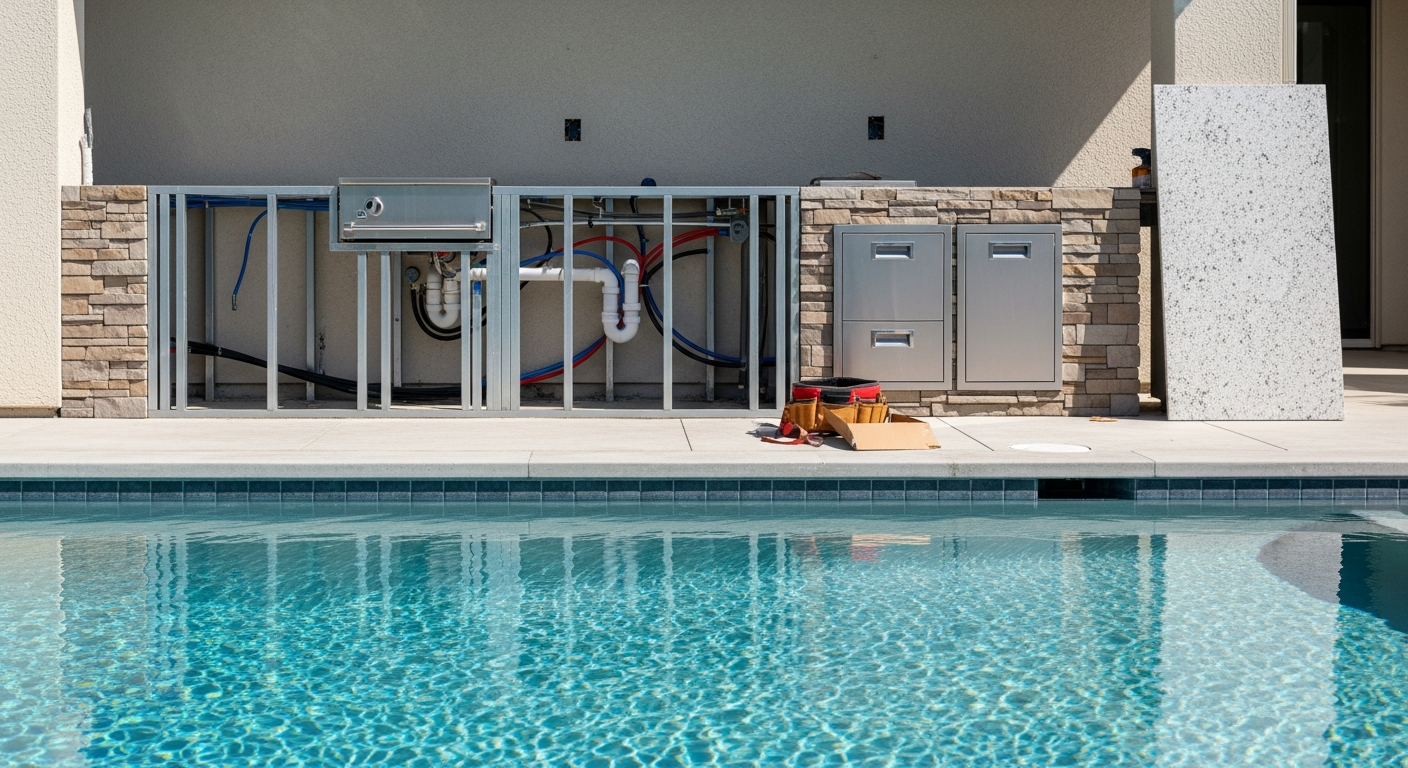
- Foundation and Utility Rough-In: We pour a **monolithic concrete slab with integrated footers**, not a simple floating pad. All plumbing (gas, water, drainage) and electrical conduits are laid within the pour. Using flexible PEX-A for water lines is critical to accommodate minor slab shifts over time.
- Core Structure Assembly: This is where we erect the CMU block or weld the aluminum frame. Every connection is squared and leveled with laser precision. This is the skeleton; any imperfection here will be magnified in the finished product.
- Appliance and Cabinet Integration: We install only appliances with a confirmed **316L stainless steel rating**. I also install weatherproof electrical boxes with GFCI outlets and ensure all gas connections are leak-tested with a digital manometer to a pressure of 1.5 times the working pressure.
- Cladding and Countertop Installation: The final exterior finish is applied, whether it's stucco, stone veneer, or tile. Countertops are installed using a specialized outdoor-rated epoxy adhesive, not standard silicone, which will degrade under UV exposure.
Precision Tuning and Quality Assurance Standards
Once the main build is complete, I move to what I call the precision phase. This is where a good kitchen becomes exceptional. One of my key metrics is **ventilation efficiency**. An outdoor grill hood needs to handle a much higher CFM (Cubic Feet per Minute) than an indoor one due to crosswinds. I calculate the required CFM based on the grill's total BTU output and the property's prevailing wind direction to prevent smoke from overwhelming the seating area. Another critical check is the **water runoff test**. I flood the countertops and patio area with a hose to simulate a heavy Naples downpour. I am looking for any areas of standing water, which indicate an improper slope. Proper drainage is not a luxury; it's essential for preventing water damage to the base of the structure and the surrounding decking. My final quality check involves inspecting every single grout line and seam, ensuring they are perfectly sealed with a **silane-based penetrating sealer** to block moisture intrusion. Have you calculated the necessary CFM for your grill's BTU rating to ensure proper ventilation against prevailing coastal winds?Written by

Tags
low cost outdoor kitchen
outdoor kitchen budget
backyard kitchen cost
outdoor kitchen estimate
outdoor kitchen price range