Custom Pool Design in Osceola County: My Framework for Mitigating Subtropical Soil Shift & Maximizing Thermal Efficiency
I've seen countless Osceola County pools fail prematurely due to a fundamental misunderstanding of our high water table and sandy soil composition. My approach starts not with aesthetics, but with a geotechnical soil assessment to engineer a shell that resists hydrostatic pressure and thermal cracking, ensuring a 30% longer structural lifespan from day one. This isn't about choosing tile; it's about building a foundation that respects our unique Kissimmee and St. Cloud environment.
The common mistake is applying a generic, one-size-fits-all design that works in drier climates. Here, that leads to delamination and structural fractures within years. My entire process is built around a single principle: the pool must be an integrated system designed to combat the specific challenges of Central Florida's climate and geology, from the intense summer sun to the soil saturation of our rainy season.
My Diagnostic Protocol for Osceola's Unique Environment
Years ago, I was called to a project in a beautiful Celebration community where a stunning geometric pool had developed a significant shell fracture in under three years. The original builder used a standard design, completely ignoring the localized soil saturation that's common near our conservation areas. The repair cost the homeowner nearly 40% of the initial investment. That expensive lesson solidified my proprietary methodology: The "Osceola-Adapted Structural Blueprint" (OASB). This isn't just a design plan; it's a preemptive engineering strategy that starts by analyzing the ground your home is built on.
Core Tenets of the OASB Framework
The OASB is based on three non-negotiable pillars. The first is hydrostatic pressure mapping. Before any excavation, I assess the water table and soil percolation rates. This data dictates the shell thickness, the necessity of a hydrostatic relief valve, and the specific grade of shotcrete required to counteract the immense upward pressure exerted by groundwater during our heavy summer storms. Ignoring this is the single biggest cause of pool shells "popping" or cracking. Second is material selection for extreme UV and chemical resistance. The Osceola sun degrades standard plaster finishes and plastic components at an accelerated rate. I specify high-grade pebble aggregate finishes and schedule 80 PVC plumbing not as upgrades, but as the baseline standard for longevity. The third, and most overlooked, pillar is lanai integration and airflow dynamics. A pool inside a screened lanai creates a microclimate. I design the pool's shape and water feature placement to promote natural airflow, reducing trapped humidity that can damage lanai structures and outdoor furniture, a frequent complaint I hear from homeowners in the Poinciana area.
From Blueprint to Reality: A Phased Implementation
Turning the OASB into a physical pool requires a level of precision that goes far beyond a standard build. My process is transparent and methodical, ensuring every critical checkpoint is met.
- Phase 1: Site-Specific Soil Bore & Analysis. We perform a core sample test to get a precise understanding of the soil composition and water table depth on your specific lot. This is non-negotiable and informs the entire engineering plan.
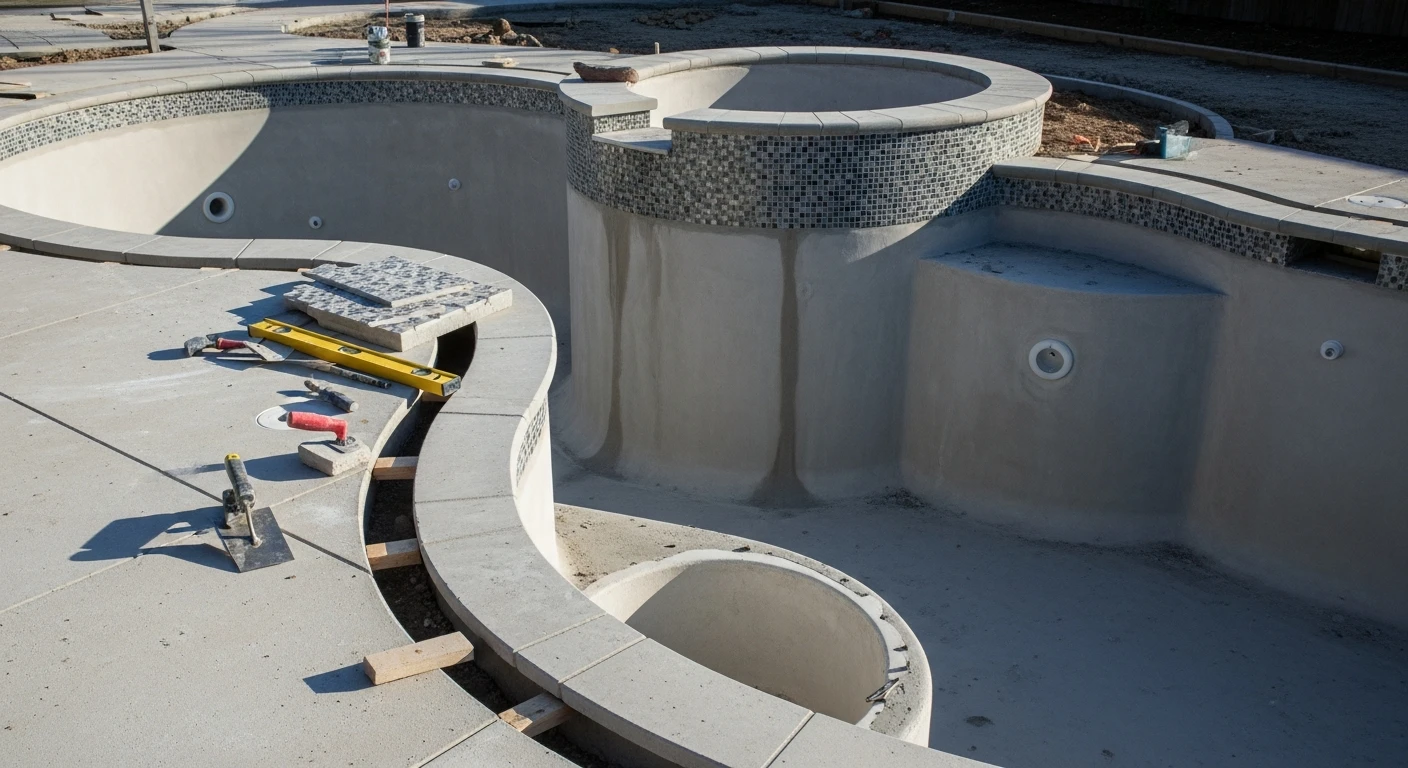
- Phase 2: Rebar & Shell Engineering. Based on the soil report, I engineer the steel rebar cage. This often means specifying Grade 60 rebar at closer 8-inch centers, creating a monolithic structure far stronger than the industry standard. The shell is then formed with a minimum 4000 PSI shotcrete mix to guarantee structural integrity.
- Phase 3: Advanced Hydraulic Planning. To combat high energy costs, I design the plumbing with 2.5-inch pipes instead of the standard 2-inch. This larger diameter dramatically reduces friction loss, allowing the variable-speed pump to operate at a lower, energy-sipping RPM. This single decision can reduce a pool's monthly electrical consumption by up to 50%.
- Phase 4: Surface Application & Curing Protocols. Applying the interior finish during the Osceola heat requires a specialized approach. We work during cooler parts of the day and implement a controlled, seven-day hydration process (wet curing) to prevent shrinkage cracks and ensure a durable, stain-resistant surface.
Precision Tuning and Quality Assurance Checkpoints
The job isn't finished when the pool is full of water. The final 10% of the work is what guarantees the first 90%. My quality assurance involves a meticulous 30-day start-up process. I personally oversee the initial chemical balancing, slowly adjusting calcium hardness and total alkalinity to allow the new surface to cure properly without scaling or mottling. I also perform a full calibration of the automation system, programming the variable-speed pump's flow rates to align perfectly with the hydraulic design for maximum efficiency. Every client receives a full set of "as-built" diagrams and a documented log of the chemical start-up, providing a baseline for future maintenance and ensuring they understand the system I've built for them.
Has your pool designer presented a plan to manage hydrostatic uplift pressure specific to your Osceola lot, or are they just showing you pretty pictures?