Install Pavers Pinellas County: My Method for a 30-Year Lifespan in Florida's Sandy Soil
If you're looking to install pavers in Pinellas County, the standard advice you find online is actively detrimental to your project. The single greatest point of failure I encounter, from waterfront properties in Clearwater to historic bungalows in Kenwood, is a paver base that collapses under the stress of our torrential summer downpours and high water table. My entire methodology is built around preventing this catastrophic and costly failure before a single paver is laid. My process rejects the common 4-inch gravel base and instead mandates a minimum 8-inch crushed concrete base, compacted in separate lifts, over a non-woven geotextile fabric barrier. This combination creates a stable, water-permeable foundation that resists the unique hydrostatic pressure of our local soil, guaranteeing you won't see sinking or shifting pavers for decades. This isn't an upgrade; for Pinellas County, it's the only correct way to do the job.My Pre-Installation Soil Drainage Audit for Pinellas Homes
Before I even quote a project, I perform a mandatory soil and drainage assessment. I once had to completely tear out and redo a beautiful travertine pool deck in a Dunedin home because the previous installer treated our sandy, low-lying ground like it was solid clay. They saved a few hundred dollars on the base, and it cost the homeowner over $15,000 to fix just two years later. My audit focuses on three critical, non-negotiable factors specific to our area.The Core Components of a Sink-Proof Paver Base
The success of any paver project in Pinellas is determined entirely by what you can't see. The base is everything. My proprietary system relies on a specific sequence and material choice. First, the geotextile fabric is laid directly on the graded sub-soil. This fabric is critical; it separates the sandy soil from your aggregate base, preventing the sand from migrating upwards and the base from sinking downwards over time. Second, I use FDOT-certified crushed concrete, not limestone. Crushed concrete has angular, interlocking properties that provide superior stability once compacted, a vital feature for our unstable soil. Lastly, the compaction itself is a science. Each 4-inch layer, or "lift," of the base must be compacted to a minimum of 95% Proctor density. Anything less, and you're building in a future failure.The 5 Critical Stages of a Pinellas-Proof Paver Installation
Executing a paver installation that can withstand Florida's climate requires a level of precision that most installers skip. I've refined my process over hundreds of local projects to eliminate common failure points.- Stage 1: Excavation and Grading. I excavate deeper than standard practice, typically 10-12 inches, to accommodate the robust base. The area is then precisely graded with a minimum 2% slope away from any structures to manage surface water runoff during our heavy rains.
- Stage 2: Geotextile and Base Installation. The geotextile fabric is laid down, followed by the first 4-inch lift of crushed concrete. This layer is wetted and compacted with a heavy-duty plate compactor until it's unyielding. The process is repeated for the second lift.
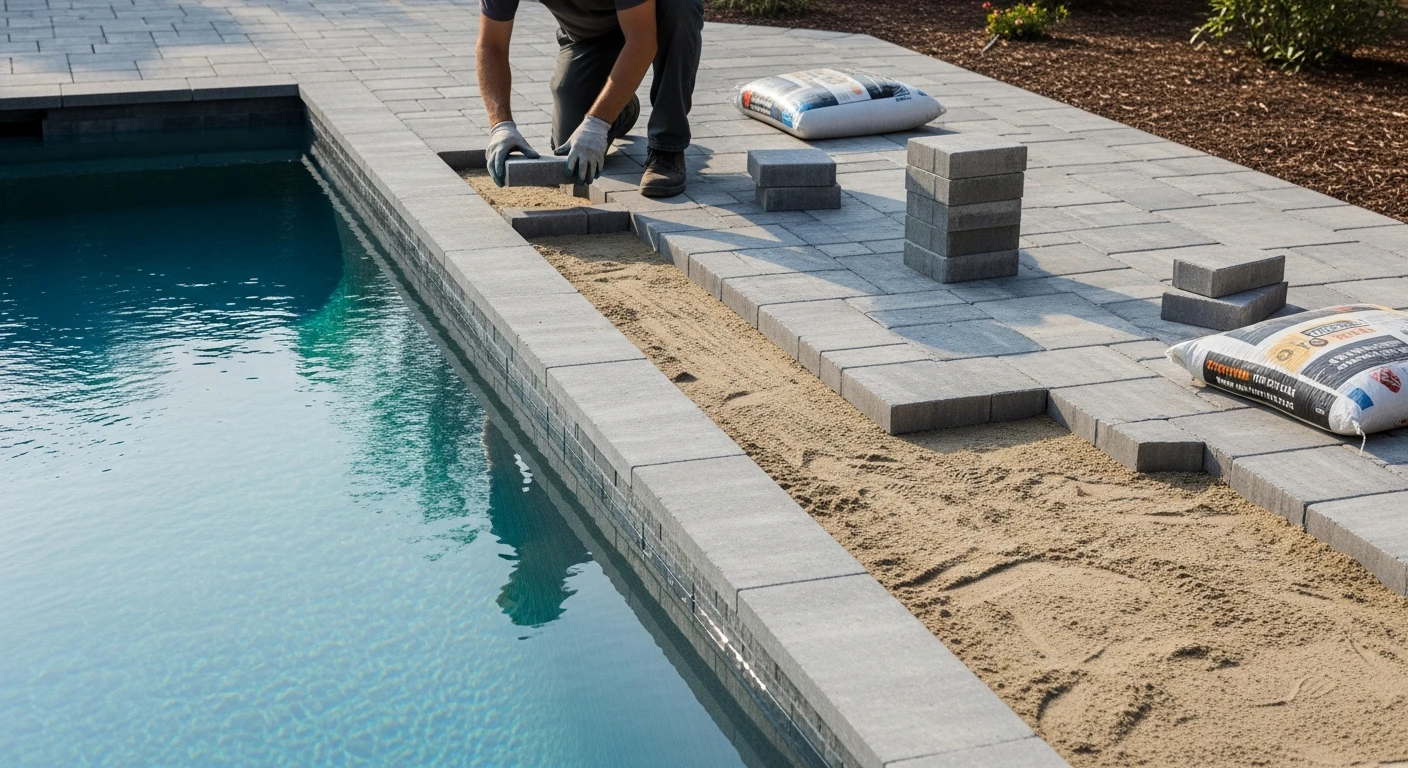
- Stage 3: Bedding Sand. A uniform 1-inch layer of concrete sand is screeded perfectly level. This is the bedding layer the pavers will sit on. Using the wrong type or depth of sand is a common mistake that leads to wobbly pavers.
- Stage 4: Paver Laying and Edge Restraints. Pavers are laid in the desired pattern, and concrete or high-grade plastic edge restraints are installed immediately. These are anchored with 12-inch steel spikes to prevent any lateral movement of the entire paver field.
- Stage 5: Joint Sand and Final Compaction. The final, and arguably most important, step. We sweep in the jointing sand and then run the plate compactor over the pavers (with a protective mat) to lock them together.
Post-Installation Checks: Joint Sand Stabilization and Sealing Against Salt Air
After the initial installation, the job isn't done. The joints are the weak point. I exclusively use high-quality polymeric sand. When activated with a light mist of water, it hardens to form a durable, flexible joint that prevents weed growth and insect intrusion. For homes near the coast, like in St. Pete Beach or Tarpon Springs, I strongly recommend a two-coat application of a silane-siloxane-based sealant. This penetrates the paver to create a barrier against salt air degradation and efflorescence, which can ruin the appearance of your investment. This step alone can increase the paver's aesthetic lifespan by 50%. Are you confident your current paver plan accounts for the hydrostatic pressure from Pinellas County's water table after a 3-inch downpour?Written by

Tags
concrete paver installers near me
paver installers in my area
paving stone installation near me
patio paver installers in my area
paver work near me