
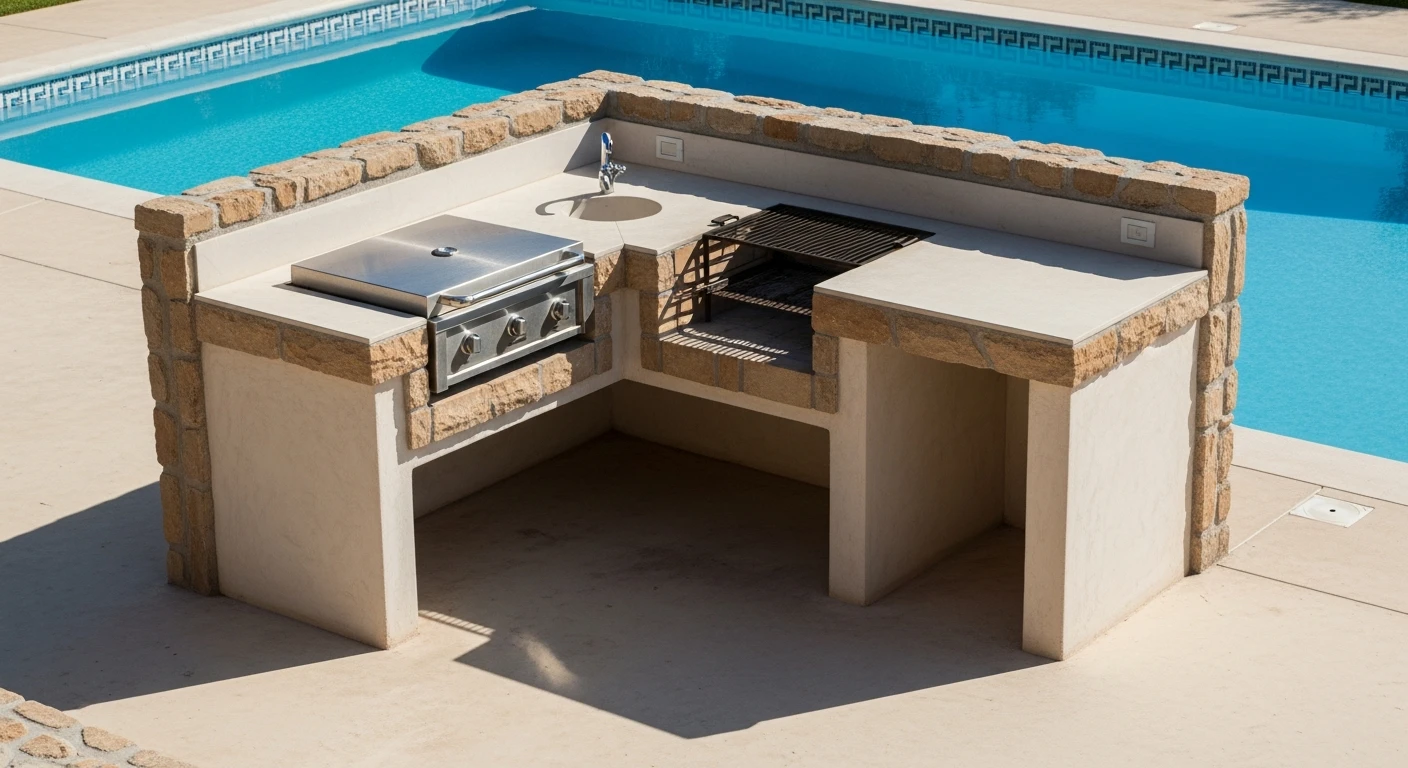
L-Shaped BBQ Island: A Material Protocol for 30-Year Durability in Pinellas County's Salt Air
My biggest learning curve when I started designing outdoor kitchens in Pinellas County wasn't the layout; it was the materials. I saw a gorgeous, expensive L-shaped BBQ island on a waterfront property in St. Pete Beach fail in under five years. The stone veneer was perfect, the granite top was pristine, but the internal frame, made of standard galvanized steel, had disintegrated from the inside out due to the relentless salt spray. That project's failure became the foundation of my material-first methodology. The common approach is to focus on the grill and the countertop aesthetics. I reverse that. For any project from Clearwater to the bayous of Tarpon Springs, my initial analysis focuses on the structural materials' ability to resist chloride-induced corrosion. The secret to an L-shaped island that lasts for decades here isn't the brand of your grill; it's specifying a frame made of either welded 6061-T6 aluminum alloy or, for maximum resilience, 316L marine-grade stainless steel. This simple, upfront decision adds maybe 15-20% to the frame cost but increases the structural lifespan by over 500% in our coastal environment.My Diagnostic Framework for Coastal Outdoor Kitchens
Before I even sketch a design, I perform what I call a Micro-Climate Assessment on the property. An L-shaped island for a home in an inland Seminole neighborhood has different exposure variables than one on a lanai in Dunedin overlooking St. Joseph Sound. My assessment scores three critical factors: proximity to saltwater, direct afternoon sun exposure (UV degradation on polymers and sealants), and prevailing wind direction, which dictates how salt and moisture are carried and deposited. This yields a Corrosion-Vulnerability Index (CVI) that dictates the minimum material specifications.Frame Material Science: Why Standard Galvanized Steel Fails
I learned the hard way that "outdoor-rated" doesn't mean "Pinellas-rated." Standard galvanized steel studs, the go-to for many builders, rely on a zinc coating. In most places, this is fine. But here, the chloride ions from the salt air actively attack and strip that zinc coating, a process called dezincification. Once the coating is compromised at a single screw point or cut edge, rust begins, and the frame's load-bearing capacity is compromised. This is why I exclusively use 316L stainless steel, which contains molybdenum, or welded aluminum. These materials form a passive oxidation layer that self-heals, making them fundamentally inert to the salt-rich humidity that defines our climate.The Blueprint: From Foundation to First Sear
Building a structurally sound L-shaped BBQ island that respects the unique challenges of Pinellas County follows a precise sequence. Deviating from it is how you get callbacks and premature failures.- Foundation & Footings: Our sandy soil requires more than a simple concrete slab. I always specify 18-inch deep concrete footers with #4 rebar reinforcement at the perimeter of the island's footprint. This prevents the settling and cracking I often see in projects built on insufficiently prepared ground.
- Frame Assembly & Welding: The frame must be constructed with either TIG or MIG welds, not just screws. Every screw penetration is a potential point for water intrusion and corrosion. I mandate that all joints be fully welded to create a monolithic, sealed structure.
- Cladding and Countertop Selection: I steer clients away from porous materials like travertine, which can spall and hold salt. Instead, I recommend dense, non-porous quartzite or a high-grade, sealed granite. The countertop installation is critical; a polyurethane-based construction adhesive is used instead of a standard mortar to accommodate thermal expansion and prevent cracking.
- Appliance and Ventilation Integration: This is a common failure point. I've seen expensive grills overheat because of improper ventilation. My standard is to install a minimum of two vents per enclosed cabinet bay, creating a cross-ventilation channel. All appliance cutouts are measured to a 1/8-inch tolerance and sealed with high-temperature silicone.
Precision Adjustments and Quality Standards
The difference between a good build and a great one is in the details. For the seating overhang on the "L" portion, I never allow a cantilever of more than 10 inches on a 3cm stone slab without installing hidden steel support brackets tied directly to the frame. This prevents stress fractures over time. Furthermore, every electrical outlet installed is a GFCI-protected, marine-grade twist-lock receptacle housed in a "bubble" cover. It’s a small detail that prevents the constant tripping and corrosion issues common in standard outdoor outlets exposed to our humidity. Now that you're specifying marine-grade materials for the frame, have you considered how the different thermal expansion rates between your 316L steel frame and your chosen quartzite countertop will be managed to prevent shear stress and cracking during a Florida summer heatwave?Written by

Tags
l shaped outdoor bbq
l shaped outdoor bbq island
l shaped outdoor kitchen layout
l shaped outdoor kitchen with pizza oven
l shaped outdoor kitchen with pergola


