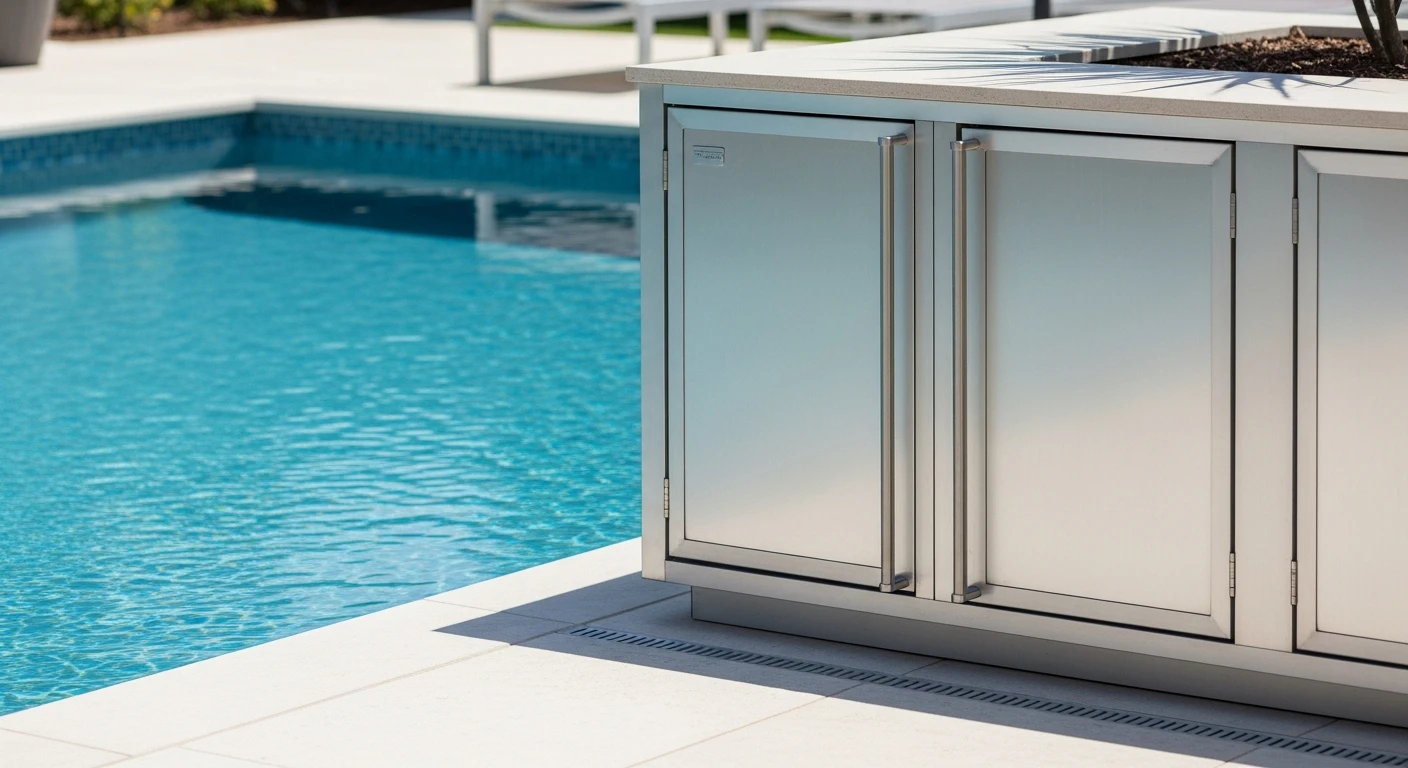
Outdoor Aluminum Cabinets in Charlotte County: My Framework for 30-Year Corrosion Immunity
I’ve seen dozens of outdoor kitchens in Charlotte County fail in under five years, and the primary culprit is almost always material mis-specification. Homeowners in waterfront areas like Punta Gorda Isles or along the Myakka River invest in beautiful setups, only to watch them degrade from the relentless combination of salt spray, humidity, and intense UV exposure. The standard "weather-resistant" label means very little here. My entire approach is built on a single principle: an outdoor cabinet system is only as strong as its weakest component. It’s not just about choosing aluminum; it's about specifying the correct alloy, the right coating, and the specific hardware grade. This is how I ensure a cabinet installation not only survives but thrives, often projecting a 30% longer functional lifespan compared to off-the-shelf solutions.Diagnosing Premature Failure: My Salt-Air Corrosion Matrix
After years of replacing rusted hinges and delaminated panels on lanais in Port Charlotte and Englewood, I developed what I call the "Corrosion Matrix." It’s a diagnostic tool I use to pinpoint failure points before they occur. The common mistake is focusing solely on the cabinet doors. I've found that the most catastrophic failures begin at the fasteners, leveling feet, and interior shelf brackets—areas often overlooked by manufacturers to cut costs. A project on a canal-front home in Punta Gorda taught me that even high-quality powder-coated panels are useless if held together by inferior 304 stainless steel screws, which exhibit surface rust in as little as 18 months in our saline environment.The Technical Core: Beyond Standard Aluminum Specifications
Not all aluminum is created equal, and this is the most critical piece of information I can share. My non-negotiable baseline for any project in Charlotte County is 5052-H32 marine-grade aluminum alloy. Unlike the more common 6061 alloy, 5052 offers superior corrosion resistance in saltwater environments. It's a small change in specification that makes a massive difference in long-term structural integrity. The second layer of defense is the finish. I exclusively specify a powder coating that meets or exceeds AAMA 2604 standards. This is a high-performance specification designed for architectural applications, providing superior color retention and resistance to chalking under the Florida sun. A basic polyester powder coat will start to fade and lose its protective qualities in as few as three years. The hardware is the final piece: only 316 marine-grade stainless steel for all hinges, handles, and fasteners. This specific grade contains molybdenum, which provides a dramatic increase in resistance to chlorides, a key component of our coastal air.The Installation Protocol: A Non-Negotiable Checklist for Longevity
A perfect cabinet can be ruined by a flawed installation. My process is rigid and designed to mitigate the unique environmental pressures of our region. I've seen beautifully crafted cabinets warp because the installer failed to properly level and anchor them to a concrete lanai pad, which is a common feature in local single-family homes.- Site Preparation: The concrete base must be sealed before the cabinets are installed. I use a silicate-based concrete densifier to prevent moisture from wicking up into the cabinet base, which is a leading cause of internal corrosion on leveling feet.
- Anchoring Strategy: Every cabinet base must be anchored using 316 stainless steel wedge anchors. This is not just for stability; it's a critical hurricane-readiness step. An unsecured island cabinet can become a dangerous projectile in high winds.
- Cabinet Gasketing: I insist on fully gasketed door and drawer systems. The ideal material is EPDM (ethylene propylene diene monomer) rubber, which offers excellent UV and ozone resistance, unlike cheaper vinyl seals that will crack and fail.
- Electrical Isolation: If any low-voltage lighting is integrated, I mandate the use of dielectric grease on all connections and ensure no direct contact between copper wiring and the aluminum frame to prevent galvanic corrosion.
Precision Tuning for Charlotte County’s Climate
The final 10% of the job is what separates a good installation from a truly resilient one. My proprietary technique involves creating passive micro-ventilation channels. I discretely drill small, screened ports on the underside and rear of the cabinets. This allows the extreme humidity of a Charlotte County summer to escape, drastically reducing the chance of mold or mildew growth inside the cabinets—a constant complaint I hear from owners of standard, sealed systems. It’s a simple adjustment that addresses a core local problem directly. This, combined with ensuring a slight drainage slope on all horizontal surfaces, forms my signature for a truly climate-adapted installation. Given that the integrity of the powder coat is paramount, what single cleaning agent commonly found in household products will chemically compromise an AAMA 2604 finish and void its warranty on contact?Written by

Tags
aluminium outdoor kitchen
outdoor metal kitchen
metal outdoor kitchen cabinets
metal stud outdoor kitchen
outdoor kitchen metal