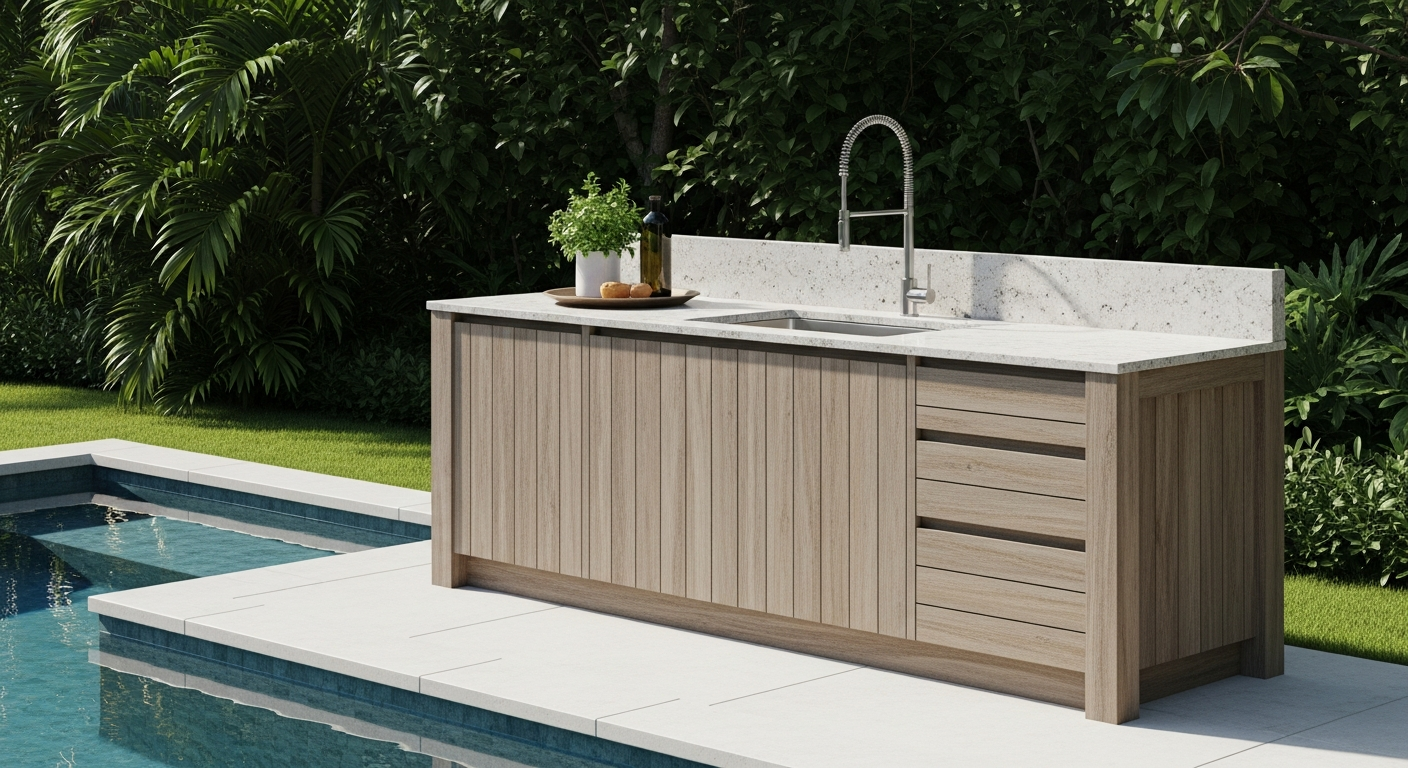
Outdoor Island with Sink: My Framework for 30-Year Durability in Lee County's Climate
After correcting dozens of failing outdoor kitchens across Lee County, from waterfront properties in Cape Coral to sprawling estates in Fort Myers, I’ve pinpointed the exact failure points. The combination of intense UV exposure, high humidity, and salt-laden air creates a uniquely corrosive environment that standard construction methods simply cannot withstand. My approach isn't about just building an outdoor island; it’s about engineering a permanent outdoor fixture designed to resist the specific environmental stressors of Southwest Florida. Most contractors overlook the subtle but critical interactions between materials and our climate. They’ll install a beautiful granite countertop on a standard concrete block base, only for the grout to fail and the internal structure to degrade from moisture intrusion within three to five years. My methodology focuses on creating a completely sealed, non-porous system from the ground up, ensuring a functional lifespan that I measure in decades, not seasons.My Diagnostic Protocol for Lee County's Corrosive Environment
Before a single drawing is made, I perform a site-specific environmental assessment. A project on Sanibel Island requires a vastly different material and sealing strategy than one in a more inland Lehigh Acres home. My analysis isn't a simple walkthrough; it's a technical audit. I identified that the primary failure cascade begins with water intrusion, so my entire process is built around creating a waterproof vessel. My proprietary methodology consists of evaluating three critical variables: moisture saturation, UV degradation, and galvanic corrosion potential. This initial diagnosis dictates the entire material selection and construction process, preventing the costly repairs I'm so often called in to fix.The Material Science Behind a Weatherproof Sink Island
The secret to longevity isn't just using "good" materials; it's using the *right* materials in the *right combination*. A common error I see is pairing a stainless steel sink with brass fittings without proper dielectric unions, which immediately creates a battery effect and accelerates corrosion—a process called galvanic corrosion. For Lee County, my non-negotiable material stack is very specific. For countertops, I move clients away from porous natural stones toward sintered stone like Dekton, which has near-zero porosity and is impervious to UV fading. For the sink itself, I specify only 316L marine-grade stainless steel, which has a higher molybdenum content for superior chloride resistance compared to the standard 304 grade. The island’s structure must be either a poured concrete form reinforced with fiberglass rebar (which doesn't rust) or a welded frame made from 6061-T6 aluminum alloy, fully sealed with a marine-grade powder coat.Step-by-Step Implementation for a Fail-Proof Foundation and Plumbing
A beautiful island on a cracked or settled foundation is a complete failure. The sandy, shifting soil in much of Lee County demands a more robust approach than a simple concrete pad. Likewise, the plumbing must be designed to handle intense rain and prevent backflow.Foundation and Structural Build
- Site Excavation: I mandate digging 6 inches deeper than the final slab depth to create a compacted gravel sub-base, which drastically improves drainage and stability.
- Form and Reinforcement: We form the slab and use a grid of #3 fiberglass rebar, ensuring it's elevated on chairs so it sits in the middle of the concrete mass, not at the bottom.
- The Monolithic Pour: The critical step is executing a monolithic slab pour, where the foundation and the core island footers are poured as one single, continuous piece of concrete. This eliminates the cold joint between the slab and the island base, which is the number one entry point for moisture.
- Curing and Sealing: We wet-cure the concrete for a minimum of 72 hours under plastic sheeting to achieve maximum hardness, then seal it with a penetrating silicate sealer before any framing is built on top.
Plumbing and Fixture Integration
- Dedicated Drainage: I run a dedicated 2-inch PVC drain line for the sink, pitched at a precise 1/4-inch per foot slope to a dry well or a direct connection to the home's main sewer line. This avoids the common mistake of tying into pool or patio drains, which are often not equipped to handle grease or food particles.
- Install a P-Trap with a Cleanout: Every sink installation must include a full-size P-trap and an accessible cleanout. This seems obvious, but I've seen it omitted in outdoor projects to save space, leading to inevitable clogs from leaves and sediment.
- Isolate All Metal Components: Use nylon or rubber gaskets and dielectric unions to isolate the stainless steel sink from all other metal fixtures and framing. This single step prevents the galvanic corrosion that can destroy a faucet or drain assembly in just a couple of seasons.
Precision Sealing and Final Assembly Standards
The final 10% of the work determines 90% of the island's weather resistance. Once the structure and countertop are in place, the sealing process begins. All joints, especially where the countertop meets the base and where the sink is undermounted, are sealed not with simple silicone but with a two-part marine-grade epoxy adhesive sealant. This creates a permanent, waterproof, and structurally sound bond that will not shrink or crack under the Florida sun. Before handover, I conduct a 2-hour static leak test on the plumbing and flood-test the countertop to verify that all water sheets off correctly and no pooling occurs. Given the intense seasonal rainfall in Lee County, have you properly calculated the hydrostatic pressure that could be exerted on your underground plumbing lines and specified a pipe schedule that can withstand it without failing?Written by

Tags
outdoor kitchen island with grill and sink
outdoor kitchen islands for sale
outdoor kitchens near me
portable outdoor kitchen island with sink
barbeque with sink