Outdoor Kitchen Ideas: The Zonal Durability Framework for a 20-Year Lifespan
Most articles on outdoor kitchen ideas focus on aesthetics and layouts, a critical flaw that I’ve seen lead to premature material failure and budget overruns in dozens of projects. The real challenge isn't choosing an L-shape over a U-shape; it's engineering a system that withstands UV radiation, thermal cycling, and moisture intrusion. My approach bypasses generic ideas and starts with a technical audit.
I developed the Zonal Durability Framework to solve this exact problem. It’s a methodology that maps material science and utility requirements to three distinct operational zones: the Hot Zone (cooking), the Wet Zone (prep/cleaning), and the Cold Zone (refrigeration). This framework shifts the focus from "what it looks like" to "how it will perform in a decade," preventing the most common and costly mistakes I've had to fix for clients.
Diagnosing the Core Flaw: Beyond Aesthetics to The Zonal Durability Framework
The single biggest error I consistently encounter is a one-size-fits-all material selection. A client might choose a beautiful, porous natural stone for their entire countertop, only to find it permanently stained by grease near the grill and damaged by freeze-thaw cycles near the sink within two years. The layout is irrelevant if the foundational materials are incorrectly specified for their function. My framework forces a more granular, intelligent design process. It’s not about limiting ideas, but about ensuring they are viable. We analyze the specific environmental and operational stresses within each zone and select materials and components engineered to withstand those precise conditions, drastically increasing the system's operational life.
Material Science & Utility Mapping for Each Zone
Drilling down, the Zonal Durability Framework becomes a technical specification sheet. I learned the hard way that a beautiful design on paper means nothing if the grill's heat cracks the adjacent countertop or the refrigerator overheats from improper ventilation.
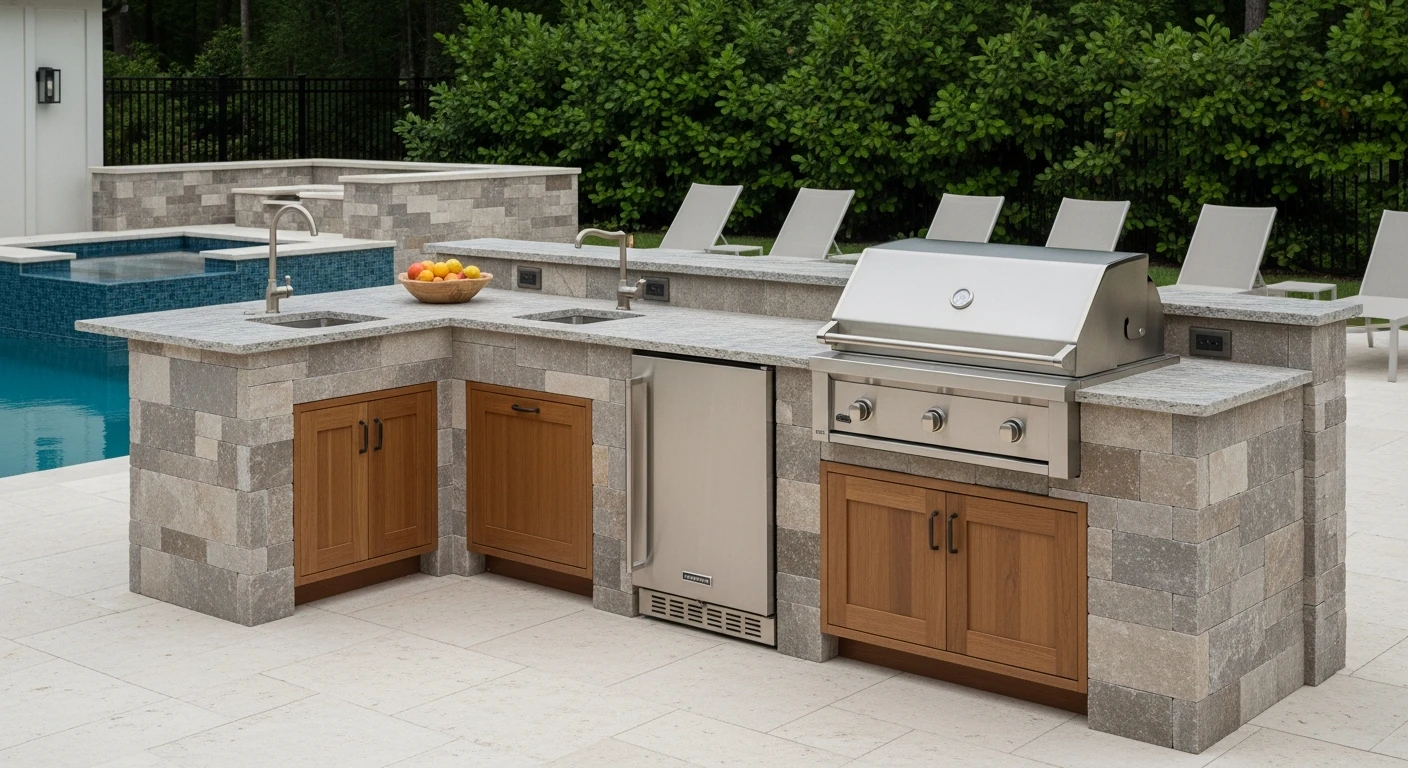
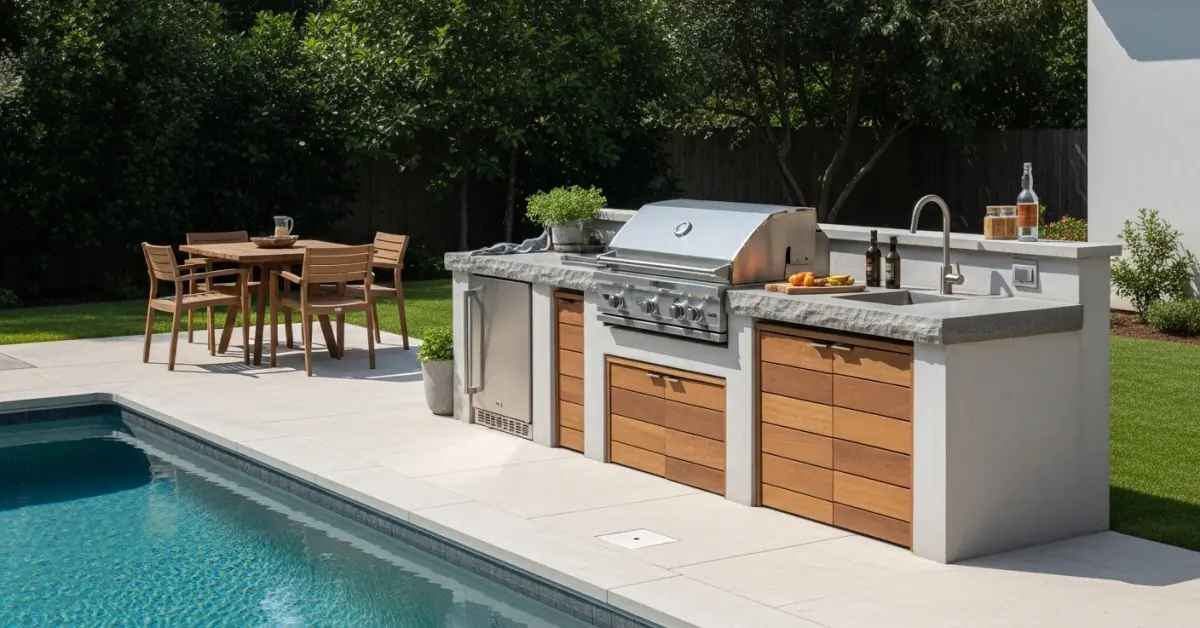
- The Hot Zone (Grill, Side Burners): This area demands non-combustible construction. I exclusively specify framing with steel studs or concrete block (CMU). The surrounding countertop must have a high thermal shock resistance; materials like sintered stone (e.g., Dekton) or specific grades of granite are superior. The most critical, and often overlooked, detail is the appliance itself. I always push for 316 marine-grade stainless steel over the more common 304 grade, especially in coastal areas, for a 30% increase in corrosion resistance. Ventilation is non-negotiable; an insulated grill jacket is a must, with specific clearance for airflow to prevent heat buildup that can damage internal components.
- The Wet Zone (Sink, Prep Area): Water is the enemy here. Cabinetry must be non-absorbent. I've moved away from sealed wood entirely and now recommend HDPE or PVC polymer cabinets, which are impervious to moisture. For countertops, a non-porous material like quartzite or a high-quality sealed concrete is essential to prevent staining and bacteria growth. Plumbing requires a winterization plan; I always design in a simple shut-off and drain valve system accessible from a discrete panel to prevent pipe bursts.
- The Cold Zone (Refrigerator, Ice Maker): The mistake I see most often is installing an indoor-rated mini-fridge outdoors. It will fail. You must use a UL-rated outdoor refrigerator, which is designed to operate in ambient temperatures up to 100°F or higher. Furthermore, the enclosure requires passive ventilation—typically vents at the bottom front and top rear—to allow the compressor to breathe. Without this, I've seen units burn out in a single season.
- Conduct a Full Site & Utility Audit: Before any design, we perform a utility mapping. I locate and mark all existing electrical, gas, and water lines. This dictates the feasible locations for each zone and prevents expensive trenching or rerouting later. We also analyze sun exposure and prevailing winds to position the grill so smoke is carried away from seating areas.
- Develop the Zonal Layout: Using the audit data, I sketch the placement of the Hot, Wet, and Cold zones. The goal is to create an efficient workflow, similar to the classic kitchen triangle. The prep area (Wet Zone) should ideally be between the refrigerator (Cold Zone) and the grill (Hot Zone).
- Create the Material Specification Sheet: This is a document listing every single component, from the frame screws to the countertop sealant, assigned to its specific zone based on the durability requirements we established. This eliminates ambiguity for the builder.
- Draft the Appliance Integration Plan: We gather the manufacturer's spec sheets for every appliance. This plan includes precise cutout dimensions, clearance requirements, and utility connection points (gas BTU load, electrical amperage, water line size). This is where 90% of DIY outdoor kitchens fail.
- Specify Frame & Substrate Construction: The final architectural step. We decide between light-gauge steel framing for its stability and resistance to rot, or CMU for its sheer mass and durability. A crucial detail is specifying the right backer board; I use a cement-based board with a waterproof membrane, never drywall or green board.
Tags
outdoor kitchen ideas near me
outdoor kitchen remodeling
backyard kitchen and pool designs
backyard pool and kitchen designs
outdoor kitchen designers
Outdoor Kitchen Ideas FAQ
What materials should I choose for cabinets and countertops that won't get ruined by my saltwater pool?
You must select materials specifically rated for coastal or marine environments to prevent rapid corrosion and degradation. For cabinets, marine-grade polymers or teak are superior choices over standard stainless steel, which can still show rust spots from constant salt exposure. For countertops, opt for non-porous materials like granite or sealed concrete, as they resist staining from both food and pool chemicals. A common mistake is using porous stone like travertine, which can absorb chlorinated water and discolor or weaken over time, leading to costly replacement.
Where is the best place to locate my outdoor kitchen relative to the pool?
Position your outdoor kitchen at least 10 to 15 feet away from the pool's edge and downwind from the prevailing breeze direction. This placement minimizes the amount of grease, smoke, and food debris that blows into your pool water, which can clog your cartridge filter and throw off your water chemistry. Placing a grill too close also creates a safety hazard with wet, running children. A poorly placed kitchen can double your pool cleaning workload and increase chemical consumption as you constantly fight organic contaminants.
Do I need a separate drainage system for my outdoor kitchen sink and grill?
Yes, your outdoor kitchen requires a dedicated drainage system completely separate from your pool's plumbing and the surrounding deck drains. Kitchen drainage contains grease, food particles, and cleaning agents that must be routed to your home's sanitary sewer line, not the storm drain or pool filter system. Allowing greasy runoff to enter your pool's skimmer can create a serious scum line and overwhelm your filtration, while draining it onto the deck creates a dangerous, slippery surface and can stain the concrete or pavers.
What are the most important safety features to consider for an outdoor kitchen next to a pool?
Your primary safety focus should be on electrical and fire prevention, especially in a wet environment. All electrical outlets must be GFCI-protected (Ground Fault Circuit Interrupter) and installed in weatherproof boxes to prevent electrocution risk. Ensure your grill has at least 36 inches of clearance from any combustible structures, and install a non-slip surface on the flooring in the kitchen area. A critical but often overlooked feature is task lighting; good illumination prevents accidents during evening cooking and helps you see what you're doing around hot surfaces.
Will adding a refrigerator or ice maker outdoors affect my utility bills much?
An outdoor-rated refrigerator or ice maker will noticeably increase your electricity bill, as it must work much harder to maintain cold temperatures in direct sun and high heat. Unlike an indoor unit, an outdoor model's compressor may run almost constantly on hot summer days, potentially adding $20-$50 per month to your utility costs depending on the climate and unit efficiency. To mitigate this, install the appliance in a shaded area and ensure it has proper ventilation around the back and sides to prevent overheating and premature failure.
How do I prevent pests like ants and rodents from invading my outdoor kitchen?
Effective pest control requires eliminating access to food, water, and shelter by sealing your kitchen components tightly. Choose cabinets with tightly sealed doors and drawers, and ensure any utility pass-throughs for gas or water lines are sealed with caulk or spray foam. A built-in trash bin with a heavy, self-closing lid is essential. The most overlooked step is cleaning the grease trap or drip pan on your grill after every use; accumulated grease is a primary attractant for everything from ants to raccoons.