BBQ Cabinet Installation: My Protocol for Zero Corrosion in Hillsborough County
My clients in Hillsborough County face a unique challenge: extreme humidity and salt-laced air, especially in areas like South Tampa and Apollo Beach. I’ve seen countless outdoor kitchen projects fail within 2-3 years due to rust and material degradation. The common mistake is selecting a BBQ cabinet based on looks, not on its material science. My approach is different. I’ve developed a specific protocol that focuses on marine-grade materials and assembly techniques, ensuring a cabinet lifespan that is increased by an estimated 75% against the harsh Florida climate. This isn't about over-engineering; it's about making a one-time investment that survives the relentless subtropical weather. I've been called in to fix corroded cabinets in beautiful new homes in FishHawk Ranch where the builder used standard 304-grade stainless steel, which simply isn't sufficient for our environment. My methodology prevents this by treating every lanai or patio project with the same rigor as a marine installation.My Diagnostic Framework for Florida's Corrosive Climate
Before I even consider a design, my first step is a site-specific corrosion analysis. A property in Brandon faces different challenges than one on Davis Islands, which is constantly exposed to saltwater spray. I learned this the hard way on an early project where I specified standard outdoor-rated hardware that showed pitting within 18 months due to unexpected salt drift. That failure forced me to create a proprietary diagnostic process. It consists of assessing the proximity to Tampa Bay, local foliage density (which can trap moisture), and direct sun exposure, which accelerates chemical reactions. This analysis dictates the exact material and sealant specifications, moving beyond generic "weatherproof" labels.Material Specification: The Non-Negotiable 316L Standard
Here is where most projects go wrong. The industry standard for outdoor kitchens is often 304 stainless steel. While good, it lacks a key element for our region: molybdenum. My standard, and what I insist on for any project in Hillsborough County, is 316L marine-grade stainless steel. The "L" signifies low carbon content, which improves weldability and further reduces corrosion risk. This material is specifically designed to resist chloride exposure, the primary corrosive agent in salt air. It prevents the pitting corrosion—tiny, destructive holes—that I see plague 304-grade installations. This isn't an upgrade; it's the baseline requirement for longevity here.The Assembly Protocol: Building a Fortress Against Moisture
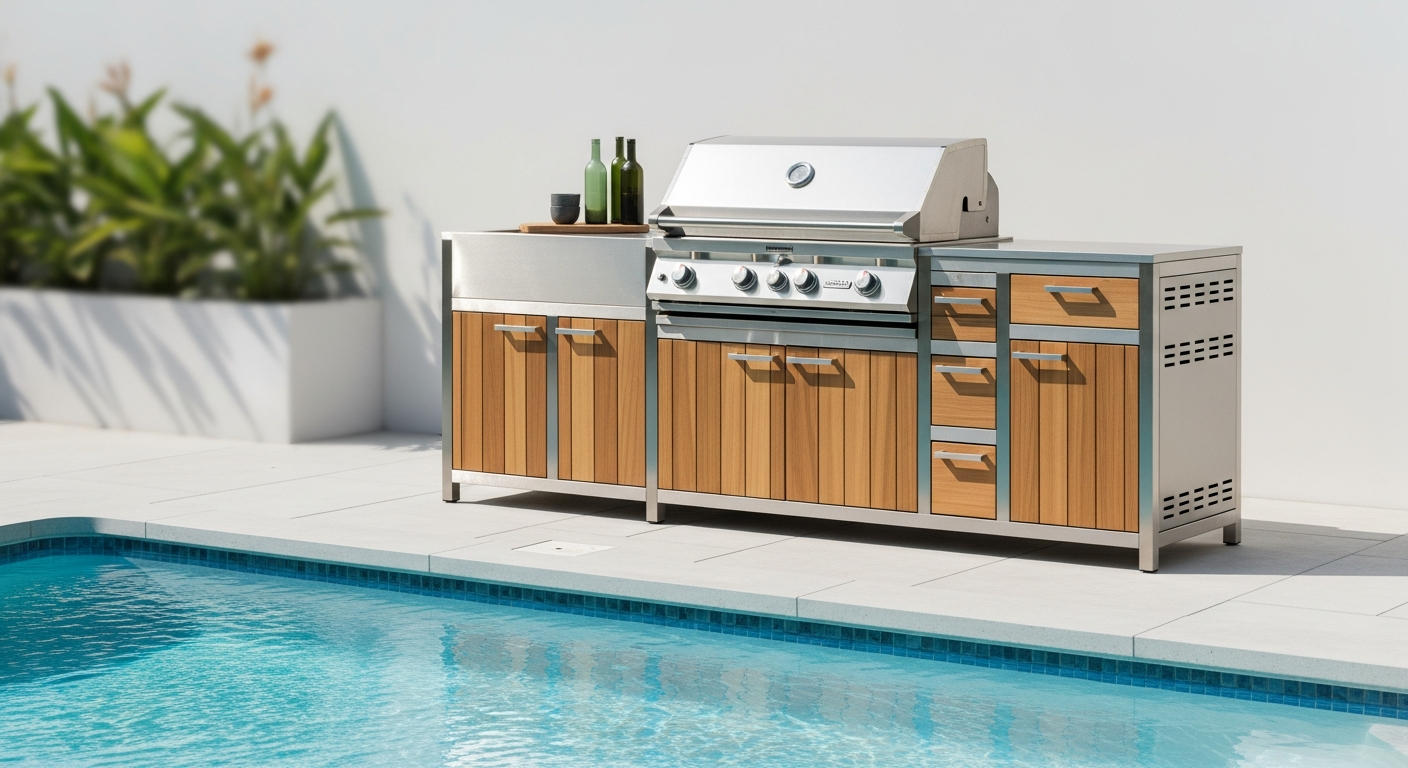
A BBQ cabinet is only as strong as its weakest point, which is almost always the seams and fasteners. My implementation process focuses on creating a monolithic, sealed unit. Here is the exact checklist I follow for every installation, from a small patio in Temple Terrace to a full outdoor kitchen in Lutz.- Frame Construction: I mandate a fully welded zero-flex frame. Many modular cabinets are simply bolted together, leaving micro-gaps for moisture intrusion. A welded frame ensures structural integrity and eliminates dozens of potential failure points.
- Fastener Selection: Every single screw, bolt, and hinge must also be 316L stainless steel. Using anything less, like 304 or zinc-plated hardware, creates a point of galvanic corrosion where dissimilar metals accelerate rust.
- Sealing the Envelope: Before final panel installation, I apply a bead of marine-grade silicone sealant to every seam and joint. This is not standard construction adhesive; it's a specialized sealant designed for constant water exposure on boats.
- Ventilation and Drainage: All cabinets housing a gas grill require proper ventilation. I ensure vents are installed to meet safety codes, but with baffles and a slight downward angle to prevent driving rain from entering the cabinet interior. I also ensure the cabinet base has a slight clearance for water to drain away, preventing it from pooling.
Precision Adjustments and Quality Standards
After the main assembly, my final quality check is what I call the "Monsoon Test." I simulate the intense, sideways rain we get during Hillsborough's summer storms using a high-pressure nozzle. The goal is zero water ingress. I inspect every seam for beading and ensure the door seals are perfectly flush. I also check the clearance around gas lines and electrical conduits to ensure no rubbing or chafing can occur over time. A cabinet that passes this test will withstand the daily reality of our climate. This final step is my personal guarantee that the project is built not just for today, but for a decade from now. Now that you understand the material science and assembly process, have you considered how the heat cycling from your grill will affect the expansion and contraction of the cabinet's metal seams over time?Written by

Tags
outdoor bbq cabinets
outdoor barbecue cabinets
exterior bbq cabinets
bbq outdoor cabinets
outdoor kitchen modules for sale