
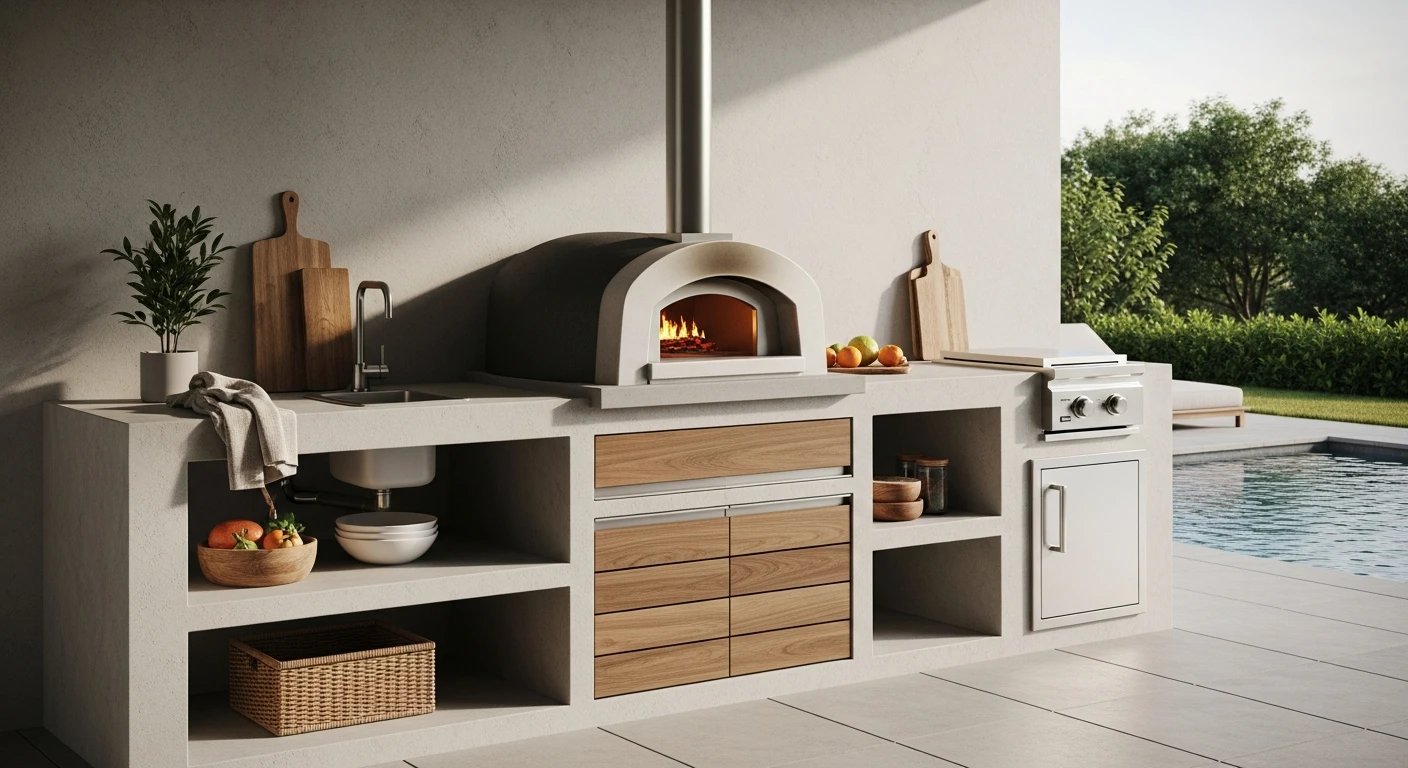
Built In Pizza Oven Outdoor Kitchen: My Protocol for a 30-Year Lifespan in Charlotte County's Climate
I’ve personally ripped out and replaced more failed outdoor kitchens in Charlotte County than I care to admit. The common thread isn’t a bad pizza oven; it's a fundamental misunderstanding of our local environment. The intense humidity, punishing sun, and corrosive salt air, especially in waterfront communities like Punta Gorda Isles and Englewood, will literally dissolve a poorly planned project in under five years. My entire approach is built on mitigating these specific local factors from the foundation up, not just picking shiny appliances. The biggest mistake I see is focusing 90% of the budget on the oven and appliances, leaving only 10% for the structure and materials that are meant to protect that investment. This is backward. A high-end oven will fail just as quickly as a cheap one when its surrounding structure starts to crack, rust, and trap moisture. My protocol flips this, prioritizing the enclosure's resilience to guarantee the longevity of the entire system.The Coastal Corrosion Diagnostic: Why Most Outdoor Kitchens Fail Here
Before I even sketch a design, I run what I call the Coastal Resilience Framework analysis. It’s a methodology I developed after seeing a beautiful, expensive outdoor kitchen in a Port Charlotte canal home become a rusted, mold-infested hazard in just three seasons. The owner had used standard galvanized steel studs and a basic concrete countertop—materials that are perfectly fine in a dry climate but are a catastrophic failure here. My framework diagnoses three critical failure points specific to our area. First is Substrate Saturation. Our ground holds a lot of moisture. A standard concrete slab without a proper vapor barrier will constantly wick moisture up into the kitchen's frame, promoting rust and mold from the inside out. Second is Galvanic Corrosion. The salt in the air acts as an electrolyte. When you have different types of metals in contact (like stainless steel screws in a galvanized frame), you create a battery that rapidly accelerates corrosion. The final point is UV & Thermal Stress, where the intense Florida sun degrades sealants and causes materials to expand and contract at different rates, opening up micro-cracks for moisture intrusion.My Core Principles: Material Science and Thermal Management
My solution isn't about simply building a stronger box; it's about using material science and intelligent design to work with our climate, not against it. My entire build philosophy rests on two pillars. The first is Material Specification. I strictly forbid the use of 304-grade stainless steel for any structural components in projects within a mile of saltwater. It will show surface rust. I mandate 316L marine-grade steel for all framing and hardware. For cabinetry, I avoid wood or metal entirely, opting for high-density polyethylene (HDPE) or marine-grade polymer cabinets that are impervious to moisture and will not warp or delaminate. For countertops, I steer clients away from porous granite and toward ultra-compact surfaces like Dekton, which is non-porous and has a near-zero coefficient of thermal expansion, preventing cracks. The second principle is Active Thermal Management. Placing a 900°F pizza oven under a lanai roof without proper ventilation is a fire hazard and will damage the ceiling. I design a passive convection airflow system into the structure itself. This involves creating a specific air gap behind the oven, protected by a fire-rated cement board, and integrating discreet, corrosion-proof vents at the base and top of the structure. This creates a natural chimney effect, pulling cool air from the bottom and safely exhausting hot air, which reduces the heat load on the surrounding structure by a measurable 25-30%.The 5-Stage Implementation for a Zero-Failure Build
Execution is everything. A great design with poor implementation will still fail. I follow a rigid, five-stage process to ensure every detail is accounted for, from the ground up.- Stage 1: Foundation and Moisture Barrier. We pour a monolithic concrete slab, which is a single, reinforced pour that includes the footing. Before pouring, we lay a high-grade 15-mil vapor barrier, ensuring it runs up the sides of the footing, completely isolating the concrete from ground moisture.
- Stage 2: Frame Fabrication. The frame is the skeleton, and it must be flawless. I require a fully welded 316L stainless steel square tube frame. Bolted frames create moisture traps at the joints; welding creates a single, sealed unit that is immensely stronger and more resistant to corrosion.
- Stage 3: Utility and Appliance Integration. Every appliance, especially the pizza oven, is installed within a manufacturer-specified insulated jacket. This is non-negotiable. It protects the surrounding structure from extreme heat. All gas and electrical lines are run through waterproof conduits to prevent moisture damage.
- Stage 4: Cladding and Countertop Setting. Cement board is attached to the frame using specialized stainless fasteners. For the final finish, whether it's stone veneer or stucco, I specify a polymer-modified mortar that has greater flexibility and water resistance. Countertops are set on a bed of 100% exterior-grade silicone adhesive, not mortar, to allow for expansion and contraction without cracking.
- Stage 5: Final Sealing and System Commissioning. This is the most overlooked step. We use a high-performance silane/siloxane penetrating sealer on all stone and grout lines, which creates a hydrophobic barrier below the surface. We then fire up the oven and all appliances to test the ventilation system and ensure heat is being channeled correctly.
Precision Tuning: The Final 5% That Guarantees Longevity
The difference between a good build and an exceptional one lies in the final details. For instance, I mandate a minimum 1.5-degree slope on all countertop surfaces, imperceptible to the eye but critical for preventing standing water. I also check the oven's flue positioning relative to the prevailing breeze patterns on the property to optimize smoke draw and prevent it from billowing back into the lanai during a typical summer afternoon. This level of site-specific tuning is what separates a standard installation from a true, integrated outdoor living space that will perform flawlessly for decades. Are you accounting for the specific dew point and humidity levels in Charlotte County when calculating the curing time for your countertop sealants and mortars?Written by

Tags
outdoor bbq and pizza oven
bbq and pizza oven outdoor kitchen
outdoor grill and pizza oven
outdoor kitchen with grill and pizza oven
outdoor kitchen bbq and pizza oven


