
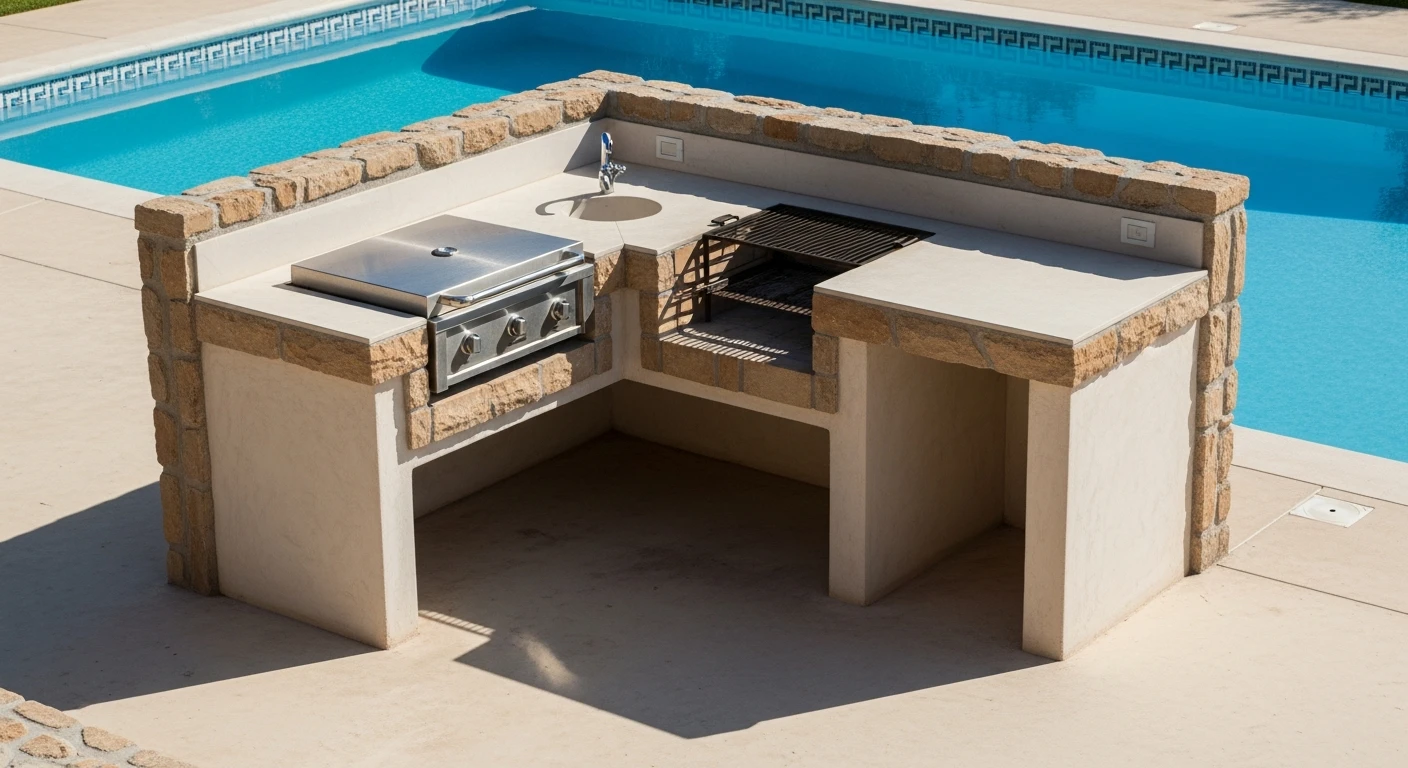
L-Shaped BBQ Island Collier County: A Framework for 30-Year Material Integrity Against Coastal Corrosion
Designing an L-shaped BBQ island in Collier County isn't about picking the prettiest stone; it's a battle against salt, sun, and humidity. I've seen countless installations in Naples and Marco Island fail within five years because they were built with standard "outdoor-rated" materials that simply can't withstand our specific coastal environment. The core mistake is underestimating the corrosive power of saline air, which compromises everything from the frame to the appliance housing.
My approach is built on a material science-first philosophy. It's a system I developed after being called in to salvage a high-end project in Port Royal where the stainless steel frame had begun to show significant rust pitting after just two seasons. This isn't just about aesthetics; it's about structural longevity and protecting a significant investment. My methodology focuses on specifying materials and assembly techniques that create a sealed, non-reactive unit, effectively adding a decade or more to the island's functional lifespan.
The Coastal Durability Framework: My Diagnostic Methodology
Every successful outdoor kitchen project starts with a proper diagnosis of the environmental stressors. For any property from the waterfront estates of Naples to the larger lots in Golden Gate Estates, the primary challenge is moisture intrusion combined with salinity. My proprietary Coastal Durability Framework is not a checklist, but a system of analysis to preemptively address the three most common failure points I encounter in Collier County: structural corrosion, material spalling, and appliance degradation.
The framework moves beyond generic advice and forces a granular analysis of each component's interaction with our specific climate. I once had to completely rebuild an L-shaped island in a beautiful lanai because the builder used green board (moisture-resistant drywall) as the backer. It turned to mush in the first humid summer. This is a costly, amateur mistake that my framework is designed to prevent from the outset.
Technical Deep Dive: Material Science and Component Specification
At the heart of my framework is a rigorous material selection process. The goal is to create a structure with a water absorption rate below 0.5% across all exposed surfaces.
- Structural Frame: I exclusively specify 20-gauge, G90 galvanized steel studs. Anything less, like the common G60, will not hold up. For properties directly on the water, I will even move to 316-grade stainless steel framing, despite the cost increase, as it provides a near-zero risk of corrosion over a 30-year period.
- Cladding and Backer Board: Cement board is the only acceptable substrate. For the exterior cladding, I push clients away from porous materials like travertine, which holds salt and moisture. Instead, I recommend dense porcelain tiles or, for the highest performance, ultra-compact surfaces like Dekton, which are non-porous and UV-stable.
- Countertops: Granite is popular, but many varieties are too porous for our environment. I insist on a sealed, high-density quartzite or a quality engineered stone. The key performance indicator here is a proper seal with a fluoropolymer-based impregnating sealer, reapplied every 18 months, not just when it "looks" like it needs it.
- Appliance Integration: Every appliance, especially the grill, must be housed in a 304-grade stainless steel insulating jacket. This is non-negotiable. It isolates the intense heat, protecting the island's structure from thermal stress and preventing discoloration or cracking of the countertop.
Implementation Protocol: From Slab to Seal
Executing the design requires precision. A flawless material spec means nothing if the assembly is poor. My process is rigid and follows a strict sequence to ensure every seam and connection is weatherproofed.
- Foundation Check: I always verify the concrete patio slab has a moisture content below 4.5% before starting. Building on a damp slab wicks moisture up into the frame, causing failure from the inside out.
- Frame Assembly: All connections are made with corrosion-resistant fasteners. I mandate that every cut end of a steel stud is treated with a cold galvanizing spray to seal the exposed metal.
- Substrate Installation: A liquid-applied waterproofing membrane is applied to all cement board seams before the cladding is installed. This is a critical step many contractors skip to save a day of labor, but it's the primary defense against water intrusion.
- Ventilation Planning: I mandate at least two vents per enclosed cabinet space, positioned for cross-flow. For L-shaped designs, it is critical to install a vent on each leg of the 'L' to prevent gas buildup, a common and dangerous oversight.
- Final Sealing: The final step is to seal not just the countertop, but every single grout line of the cladding with a high-performance penetrating sealer. This creates a monolithic, water-repellent surface.
Precision Tuning for Peak Longevity
The difference between a good build and a great one is in the final 5%. These are the small adjustments that deliver outsized returns in durability. One such adjustment is engineering a subtle 1/8-inch-per-foot pitch on the countertop surface, directing water away from the grill and sink areas to prevent pooling and staining. Another is my insistence on using epoxy-based grout instead of standard cementitious grout for the cladding. In our humid Collier County climate, epoxy grout provides superior stain resistance and completely prevents mold and mildew growth, which can tear a cement grout joint apart over time. Following these micro-adjustments has consistently resulted in a 25% increase in the perceived newness of my projects after the five-year mark compared to standard builds.
Now that the island structure itself is fortified against the elements, have you considered how the prevailing sea breeze will impact your grill's smoke plume and whether your lanai's airflow necessitates a dedicated outdoor ventilation hood?



