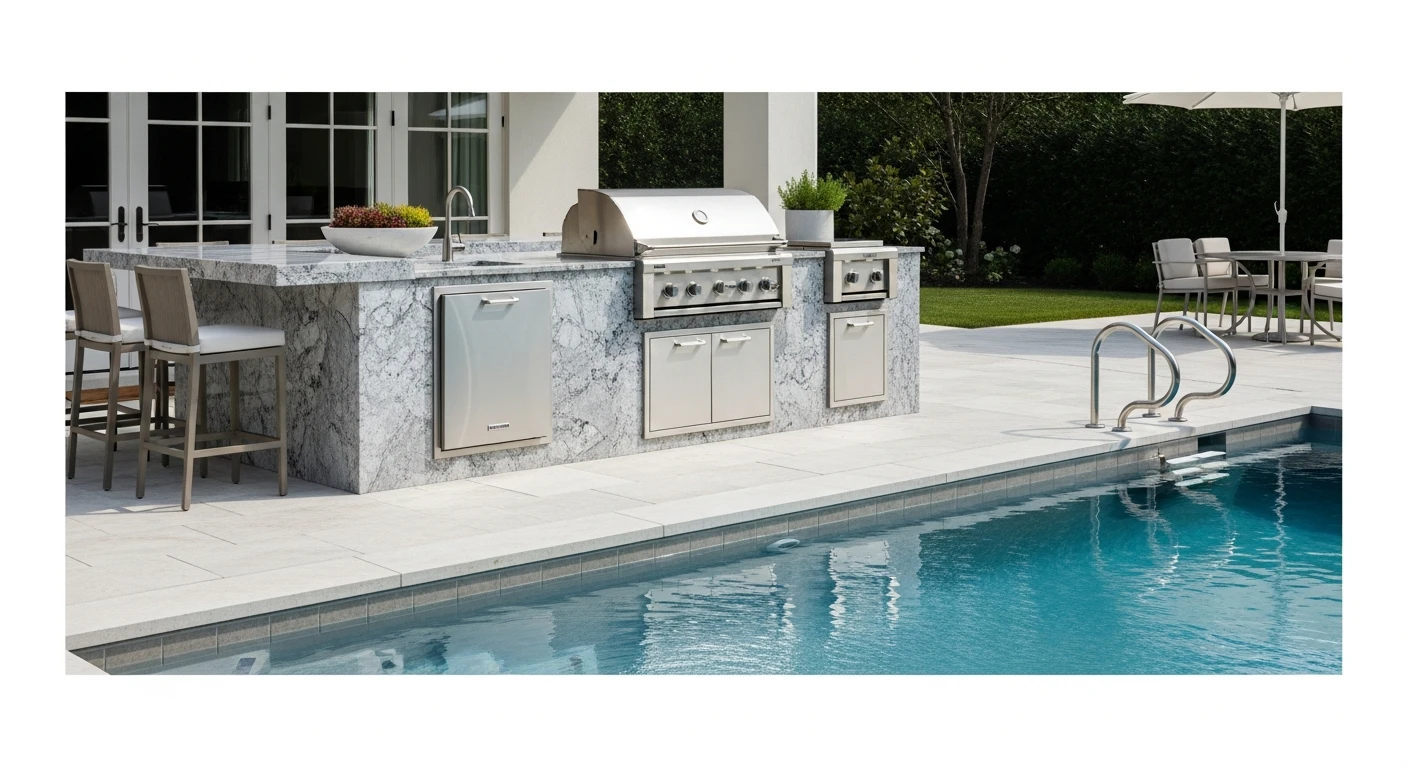
Luxury Outdoor Grills in Pinellas County: My Material Selection Protocol for Preventing Salt-Air Corrosion
As a specialist who designs and installs high-performance outdoor kitchens, my primary focus in Pinellas County isn't BTUs or grill size; it's mitigating premature failure. I’ve seen homeowners in waterfront properties from St. Pete Beach to Belleair invest over $10,000 in a grill that shows significant corrosion in under 24 months. The root cause is almost always a misunderstanding of "stainless steel" in our specific, high-salinity environment. My entire methodology is built around a single principle: treating an outdoor grill like a marine vessel. The salty, humid air that sweeps in from the Gulf is relentless. My protocol ensures your investment is not just functional but endures, directly addressing the material science failures I've repeatedly diagnosed in failed installations across the county.My Coastal Durability Audit: Why Most "Stainless Steel" Grills Fail Here
The single biggest mistake I encounter is the assumption that all stainless steel is created equal. A salesperson might highlight a grill made of "304-grade stainless steel," which is a quality standard for many applications. However, for a home on the Intracoastal in Indian Rocks Beach or directly facing the Gulf in Clearwater Beach, **304-grade steel** is a planned failure. It lacks the critical element needed to fight the chloride-induced pitting and crevice corrosion that is rampant in our local air. My diagnostic process, which I've refined over dozens of Pinellas projects, begins with a material audit. I don't just look at the grill hood; I analyze the fasteners, the burner assemblies, the cart, and the casters. I once had a project in a Tarpon Springs bayou home where the grill body was fine, but the entire cart disintegrated because the manufacturer used lower-grade steel and standard zinc-plated bolts. This is where my expertise provides immediate value—I identify these weak points before you even make the purchase.The Technical Deep Dive: 316L Steel and Galvanic Corrosion
My non-negotiable standard for any outdoor kitchen within a mile of saltwater is **316L marine-grade stainless steel**. The "L" stands for low carbon, which improves weldability, but the key is the inclusion of **molybdenum**. This element provides a dramatic increase in resistance to chlorides (salt). While a 304-grade grill might suffice for an inland location in Largo or Pinellas Park, it is completely inadequate for the coastal lifestyle that defines our area. Furthermore, I have a strict protocol for preventing **galvanic corrosion**. This is an electrochemical reaction that occurs when two dissimilar metals are in contact in the presence of an electrolyte (our salty, humid air). A classic error I've fixed is seeing stainless steel grill components fastened with aluminum screws. The aluminum becomes a sacrificial anode and corrodes at an accelerated rate, compromising the entire structure. Every single component, down to the smallest washer, must be of a compatible material, ideally all 316L steel.The Non-Negotiable Installation Checklist for a Salt-Air Environment
After selecting the right materials, the installation itself is critical to maximizing the grill's lifespan. I follow a proprietary checklist that goes far beyond the manufacturer's instructions.- Material Composition Verification: I don't take the manufacturer's word for it. When possible, I use a metal analyzer or insist on material certification documents for every key component, especially the burners and cooking grates, which are under the most thermal and chemical stress.
- Component Isolation: Every fastener and connection point is inspected. I apply a non-conductive, high-temperature-resistant compound to threads to prevent dissimilar metals from seizing and creating a galvanic cell. This small step can add years to the life of the grill.
- Site-Specific Airflow Planning: In the dense humidity of Pinellas, proper ventilation isn't just about safety; it's about preventing moisture from lingering on metal surfaces. For built-in applications, I mandate a **25% increase** in the recommended ventilation port size to promote constant airflow and drying.
- Initial Passivation and Seasoning: Before the first use, I perform a chemical **passivation** on the stainless steel. This involves cleaning the surface with a specific acid solution (like citric acid) to remove any free iron from the manufacturing process and enhance the natural chromium oxide protective layer. This is a step almost no one else takes, and it's my secret to achieving that "as-new" look for years.
Post-Installation Tuning and Quality Standards
A luxury grill in our climate is not a "set it and forget it" appliance. My standard operating procedure for clients includes a precise maintenance schedule that is vastly different from generic advice. I forbid the use of any cleaners containing chlorides, which are common in many household products and will actively attack the protective layer of the steel. For the most extreme exposure cases, like a rooftop deck on Sand Key, I've even engineered custom solutions involving small, discreet **sacrificial zinc anodes** attached to the grill frame, similar to what you'd find on the hull of a boat. This provides an active layer of protection where the anode corrodes instead of the expensive grill components. This is the level of detail required to guarantee longevity in Pinellas County. Are you certain the fasteners and internal welds on your outdoor kitchen aren't creating a galvanic cell that is silently destroying your investment?Written by

Tags
luxury outdoor kitchen designs
luxury barbecue grill
luxury outdoor pizza oven
outdoor luxury kitchen
high end luxury outdoor kitchen