Luxury Outdoor Kitchens in Hillsborough County: My Framework for Resisting Humidity, Salt Spray, and UV Degradation
The most common failure I see in luxury outdoor kitchens across Hillsborough County isn't a faulty grill; it's catastrophic material decay after just a few seasons. From a waterfront home on Davis Islands to a sprawling estate in Avila, I’ve been called in to diagnose kitchens that looked stunning on day one but were rusting, warping, and molding by year three. The root cause is almost always a design that ignores our specific sub-tropical climate: the brutal humidity, the corrosive salt-laden air near the bay, and the relentless UV exposure. My entire approach is built on a single principle: an outdoor kitchen in Tampa, Brandon, or Apollo Beach must be engineered less like a kitchen and more like a marine vessel. This means prioritizing **material science** and **structural ventilation** above all else. A project's success isn't measured by the brand of the smoker, but by its ability to look and function perfectly after weathering five hurricane seasons and a decade of humid summers. This is how I ensure a 25-year+ functional lifespan, not just a 5-year aesthetic one.The TPA-1 Climate Stress Test: My Diagnostic Protocol
Before I even sketch a layout, I perform what I call the **TPA-1 Climate Stress Test** on the property. I developed this protocol after seeing a gorgeous, high-end outdoor kitchen in a Hyde Park historic home fail prematurely. The contractor used standard high-grade materials, but failed to account for the trapped moisture and lack of airflow under a dense canopy of oak trees. My test analyzes the specific micro-environment of the proposed site, going far beyond a simple "sun or shade" assessment. It's a site-specific analysis that dictates every subsequent decision. This isn't about choosing colors. It's about data. I map the sun's path across the lanai for all four seasons to identify UV hotspots. I use a digital anemometer to understand prevailing breezes and airflow patterns, which is critical for smoke ventilation and preventing stagnant, moist air. For any property east of the Howard Frankland Bridge, I assume a high-salinity environment and automatically upgrade my material specifications. A kitchen in Carrollwood faces different challenges than one in South Tampa, and my design must reflect that reality from the very beginning.Material Forensics: Why 304 Stainless Is a Costly Mistake Here
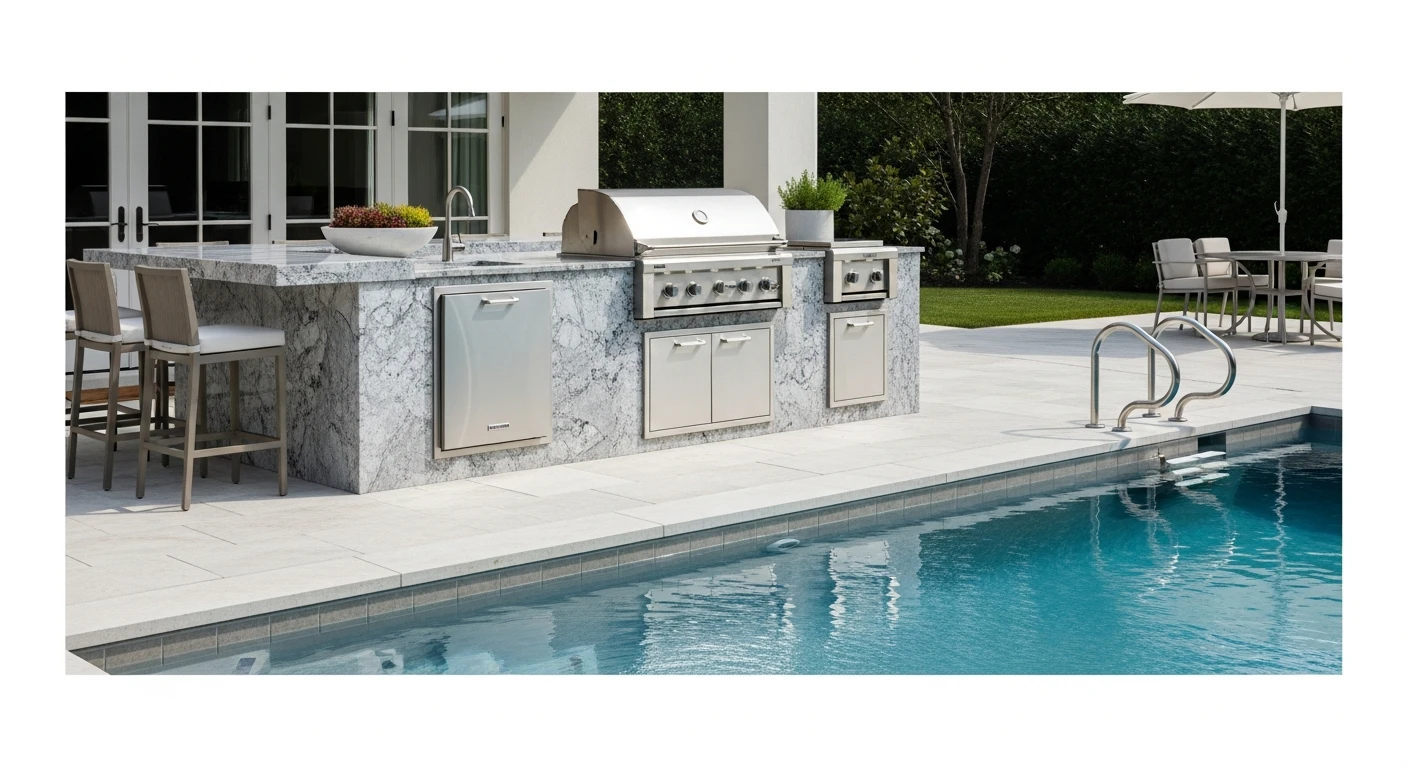
Most designers will specify 304-grade stainless steel as the "gold standard." In Hillsborough County, I consider that professional negligence, especially near the water. The high chloride content in our air from Tampa Bay aggressively attacks 304 steel, causing pitting and rust, particularly at the welds. My baseline specification is **316L Marine-Grade Stainless Steel**. The "L" signifies low carbon content, which provides superior corrosion resistance at the weld points—exactly where I see other installations fail first. It's a small change on a spec sheet that adds years of life to the project. For cabinetry, I’ve seen expensive powder-coated metal cabinets delaminate and wood warp beyond repair. My non-negotiable solution is cabinetry made from **High-Density Polyethylene (HDPE)**. This is a polymer material that is completely impervious to water, will not swell or rot, and has UV inhibitors integrated into the material itself, not just as a surface coating. For countertops, I steer clients away from porous natural stones like granite, which can harbor mold in our humidity. My go-to is **sintered stone, like Dekton**. Its near-zero porosity means it won’t stain or suffer from the thermal shock of a hot pan on a cool, rain-swept evening.The Vented-Frame System: A Non-Negotiable for Hillsborough County
The secret to longevity here is defeating trapped moisture. An outdoor kitchen must breathe. My proprietary **Vented-Frame System** is an installation methodology I designed specifically to create constant passive airflow through the kitchen island's structure, protecting appliance electronics and preventing mold growth from the inside out. This is my checklist for every single build:- Foundation First: The structure is built on a sealed, monolithic concrete slab, never directly on pavers. This prevents ground moisture from wicking up into the frame.
- Aluminum Framing Only: The core structure is a custom-welded frame of **6061-T6 aluminum tubing**. Unlike steel, it will never rust. Unlike wood, it will never rot or be a target for termites.
- Strategic Venting Panels: I mandate the installation of discreet, color-matched **stainless steel vents** at the base and upper rear of the cabinet structure. This creates a natural thermal convection, pulling cool, dry air in from the bottom and exhausting hot, moist air out the top.
- Appliance Isolation Jackets: Every single heat-producing appliance, especially the grill, must be installed with its manufacturer-specified **insulating jacket**. I’ve seen this step skipped to save a few hundred dollars, only to cause the countertop to crack or the adjacent HDPE cabinet to warp from the intense heat.
- Weatherproof Utility Runs: All electrical and gas lines are run through **liquid-tight flexible conduit**. Every penetration point into the structure is sealed with marine-grade silicone to create a watertight barrier against our driving rains.
Post-Installation Commissioning: The 25-Point System Integrity Check
My job isn't done when the last drawer pull is installed. I conduct a rigorous 25-point commissioning process to ensure the system is not only beautiful but also safe and durable. This is where I catch the small errors that lead to big problems. I perform a **gas leak soap test** on every single fitting from the supply line to the appliance manifold. I personally trip and reset every GFCI outlet to ensure its functionality. I run a water test on the countertops, checking for proper slope and drainage, and ensuring every seam is perfectly sealed. I've had to fix a brand new installation in Tampa Palms where the contractor left a hairline gap in the backsplash seam, allowing water to penetrate the wall cavity. This final check is my personal guarantee that the kitchen is truly ready for the harsh reality of the Hillsborough County climate. Given that the internal components of your grill are engineered to function within specific temperature ranges, have you factored in how a non-ventilated cabinet structure can artificially increase the ambient temperature by 30 degrees, potentially voiding your appliance warranty and accelerating component failure?Written by

Tags
high end outdoor kitchen designs
modern luxury outdoor kitchen
high end outdoor grills built in
kitchen bbq grill
outdoor kitchen luxury
Luxury Outdoor Kitchen in Hillsborough FL FAQ
What kind of foundation do I need for a luxury outdoor kitchen, and can I just use my existing patio?
Your outdoor kitchen requires a dedicated, reinforced concrete slab foundation at least 10 cm thick to support the immense weight of stone countertops and heavy appliances. Placing heavy structures directly on an existing paver or thin concrete patio often leads to cracking and an unsafe, unlevel cooking surface within a few seasons. Improper foundation work is a primary cause of structural failure, leading to costly repairs like releveling the entire unit and fixing cracked gas or water lines that were stressed by the shift.
How do I choose between a built-in grill and a standalone one for a high-end setup?
A built-in grill offers a seamless, integrated look and superior stability, but it permanently fixes the layout of your kitchen and makes future upgrades or replacements significantly more complex. Standalone cart grills offer flexibility, but they create gaps in countertops and can feel less permanent. A critical factor people miss is serviceability; a built-in unit may require partial deconstruction of your counter for major repairs, whereas a standalone grill can be easily moved or swapped out, a key consideration for equipment with an average lifespan of 8 to 12 years.
Are stainless steel cabinets really the best option for outdoor weather?
Marine-grade 316 stainless steel is the superior choice for outdoor cabinets due to its enhanced corrosion resistance, especially in coastal or poolside areas with salt and chlorine exposure. Many homeowners opt for the less expensive 304-grade steel to save money, only to find rust spots appearing within a few years. While powder-coated steel offers color options, any scratch that penetrates the coating becomes an immediate entry point for rust, compromising the structure much faster than the raw, corrosion-resistant surface of high-grade stainless steel.
Do I really need a ventilation hood for my outdoor grill?
A ventilation hood is essential if your grill is located under any type of permanent roof, pergola, or covered structure, as required by most local building codes. Without proper ventilation, smoke, grease, and carbon monoxide can accumulate, creating a fire hazard and staining your overhead structure with a thick, grimy film. A common mistake is under-sizing the unit; the hood should be wider than the cooking surface to effectively capture all emissions, especially in windy conditions, preventing long-term discoloration and potential structural damage from grease buildup.
What are the most common points of failure in an outdoor kitchen's plumbing system?
The most frequent plumbing failures occur from freeze-burst damage to water lines that were not properly winterized and drained before the first hard frost. Even a small amount of trapped water can expand and crack pipes, leading to significant leaks and water damage inside the cabinet structure once thawed. Another critical failure point is the drain line for the sink; using improper materials that degrade with UV exposure or installing it without a proper slope can lead to clogs and foul odors, turning your luxury space into a maintenance headache.
Beyond the grill, what appliances are most prone to issues in an outdoor environment?
Outdoor refrigerators and ice makers are the most problematic appliances due to their constant battle with ambient heat and humidity, forcing their compressors to work much harder than indoor models. A common oversight is failing to provide adequate ventilation clearance around these units as specified by the manufacturer, often leading to premature compressor failure. This is a critical detail, as a failing refrigerator can struggle to maintain a food-safe temperature, posing a health risk in addition to the eventual cost of replacing the entire unit.