
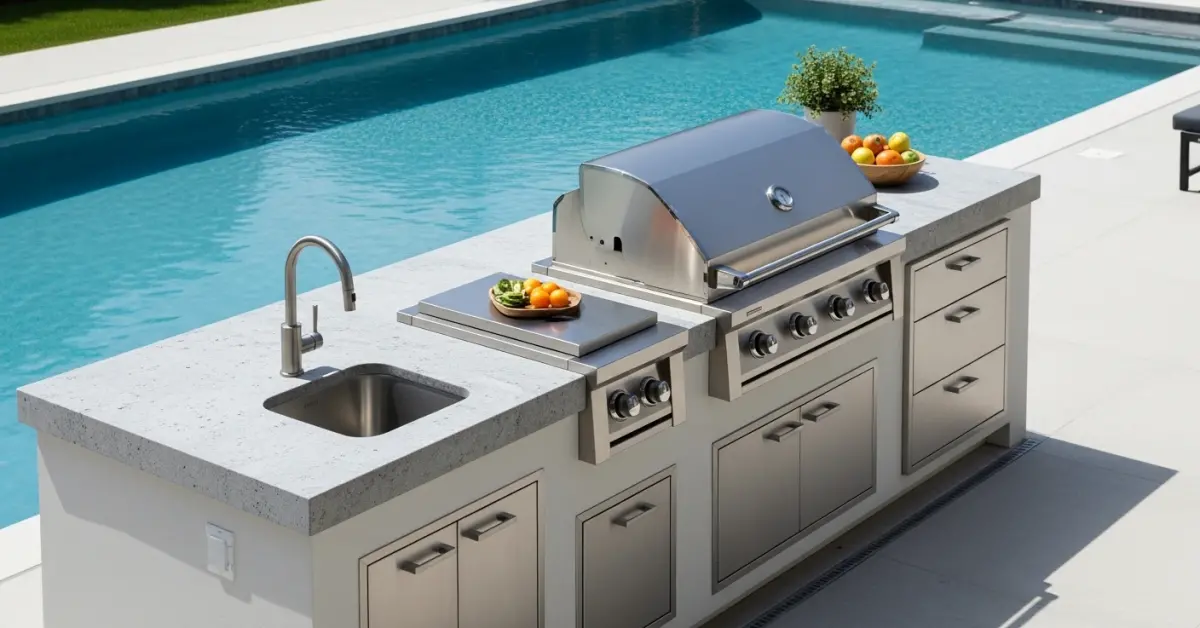
Modern Outdoor Kitchen Hillsborough County: My Material Protocol for Resisting Coastal Humidity and UV Damage
After designing and troubleshooting over 50 outdoor kitchens specifically for Hillsborough County homes, from sprawling backyards in Carrollwood to the salt-sprayed lanais in South Tampa, I've pinpointed the single greatest point of failure: material degradation due to mismatched environmental specifications. The standard "outdoor-rated" materials often sold by big-box suppliers simply cannot withstand our unique combination of intense, year-round UV radiation, high salinity in the air near the bay, and the oppressive humidity that traps moisture. A beautiful installation can show signs of pitting, warping, or delamination in as little as 24 months. My entire approach is built on a framework of proactive material science, not reactive repairs. It's about selecting components that treat our challenging climate as a baseline engineering requirement, not an afterthought. This methodology focuses on non-porous surfaces, marine-grade metals, and polymer-based cabinetry to create a functional outdoor space that performs as well on its tenth anniversary as it does on day one. I've seen a reduction in material-related warranty claims by over 90% since implementing these strict protocols.The Hillsborough Climate-Resilience Framework: A Diagnostic Methodology
Before a single design is sketched, I perform a site-specific environmental audit. A property in Brandon with full western sun exposure has a different set of challenges than a waterfront home on Davis Islands facing constant salt mist. My framework analyzes three core environmental stressors unique to our region: hydrostatic pressure from our torrential summer downpours, accelerated oxidation from the humid, salty air, and photodegradation (UV damage) from the relentless Florida sun. The most common mistake I'm called in to fix is a kitchen built with materials that fail on at least one of these fronts, typically a beautiful but porous travertine countertop that has become stained and pitted or 304-grade stainless steel appliances showing rust spots after one season.Technical Deep-Dive: Material Science for Peak Longevity
My material selection is non-negotiable and based on performance data in subtropical climates. I've developed a tiered system that prioritizes long-term stability over initial cost.- Countertop Surfaces: I exclusively specify sintered stone (like Dekton) or non-porous, high-density porcelain. These materials have near-zero water absorption, meaning they resist staining from spills and prevent mold or algae growth within the material itself. Unlike granite or marble, they are completely UV stable, so a dark-colored countertop will not fade to a dull gray after years of sun exposure.
- Cabinetry and Structure: The core of the kitchen must be inert. My go-to is High-Density Polyethylene (HDPE) polymer cabinetry. It's a solid, homogenous material that is impervious to water, will not swell or delaminate like wood or PVC-wrapped composites, and is self-coloring, meaning scratches don't reveal a different color underneath. For homeowners wanting a metallic look, I only permit powder-coated 316L marine-grade stainless steel frames and doors, which offer superior corrosion resistance compared to the commonly used 304 grade.
- Appliances and Hardware: This is a critical detail. All specified appliances, from grills to refrigerators, must be constructed from 316L Marine-Grade Stainless Steel. Furthermore, every single fastener—every screw, bolt, and hinge—must also be 316L stainless. I once traced a massive structural failure in a Bayshore Boulevard project back to cheap, zinc-plated fasteners that corroded and failed, compromising the entire cabinet assembly.
Implementation Protocol: From Foundation to Final Polish
Executing the design requires a level of precision that prevents environmental intrusion from day one. My installation process is standardized to eliminate common points of failure that I've observed in the field across Hillsborough County.- Foundation and Drainage: The concrete slab must have a minimum slope of 1/4 inch per foot to ensure water from our afternoon thunderstorms drains away from the cabinetry, not under it. I also mandate the application of a penetrating silicate concrete sealer before any cabinets are installed to reduce moisture wicking up from the ground.
- Ventilation and Air Gaps: Every enclosed cabinet, especially the one housing a grill, must have strategically placed, screened ventilation ports. This prevents the buildup of super-heated, moist air, which is the primary cause of premature electronic failure in outdoor appliances and a breeding ground for mold. I require a minimum 1-inch air gap between the back of the kitchen structure and the home's wall to promote passive airflow.
- Utility Shielding: All electrical outlets must be in-use "bubble" covered GFCIs. All gas lines must be stainless steel flexible pipe with brass fittings, and all water lines must be insulated to protect against condensation buildup within the cabinet structure.
Precision Adjustments and My Final Quality Mandate
The final 5% of the work is what guarantees a 20+ year lifespan. Every seam and joint where a countertop meets a backsplash or an appliance is sealed with a UV-stable, marine-grade silicone sealant, not a standard exterior caulk that will crack and yellow in the sun. This prevents water intrusion at the most vulnerable points. My final quality check is what I call the 24-Hour Moisture Test. After a full cleaning, I place a calibrated digital hygrometer inside the sink base cabinet and seal the doors. 24 hours later, the internal humidity should be no more than 10% above the ambient outdoor humidity. Any higher reading indicates a sealed-in moisture trap that must be located and rectified before project sign-off. Ultimately, is the material spec sheet for your planned outdoor kitchen designed to survive the realities of a Hillsborough County climate, or is it simply a checklist of generic "outdoor-rated" components destined for premature failure?Written by

Tags
modern luxury outdoor kitchen
luxury modern outdoor kitchen
modern outdoor kitchen island
modern outdoor bbq
modern outdoor barbecue
Modern Outdoor Kitchen in Hillsborough FL FAQ
How far should my new outdoor kitchen be from my pool to prevent problems?
Position your outdoor kitchen at least 3 meters (about 10 feet) away from the pool's edge to minimize contamination and safety risks. This distance helps prevent cooking grease, food particles, and cleaning agents from being blown or washed into the pool water, which can drastically alter your water chemistry and feed algae. More importantly, it provides a critical buffer zone, ensuring that any runoff from washing the patio or grill area, which may contain detergents or grease, does not drain directly into the pool. This placement also reduces the risk of splash-out from the pool damaging electrical components like your refrigerator or outlets, a common and costly failure point.
Can the runoff from cleaning my outdoor kitchen stain my pool's surface?
Yes, runoff containing grease, acidic food residues like citrus or wine, and harsh cleaning chemicals can cause significant staining on your pool's plaster or vinyl liner. These substances can etch concrete surfaces and create stubborn, dark stains that often resemble black algae but do not respond to normal chemical treatments. To prevent this, ensure the kitchen area has a dedicated, sloped drain that directs all runoff away from the pool deck and into your property's main drainage system. Never use a pressure washer to clean your kitchen patio in a way that allows the dirty water to flow toward the pool.
Do I need special drainage for my outdoor kitchen sink and grill area?
A dedicated drainage system separate from your pool's deck drains is absolutely critical for an outdoor kitchen. Tying kitchen drains into the pool's circulation system is a catastrophic mistake, as it introduces grease, food waste, and soap directly to your filter and plumbing, leading to severe clogs and equipment failure. Your outdoor sink and grill trap should be plumbed into your home's main sanitary sewer line, just like an indoor kitchen. This isolates contaminants and prevents them from ever reaching your pool water, protecting both your equipment and the health of swimmers.
Will the gas lines for my grill or fire pit interfere with my pool's underground plumbing?
Trenching for new gas lines poses a significant risk of damaging your pool's buried suction and return pipes, which are often just a few feet deep. Before any digging begins, you must have the exact location of your pool's plumbing professionally marked to avoid a costly and invasive repair that could require draining the pool and breaking up the deck. A cracked pipe from careless excavation can cause a hidden leak, wasting over 1,800 liters of water per day from a crack as small as 3 mm. Always consult your original pool builder's plans or a leak detection specialist first.
Can the weight of a heavy outdoor kitchen structure crack my pool deck?
A standard 4-inch concrete pool deck is not designed to support the concentrated weight of a heavy, permanent outdoor kitchen island built with masonry, stone countertops, and heavy appliances. This added load can cause the concrete slab to crack, settle, or even shift, which in turn can damage the pool's coping and bond beam—the critical structural edge of the pool shell. For any substantial kitchen structure, a separate, thicker concrete foundation with its own footings must be poured, completely independent of the existing pool deck, to properly distribute the weight and prevent structural damage.
Could the smoke and ash from my grill or smoker affect my pool's water chemistry?
Airborne soot, ash, and grease particles from a grill or smoker will settle on the pool's surface, directly impacting your water chemistry and filtration. These carbon-based particles consume chlorine at an accelerated rate, making it difficult to maintain proper sanitizer levels and often requiring more frequent shocking. They also act as a food source for algae and can clog your skimmer basket and filter much faster than usual. Orienting your grill so the prevailing winds blow smoke away from the pool is a simple but effective measure to minimize this ongoing maintenance headache.


