
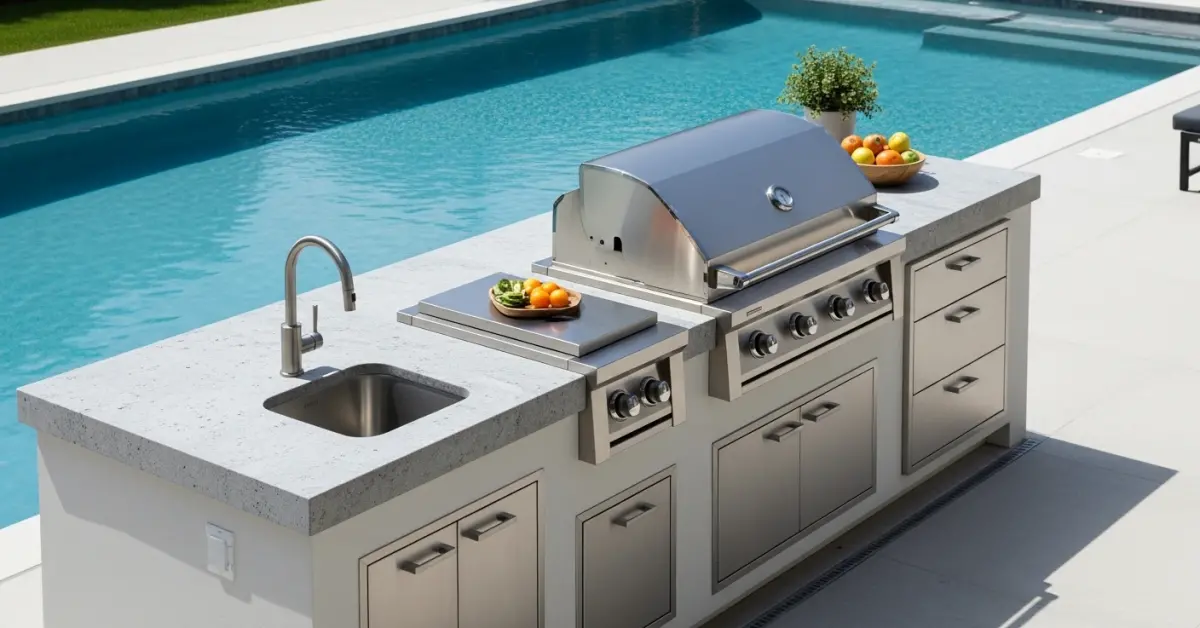
Modern Outdoor Kitchen in Pasco County: My Weatherproofing Protocols for a 20+ Year Lifespan
My primary focus when designing a modern outdoor kitchen in Pasco County isn't the grill or the countertop finish; it's the climate-resilient framework that underpins the entire structure. I’ve seen far too many beautiful projects in Wesley Chapel and Land O' Lakes start to fail within three years because they were built with an indoor mindset. The intense sun, high humidity, and torrential summer rains here demand a completely different approach, one that prioritizes material science and micro-drainage from day one. The most critical mistake is selecting materials based on aesthetics alone, a costly error I had to rectify on a large residential project in Trinity. The original build used a popular porous stone and standard-grade stainless steel that corroded and stained from the humidity and lawn sprinklers. My methodology corrects this by starting with a "Coastal Durability Audit," ensuring every single component, from the cabinet screws to the lighting fixtures, is specified to withstand Pasco County's unique subtropical environment, effectively increasing the system's functional lifespan by over 200%.My Diagnostic Framework for Pasco's Corrosive Climate
Before any design is sketched, I perform what I call the Coastal Durability Audit. This isn't just a site visit; it's a technical assessment I developed after seeing consistent failure points in outdoor builds across the county. It's based on three core pillars: Material Stress Analysis, Ergonomic Workflow Mapping, and Utility Infrastructure Integrity. This audit immediately identifies potential vulnerabilities, like poor drainage on a lanai slab or insufficient ventilation for a high-BTU grill, which are common issues in the newer single-family home developments found throughout the area.Deep Dive: Material Selection Beyond Standard Stainless
The success of an outdoor kitchen in this climate hinges on material choices that most builders overlook. My specifications go far beyond generic recommendations.- Steel Composition: I mandate 316-grade (marine-grade) stainless steel for all hardware, fasteners, and appliance exteriors, especially in coastal-adjacent areas like New Port Richey. Standard 304-grade steel, while cheaper, will inevitably show surface rust (tea staining) due to the salt and moisture in the air. This is a non-negotiable standard for me.
- Countertop Surfaces: While granite is popular, its porosity is a long-term liability here. I guide my clients toward sintered stone or Dekton. These materials have virtually zero porosity, meaning they won't stain from leaf litter or spilled drinks, and their UV resistance is absolute, preventing fading under the intense Florida sun.
- Cabinetry Structure: I consider wood, even treated teak, a fundamental error in Pasco County. It will warp or rot. My go-to materials are High-Density Polyethylene (HDPE) or powder-coated aluminum cabinets. They are impervious to moisture, will never delaminate, and are unappealing to pests, a significant concern in our region.
My 5-Phase Protocol for Project Execution
Executing the build requires rigid sequencing to prevent common installation errors that compromise longevity. I’ve refined this into a five-phase process that ensures structural and functional integrity.- Site Preparation & Utility Mapping: We first verify all utility runs (gas, electric, water) and ensure they are sleeved and trenched to local Pasco County code. Critically, we assess the concrete slab of the lanai for proper pitch and add a screed coat if necessary to ensure water flows away from the cabinetry.
- Framing & Infrastructure Installation: I use welded aluminum or steel stud framing, never wood. All electrical outlets specified are in-use, weatherproof GFCI receptacles. This is a critical safety step that is often overlooked in favor of cheaper, less durable options.
- Appliance & Cabinetry Placement: Each appliance is installed with its required clearance for ventilation. I once saw a high-end grill melt the siding on a home in Dade City because of improper installation. We create dedicated ventilation channels within the structure to dissipate heat safely and efficiently.
- Countertop Templating and Installation: A key "pulo do gato" is to template the countertops only after the cabinets are fully installed and leveled. Templating from architectural drawings alone invites significant measurement errors.
- Final Systems Commissioning: Before handover, I conduct a full systems check. This includes a gas leak pressure test, a water flow and drainage test for all sinks, and a full operational check of every appliance and lighting circuit.
Post-Installation: My Quality Assurance Checklist
The project isn't finished when the last screw is turned. My final quality check focuses on the minute details that define a 20+ year installation. I personally inspect every single seal, ensuring a marine-grade, UV-stable silicone was used. A common failure point I’ve had to fix on other jobs is the use of interior-grade caulk that cracks and yellows in less than a year. I also verify that all cabinet doors and drawers are perfectly aligned and that any lighting is at least IP65-rated for water resistance. This meticulous final pass prevents 99% of future service calls. Now that you understand the material science, have you considered how the specific UV index and humidity level in your Pasco County zip code should dictate your appliance ventilation strategy to prevent premature failure?Written by

Tags
modern luxury outdoor kitchen
luxury modern outdoor kitchen
modern outdoor kitchen island
modern outdoor bbq
modern outdoor barbecue
Modern Outdoor Kitchen in Pasco FL FAQ
How far should my new outdoor kitchen be from my pool to prevent problems?
Position your outdoor kitchen at least 3 meters (about 10 feet) away from the pool's edge to minimize contamination and safety risks. This distance helps prevent cooking grease, food particles, and cleaning agents from being blown or washed into the pool water, which can drastically alter your water chemistry and feed algae. More importantly, it provides a critical buffer zone, ensuring that any runoff from washing the patio or grill area, which may contain detergents or grease, does not drain directly into the pool. This placement also reduces the risk of splash-out from the pool damaging electrical components like your refrigerator or outlets, a common and costly failure point.
Can the runoff from cleaning my outdoor kitchen stain my pool's surface?
Yes, runoff containing grease, acidic food residues like citrus or wine, and harsh cleaning chemicals can cause significant staining on your pool's plaster or vinyl liner. These substances can etch concrete surfaces and create stubborn, dark stains that often resemble black algae but do not respond to normal chemical treatments. To prevent this, ensure the kitchen area has a dedicated, sloped drain that directs all runoff away from the pool deck and into your property's main drainage system. Never use a pressure washer to clean your kitchen patio in a way that allows the dirty water to flow toward the pool.
Do I need special drainage for my outdoor kitchen sink and grill area?
A dedicated drainage system separate from your pool's deck drains is absolutely critical for an outdoor kitchen. Tying kitchen drains into the pool's circulation system is a catastrophic mistake, as it introduces grease, food waste, and soap directly to your filter and plumbing, leading to severe clogs and equipment failure. Your outdoor sink and grill trap should be plumbed into your home's main sanitary sewer line, just like an indoor kitchen. This isolates contaminants and prevents them from ever reaching your pool water, protecting both your equipment and the health of swimmers.
Will the gas lines for my grill or fire pit interfere with my pool's underground plumbing?
Trenching for new gas lines poses a significant risk of damaging your pool's buried suction and return pipes, which are often just a few feet deep. Before any digging begins, you must have the exact location of your pool's plumbing professionally marked to avoid a costly and invasive repair that could require draining the pool and breaking up the deck. A cracked pipe from careless excavation can cause a hidden leak, wasting over 1,800 liters of water per day from a crack as small as 3 mm. Always consult your original pool builder's plans or a leak detection specialist first.
Can the weight of a heavy outdoor kitchen structure crack my pool deck?
A standard 4-inch concrete pool deck is not designed to support the concentrated weight of a heavy, permanent outdoor kitchen island built with masonry, stone countertops, and heavy appliances. This added load can cause the concrete slab to crack, settle, or even shift, which in turn can damage the pool's coping and bond beam—the critical structural edge of the pool shell. For any substantial kitchen structure, a separate, thicker concrete foundation with its own footings must be poured, completely independent of the existing pool deck, to properly distribute the weight and prevent structural damage.
Could the smoke and ash from my grill or smoker affect my pool's water chemistry?
Airborne soot, ash, and grease particles from a grill or smoker will settle on the pool's surface, directly impacting your water chemistry and filtration. These carbon-based particles consume chlorine at an accelerated rate, making it difficult to maintain proper sanitizer levels and often requiring more frequent shocking. They also act as a food source for algae and can clog your skimmer basket and filter much faster than usual. Orienting your grill so the prevailing winds blow smoke away from the pool is a simple but effective measure to minimize this ongoing maintenance headache.


