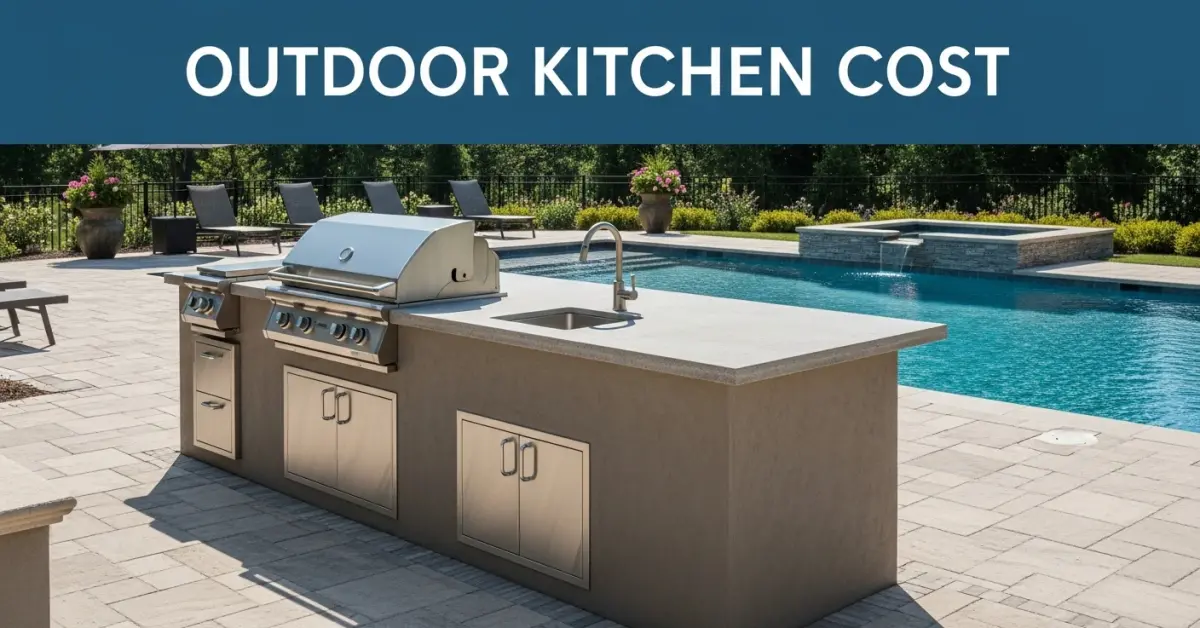
Outdoor Kitchen Cost Charlotte County: A Framework for Eliminating 30% in Long-Term Maintenance Fees
When homeowners in Charlotte County ask me for the cost of an outdoor kitchen, they expect a simple number. The reality I've learned after years of designing and building these projects, from waterfront estates in Punta Gorda Isles to family homes in Port Charlotte, is that the initial quote is only half the story. The real cost is determined by the material and engineering choices made to combat our specific coastal environment: the relentless humidity, the salt-laden air, and the intense UV exposure. I’ve been called in to repair too many five-year-old outdoor kitchens that are literally disintegrating. The wrong stainless steel rusts, the "exterior-grade" cabinets are swollen and moldy, and the stone is permanently stained. My entire approach isn't just about building you a kitchen; it’s about engineering a permanent outdoor asset that won't become a maintenance liability. The budget isn't just a number; it's a direct reflection of future-proofing against the Florida climate.My Coastal Durability Framework: A Diagnostic Approach
Before I even discuss appliances, I perform a site-specific environmental analysis. A project on a canal in South Gulf Cove faces a much higher saline corrosion risk than one further inland in Murdock. This isn't an upsell; it's a fundamental diagnostic step I developed after seeing a high-end grill on a waterfront lanai show pitting rust in under 18 months because the contractor used a lower-grade steel. My framework focuses on material science and micro-climate realities, not just aesthetics.Material Selection Protocol for High-Humidity & Saline Environments
The core of a lasting outdoor kitchen in this region comes down to a few critical, non-negotiable material choices. This is where I see the most expensive mistakes.- Cabinetry: I exclusively specify marine-grade polymers (HDPE) or specific powder-coated stainless steel cabinets. Early in my career, I used a premium sealed-wood product on a project. Within three years, the humidity inside the enclosed lanai caused the doors to warp, compromising the entire structure. HDPE is impervious to moisture, will not delaminate, and is easily cleaned, making it the superior long-term investment.
- Countertops: While granite is popular, its porosity makes it susceptible to staining from grease and Florida's notorious afternoon rain showers. I guide clients toward ultra-compact surfaces like Dekton or high-quality porcelain. These materials have near-zero porosity and offer extreme resistance to both UV fading and thermal shock from a hot pan—a critical feature for our climate.
- Appliance & Hardware Grade: This is a major point of failure. Any appliance or hardware, down to the screws and fasteners, must be 316-grade stainless steel. The common 304-grade, while cheaper, lacks the molybdenum content that provides critical resistance to chloride and salt corrosion. Using 304-grade steel is a planned obsolescence I refuse to build into my projects.
Budget Tiers & Implementation Checklists for Charlotte County Homes
Once the material foundation is set, we can realistically discuss budget tiers. I structure my projects this way so clients understand exactly what they are investing in. Below is a typical breakdown, but remember, the foundation of durable materials is constant across all tiers.The Essential Lanai Kitchen: $15,000 - $30,000
This tier is focused on core functionality and durability, perfect for smaller lanais or courtyard homes.
- Linear footage: 8-10 linear feet of cabinetry
- Structure: High-quality prefabricated modules (HDPE or powder-coated aluminum)
- Countertop: Entry-level quartz or granite (with proper sealing protocol)
- Appliances: 316-grade built-in grill, outdoor-rated refrigerator
- Critical Checklist: Verify existing GFCI outlet capacity, plan for simple propane tank integration.
The Entertainer's Hub: $30,000 - $60,000
This is the most common request I get in areas like Deep Creek, for homeowners who entertain frequently.
- Linear footage: 12-20 linear feet, often in an L-shape
- Structure: Custom-built masonry or high-end modular system
- Countertop: Dekton or premium, non-porous surface
- Appliances: Adds a sink, side burner, and increased storage/drawer systems
- Critical Checklist: Requires dedicated plumbing for the sink and often a new gas line installation. Electrical plan must account for multiple appliances and task lighting.
The Luxury Waterfront Estate: $60,000+
For high-end properties where the outdoor kitchen is a primary feature of the home.
- Linear footage: 20+ feet with islands and multiple zones
- Structure: Fully custom masonry with architectural stone or tile finishes
- Countertop: Top-tier porcelain or exotic stone
- Appliances: Pro-grade grill, pizza oven, ice maker, beverage center, warming drawers
- Critical Checklist: Complex utility mapping is non-negotiable. Requires a structural concrete footing and advanced ventilation systems, especially if under a solid roof, to comply with local building codes.
Precision Engineering: Footings, Ventilation, and Utility Mapping
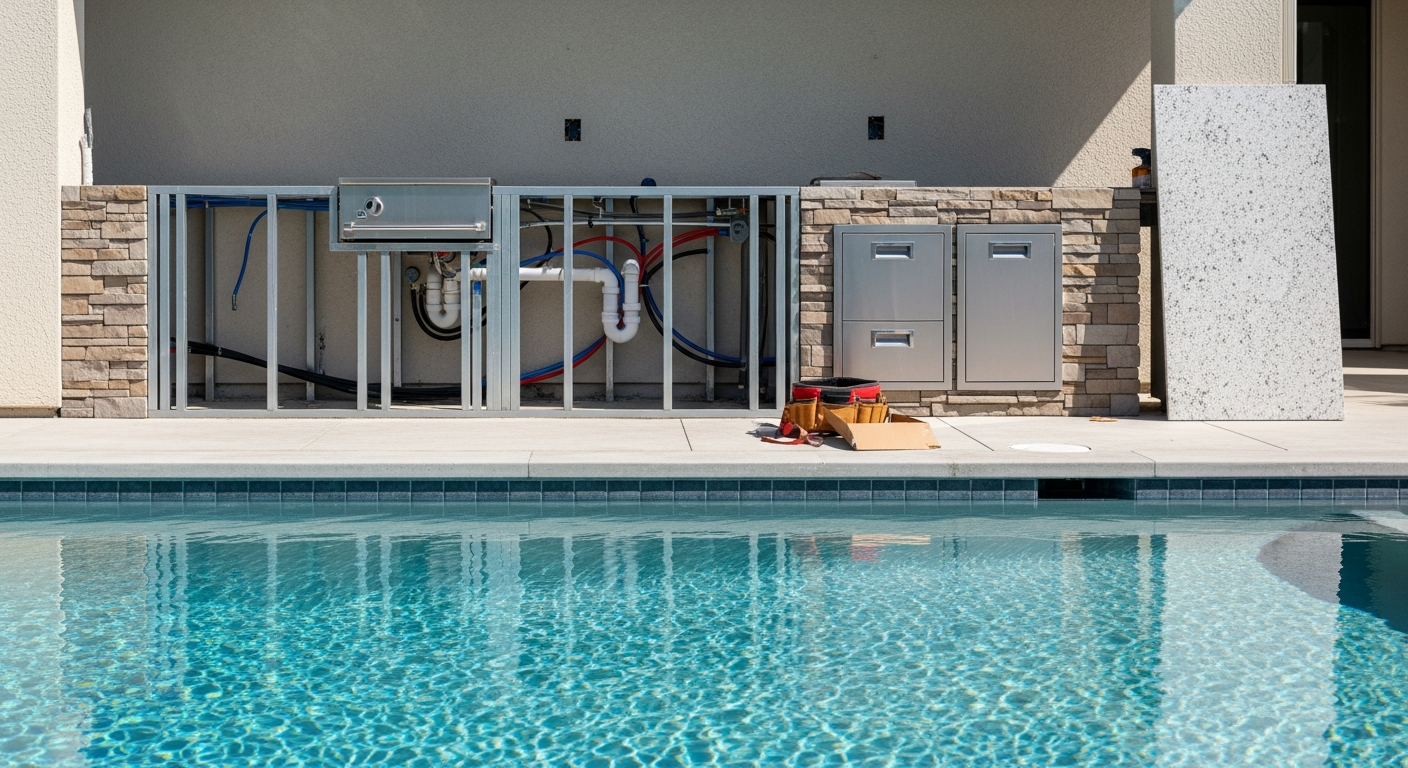
The most beautiful kitchen will fail if its foundation is flawed. In our sandy soil, a proper monolithic concrete slab with integrated footings is absolutely essential to prevent the structure from cracking and shifting over time. For any kitchen installed within a covered lanai, a correctly sized and installed ventilation hood is not just a luxury—it's a safety requirement mandated by NFPA (National Fire Protection Association) codes. We must calculate the required CFM (Cubic Feet per Minute) based on the grill's total BTU output to ensure proper smoke and grease capture, preventing damage to the ceiling and improving air quality. This is a technical step that inexperienced installers frequently overlook, leading to code violations and hazardous conditions. Has your contractor explained how they will prevent galvanic corrosion between the 316-grade stainless steel fasteners and the aluminum framing of your lanai screen enclosure?Written by

Tags
cost for an outdoor kitchen
average cost of outdoor kitchen
average cost for outdoor kitchen
cost to build outdoor kitchen
outdoor kitchen prices
Outdoor Kitchen Cost in Charlotte FL FAQ
What is a realistic all-in budget for a good quality outdoor kitchen?
A realistic starting budget for a professionally installed, high-quality outdoor kitchen is between $15,000 and $30,000. This range typically covers a durable stone or paver structure, a premium built-in gas grill, stainless steel access doors, a sink, and a compact refrigerator. The final cost is heavily influenced by your choice of countertop material, such as granite versus concrete, and the complexity of running new utility lines for gas, water, and electricity. Underestimating the cost of licensed plumbers and electricians is a common mistake that can add thousands to an initial estimate.
How much do appliances add to the total cost compared to the structure itself?
Appliances often account for 30% to 50% of the total outdoor kitchen cost, and skimping here is a long-term mistake. A basic 32-inch built-in grill might be $1,500, while a high-performance model with a sear zone and rotisserie can easily exceed $5,000. Remember that outdoor-rated appliances, especially refrigerators and ice makers, must withstand extreme temperature swings and moisture, making them significantly more expensive than their indoor counterparts. Investing in 304-grade stainless steel is non-negotiable for longevity and rust prevention, especially in coastal or humid climates.
Are prefabricated outdoor kitchen kits a cheaper and better option than custom builds?
Prefabricated kits can lower initial labor costs, but they are not always the cheaper or better long-term solution. While a kit might save you 20-30% upfront compared to a fully custom masonry build, you sacrifice design flexibility and material quality. The biggest hidden issue with many kits is their vulnerability to foundation problems; if your patio slab isn't perfectly level and stable, the pre-built modules can shift and crack. A custom-built concrete block or steel frame structure is anchored to a proper footing, ensuring it won't move with ground settlement.
What are the hidden costs of utility hookups that I should plan for?
Utility hookups for gas, water, and electricity can easily add $3,000 to $8,000, a cost many homeowners overlook. The price escalates with distance from your home's main lines; trenching 50 feet across a landscaped yard is far more expensive than tapping into a line just 10 feet away. A critical, non-obvious cost is the potential need for a dedicated GFCI-protected circuit for appliances, which requires a licensed electrician to run a new line from your main panel. Never assume you can simply use an existing outdoor outlet, as it may not support the load.
Why does the choice of countertop material impact the price so much?
Countertop material dramatically impacts the budget because it dictates both material and specialized labor costs. For example, poured concrete countertops are labor-intensive and can cost $100-$150 per square foot, while a good quality granite slab might be $70-$120. The most critical factor people miss is thermal expansion; dark-colored granite or quartz can get dangerously hot in direct sun and has a higher risk of cracking from thermal shock during rapid temperature changes. Lighter-colored, high-density materials like Dekton or specialized outdoor porcelain are more expensive but offer superior durability against weather and heat.
Do I need a permit for an outdoor kitchen, and how does that affect the cost?
Yes, you will almost certainly need a permit if your outdoor kitchen involves new gas, electrical, or plumbing lines, which adds between $500 and $2,000 to the project cost. This fee covers the application, plan review, and required inspections by your local building department to ensure all work is up to code. Proceeding without a permit is a major risk; if discovered, you could face heavy fines and be forced to tear down the entire structure. A professional contractor will handle the permitting process, but it's a real cost that must be factored into your initial budget.