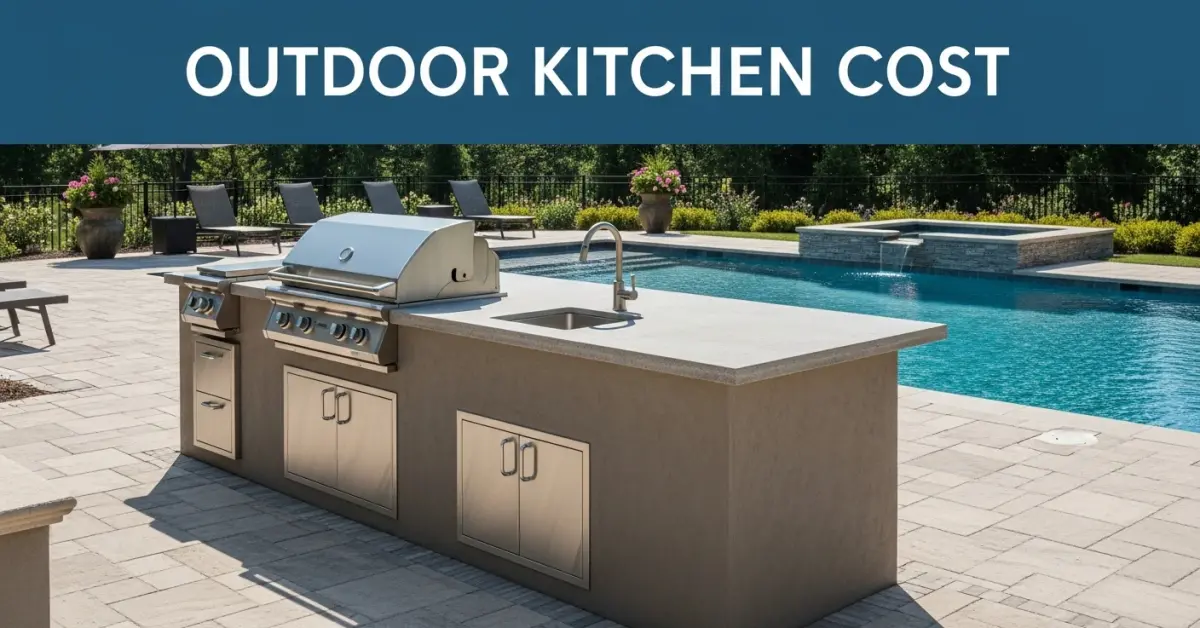
Outdoor Kitchen Cost in Osceola County: My Framework for Pre-empting 35% in Hidden Structural Fees
Most homeowners in Osceola County get sticker shock twice: first from the initial outdoor kitchen quote, and second, about two years later, when the maintenance and repair bills start rolling in. I've seen it happen from the new developments in St. Cloud to the established homes in Kissimmee. The true cost isn't in the shiny grill or the granite countertops; it's in the unseen elements that battle our relentless Florida humidity, sun, and torrential rain. My approach isn't about finding the cheapest materials; it's about calculating the Total Cost of Ownership (TCO) over a decade. A lower upfront cost often means you're buying a problem. My analysis focuses on identifying the specific environmental stressors at your property—be it the direct afternoon sun in a Celebration backyard or the moisture retention in the soil near Lake Tohopekaliga—to build a structure that actually lasts, preventing the most common and costly failures I'm often hired to fix.The Osceola Durability Audit: My Proprietary Diagnostic Method
Before a single dollar is quoted, I perform what I call the "Osceola Durability Audit." This isn't a simple measurement of the space. It’s a technical assessment to forecast long-term performance. I developed this after a project in Harmony where a beautiful travertine patio, part of a six-figure outdoor kitchen, developed hairline fractures within 18 months. The cause wasn't the material, but a standard-spec concrete slab that couldn't handle the localized soil subsidence. The client paid twice for the same floor. My audit bypasses this by analyzing three core variables:- Substrate Stability Analysis: I assess the soil composition and drainage patterns. In many parts of Osceola County, the sandy loam requires a reinforced monolithic slab, not just a basic floating pad, to prevent shifting and cracking.
- UV & Moisture Exposure Mapping: I map the sun's path across the proposed area throughout the day. This dictates material selection. A surface that gets blasted by the 3 PM sun needs a countertop with a high UV-resistance index, like Dekton, not a porous granite that will fade and degrade.
- Salinity & Airflow Evaluation: Even inland, our humid air carries particles that accelerate corrosion. This analysis determines if 304-grade stainless steel is sufficient or if an upgrade to marine-grade 316-grade steel is a non-negotiable investment for cabinet doors and appliance facings.
Technical Material & Structural Specifications
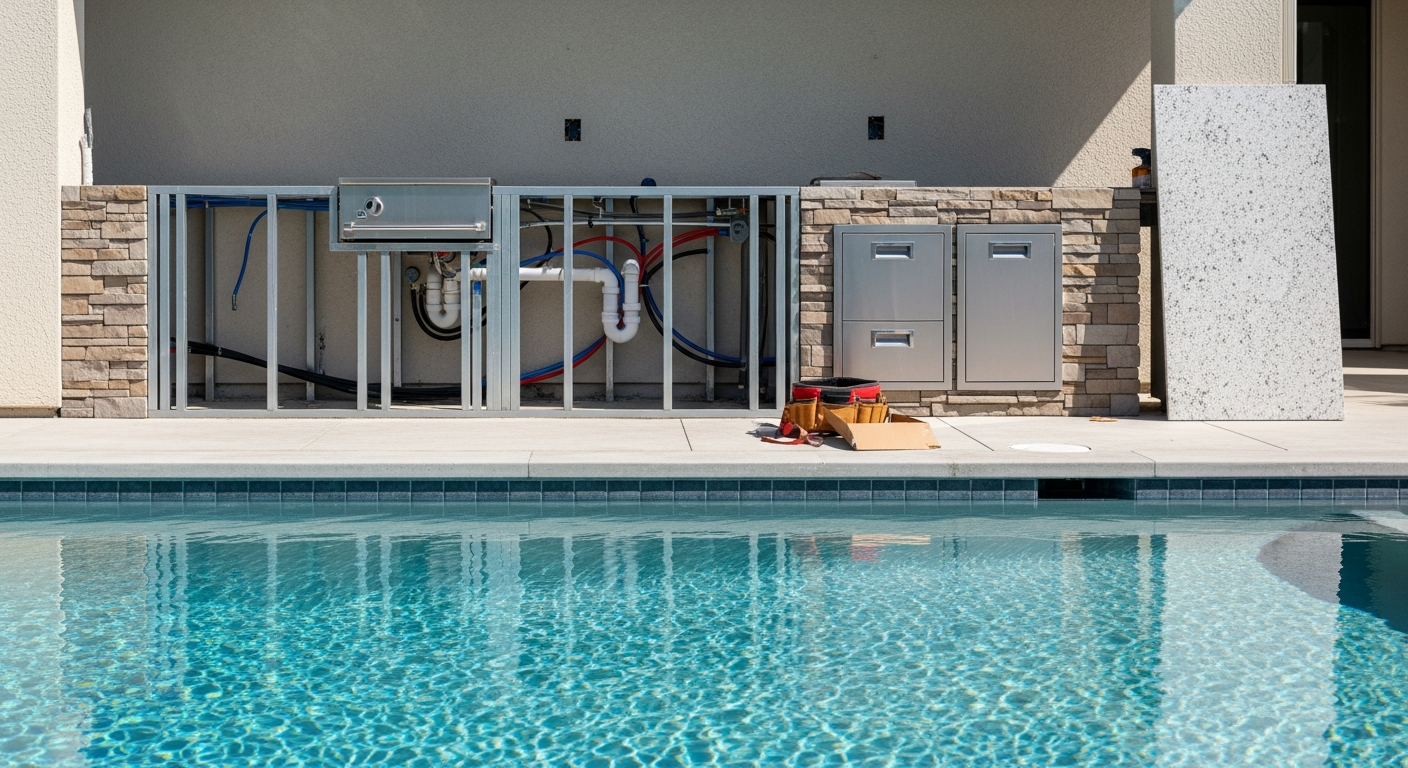
Based on the audit, my specifications become incredibly granular. This is where you gain leverage against inflated costs and future failures. A common error I see is contractors using interior-grade practices outdoors. For instance, using standard mortar for stone veneer. In our climate, I mandate a polymer-modified thinset mortar with a higher bond strength to combat the constant expansion and contraction from heat and humidity. For the core structure, I exclusively build with CMU (Concrete Masonry Unit) blocks on a reinforced concrete footer. I've been called in to replace too many rusted-out steel-stud frames that were sold as a "fast" and "affordable" option. They simply can't withstand the moisture here. Furthermore, every appliance cavity I design includes dedicated passive ventilation channels. I once had to troubleshoot a high-end outdoor refrigerator that kept failing; the issue was zero airflow, causing the compressor to overheat. It's a design flaw that costs thousands to fix after the fact.Implementation Protocol: A Step-by-Step Breakdown
Executing the project correctly is as critical as the design. My methodology follows a strict sequence to ensure structural integrity and system longevity.- Phase 1: Site Preparation & Foundation: This begins with excavation and the installation of proper drainage. We then pour a 4,000 PSI monolithic concrete slab with integrated rebar, ensuring it's properly cured to prevent surface cracking.
- Phase 2: Structural Framing & Utility Runs: The CMU block walls are erected. During this phase, licensed electricians and plumbers run dedicated lines. All outdoor electrical outlets must be GFCI-protected and housed in weatherproof "in-use" covers.
- Phase 3: Cladding & Countertop Templating: The veneer (stone, stucco, etc.) is applied. Once set, we create a precise digital template for the countertops to ensure a perfect fit with minimal seams.
- Phase 4: Countertop & Appliance Installation: The countertops are installed using a high-strength outdoor-rated epoxy. I personally oversee the installation of appliances to ensure all manufacturer requirements for ventilation and clearance are strictly followed.
- Phase 5: Final System Commissioning: Before handover, I conduct a full system check. This includes a gas line leak test, water pressure verification, and testing every single appliance function.
Precision Finishing & Long-Term Quality Standards
The final 5% of the work determines 95% of the long-term satisfaction. Two areas are non-negotiable for me. First, countertop sealing. I don't use a generic topical sealer. My standard is a penetrating, oleophobic sealer that protects the stone from within against grease and water stains. I provide clients with a re-application schedule, as this is a critical maintenance point. Second, grout selection for backsplashes or stone joints. I specify an epoxy-based grout over traditional cementitious grout. While more expensive and difficult to work with, it is virtually stain-proof and will never host mold or mildew—a pervasive issue in the damp Osceola County climate. These small, technical choices are what separate a 5-year kitchen from a 25-year one. Given the intense thermal cycling in Central Florida, have you calculated how the different thermal expansion rates of your countertop, mortar, and CMU block will be managed to prevent shear stress and eventual delamination?Written by

Tags
cost for an outdoor kitchen
average cost of outdoor kitchen
average cost for outdoor kitchen
cost to build outdoor kitchen
outdoor kitchen prices
Outdoor Kitchen Cost in Osceola FL FAQ
What is a realistic all-in budget for a good quality outdoor kitchen?
A realistic starting budget for a professionally installed, high-quality outdoor kitchen is between $15,000 and $30,000. This range typically covers a durable stone or paver structure, a premium built-in gas grill, stainless steel access doors, a sink, and a compact refrigerator. The final cost is heavily influenced by your choice of countertop material, such as granite versus concrete, and the complexity of running new utility lines for gas, water, and electricity. Underestimating the cost of licensed plumbers and electricians is a common mistake that can add thousands to an initial estimate.
How much do appliances add to the total cost compared to the structure itself?
Appliances often account for 30% to 50% of the total outdoor kitchen cost, and skimping here is a long-term mistake. A basic 32-inch built-in grill might be $1,500, while a high-performance model with a sear zone and rotisserie can easily exceed $5,000. Remember that outdoor-rated appliances, especially refrigerators and ice makers, must withstand extreme temperature swings and moisture, making them significantly more expensive than their indoor counterparts. Investing in 304-grade stainless steel is non-negotiable for longevity and rust prevention, especially in coastal or humid climates.
Are prefabricated outdoor kitchen kits a cheaper and better option than custom builds?
Prefabricated kits can lower initial labor costs, but they are not always the cheaper or better long-term solution. While a kit might save you 20-30% upfront compared to a fully custom masonry build, you sacrifice design flexibility and material quality. The biggest hidden issue with many kits is their vulnerability to foundation problems; if your patio slab isn't perfectly level and stable, the pre-built modules can shift and crack. A custom-built concrete block or steel frame structure is anchored to a proper footing, ensuring it won't move with ground settlement.
What are the hidden costs of utility hookups that I should plan for?
Utility hookups for gas, water, and electricity can easily add $3,000 to $8,000, a cost many homeowners overlook. The price escalates with distance from your home's main lines; trenching 50 feet across a landscaped yard is far more expensive than tapping into a line just 10 feet away. A critical, non-obvious cost is the potential need for a dedicated GFCI-protected circuit for appliances, which requires a licensed electrician to run a new line from your main panel. Never assume you can simply use an existing outdoor outlet, as it may not support the load.
Why does the choice of countertop material impact the price so much?
Countertop material dramatically impacts the budget because it dictates both material and specialized labor costs. For example, poured concrete countertops are labor-intensive and can cost $100-$150 per square foot, while a good quality granite slab might be $70-$120. The most critical factor people miss is thermal expansion; dark-colored granite or quartz can get dangerously hot in direct sun and has a higher risk of cracking from thermal shock during rapid temperature changes. Lighter-colored, high-density materials like Dekton or specialized outdoor porcelain are more expensive but offer superior durability against weather and heat.
Do I need a permit for an outdoor kitchen, and how does that affect the cost?
Yes, you will almost certainly need a permit if your outdoor kitchen involves new gas, electrical, or plumbing lines, which adds between $500 and $2,000 to the project cost. This fee covers the application, plan review, and required inspections by your local building department to ensure all work is up to code. Proceeding without a permit is a major risk; if discovered, you could face heavy fines and be forced to tear down the entire structure. A professional contractor will handle the permitting process, but it's a real cost that must be factored into your initial budget.