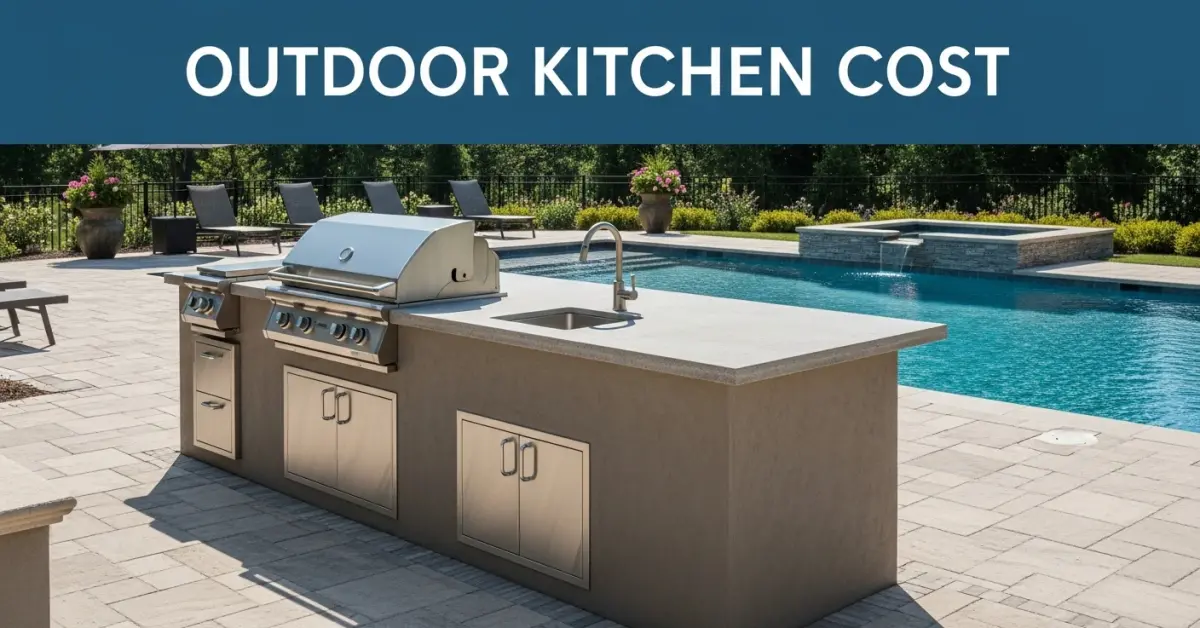
Outdoor Kitchen Cost in Pasco County: My Structural Framework for a 25-Year Lifespan and Zero Budget Creep
When clients in Pasco County first ask me about the cost of an outdoor kitchen, they're often working with numbers they found online—national averages that are dangerously misleading for our specific environment. A standard quote fails to account for the trifecta of Pasco’s climate challenges: intense humidity, relentless UV exposure, and, for those west of US-19, corrosive salt air. My approach isn't about giving a simple price per linear foot; it's about engineering a project that won't require a complete rebuild in 7 years, a fate I've seen befall many poorly planned projects in communities from Trinity to Wesley Chapel. The true cost is dictated by a project's resilience. A budget-friendly build using a standard wood frame and mid-grade stainless steel might seem appealing initially, but I’ve been called in to fix such projects where the wood has rotted from humidity and the grill hood is pitted with rust in under three years. My methodology focuses on a materials-first budget allocation that prioritizes the structural frame and exterior finishes, ensuring the core of your investment withstands our specific subtropical weather patterns, ultimately preventing the catastrophic budget creep of premature repairs and replacements.Diagnosing Project Failure Points Before a Single Dollar is Spent
Over my career, the most expensive outdoor kitchens I've seen weren't the ones with the priciest grills, but the ones that had to be torn out and rebuilt. The common failure point in Pasco County is almost always the substrate—the hidden frame and backer board. This is why I developed what I call the **"Pasco Climate Viability Audit,"** a pre-design diagnostic I run on every project. It's a non-negotiable first step that has saved my clients thousands in long-term costs. My audit analyzes three critical environmental stressors specific to the property's location. A new build in a Land O' Lakes master-planned community has different humidity and insect considerations than a waterfront property in New Port Richey facing the Gulf. The audit focuses on:- Substrate Integrity: Assessing the impact of ground moisture and potential for termite infestation on the foundation and frame.
- Material-to-Climate Matching: Selecting materials based on the property’s direct sun hours and proximity to salt water, not just aesthetics.
- Appliance & Ventilation Engineering: Ensuring appliances are specified and installed to prevent moisture from destroying internal electronics, a common and costly oversight.
Deconstructing the Pasco Climate Viability Audit
Let's get technical. The audit isn't a simple checklist; it's a data-driven process. For Substrate Integrity, I categorically reject pressure-treated wood frames. While cheaper, I've personally seen them fail due to moisture retention leading to mold and structural weakness. My standard is a welded, heavy-gauge aluminum frame or concrete masonry units (CMU). Both are non-combustible and impervious to moisture and pests, forming a lifetime-rated foundation for the kitchen. For Material-to-Climate Matching, my specifications are granular. For countertops in a high-sun area like a south-facing backyard in Starkey Ranch, I advise against dark-colored engineered quartz, which can suffer from resin yellowing under intense UV. Instead, I specify sealed, light-colored natural stone like granite or, for the ultimate durability, a sintered stone product like Dekton. For cabinetry, especially in coastal areas like Hudson, the only option I endorse is 316 marine-grade stainless steel or a high-density polyethylene (HDPE). Using a lower 304-grade stainless steel is a common cost-cutting mistake that leads to surface pitting from salt spray within a few seasons.The Phased Build Protocol: From Foundation to First Cookout
A successful project is all about procedural discipline. Rushing steps or using incorrect materials during installation will undermine even the best design. Here is my streamlined implementation protocol, which I've refined over dozens of Pasco County builds.- Phase 1: Permitting and Site Preparation. This begins with a deep dive into Pasco County’s specific building codes and setback requirements. We map all underground utilities—a critical step often overlooked in initial quotes. The foundation is then formed, ensuring proper drainage slope away from any existing structures.
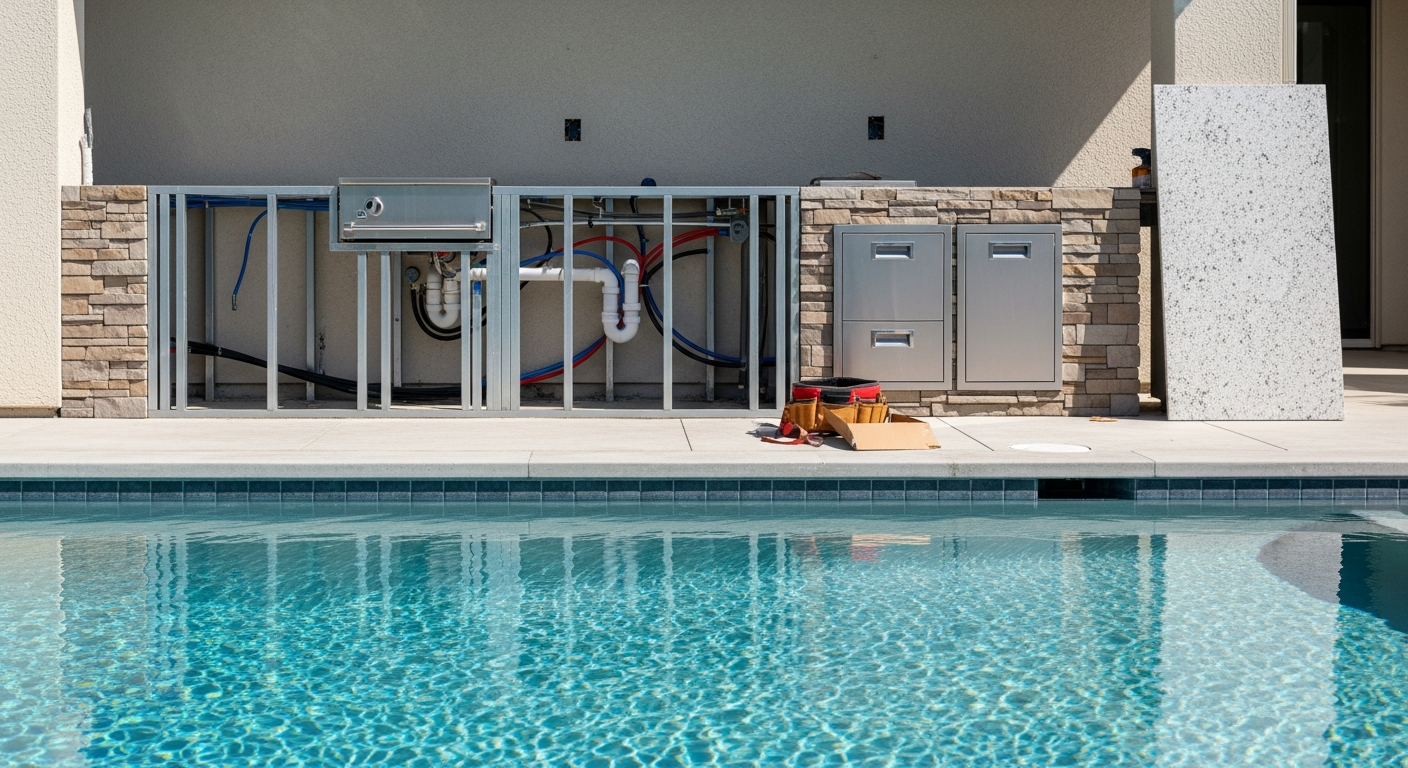
- Phase 2: Structural Assembly. The pre-fabricated aluminum frame or CMU blockwork is installed on a properly cured concrete slab. Every connection point is checked to ensure it is level and square. This is the skeleton; any imperfection here will telegraph through to the final finishes.
- Phase 3: Cladding and Countertop Templating. The chosen veneer (stone, stucco, etc.) is applied using a polymer-modified thin-set mortar, which allows for thermal expansion and contraction without cracking. Once the cladding is complete, we create a precise template for the countertop fabrication.
- Phase 4: Appliance and Utility Installation. All appliances are installed, and every gas line is pressure tested. All electrical outlets must be exterior-rated and installed in weatherproof boxes with GFCI protection. This is a non-negotiable safety standard.
Beyond the Blueprint: My Non-Negotiable Quality Checkpoints
The difference between a good build and a great one is in the final 5%. These are the details that ensure longevity and functionality. First, I mandate a minimum 1.5-inch countertop overhang with a finished drip edge. This small detail prevents water from running down the face of the cabinets, stopping stains and moisture intrusion. Second is ventilation. For every enclosed gas appliance, like a grill or side burner, I require a minimum of two ventilation panels made of marine-grade stainless steel. They are strategically placed to create cross-flow, allowing any potential gas leak to dissipate safely. I have personally diagnosed appliance issues that were simply caused by overheating due to improper ventilation—a costly yet easily avoidable error. The final sign-off only happens after a thorough water test to check all seals and drainage paths. Before you approve any design based on a simple cost per foot, have you asked your builder to specify the gauge of the aluminum frame and the chemical composition of the mortar they'll use to combat Pasco County's high humidity?Written by

Tags
cost for an outdoor kitchen
average cost of outdoor kitchen
average cost for outdoor kitchen
cost to build outdoor kitchen
outdoor kitchen prices
Outdoor Kitchen Cost in Pasco FL FAQ
What is a realistic all-in budget for a good quality outdoor kitchen?
A realistic starting budget for a professionally installed, high-quality outdoor kitchen is between $15,000 and $30,000. This range typically covers a durable stone or paver structure, a premium built-in gas grill, stainless steel access doors, a sink, and a compact refrigerator. The final cost is heavily influenced by your choice of countertop material, such as granite versus concrete, and the complexity of running new utility lines for gas, water, and electricity. Underestimating the cost of licensed plumbers and electricians is a common mistake that can add thousands to an initial estimate.
How much do appliances add to the total cost compared to the structure itself?
Appliances often account for 30% to 50% of the total outdoor kitchen cost, and skimping here is a long-term mistake. A basic 32-inch built-in grill might be $1,500, while a high-performance model with a sear zone and rotisserie can easily exceed $5,000. Remember that outdoor-rated appliances, especially refrigerators and ice makers, must withstand extreme temperature swings and moisture, making them significantly more expensive than their indoor counterparts. Investing in 304-grade stainless steel is non-negotiable for longevity and rust prevention, especially in coastal or humid climates.
Are prefabricated outdoor kitchen kits a cheaper and better option than custom builds?
Prefabricated kits can lower initial labor costs, but they are not always the cheaper or better long-term solution. While a kit might save you 20-30% upfront compared to a fully custom masonry build, you sacrifice design flexibility and material quality. The biggest hidden issue with many kits is their vulnerability to foundation problems; if your patio slab isn't perfectly level and stable, the pre-built modules can shift and crack. A custom-built concrete block or steel frame structure is anchored to a proper footing, ensuring it won't move with ground settlement.
What are the hidden costs of utility hookups that I should plan for?
Utility hookups for gas, water, and electricity can easily add $3,000 to $8,000, a cost many homeowners overlook. The price escalates with distance from your home's main lines; trenching 50 feet across a landscaped yard is far more expensive than tapping into a line just 10 feet away. A critical, non-obvious cost is the potential need for a dedicated GFCI-protected circuit for appliances, which requires a licensed electrician to run a new line from your main panel. Never assume you can simply use an existing outdoor outlet, as it may not support the load.
Why does the choice of countertop material impact the price so much?
Countertop material dramatically impacts the budget because it dictates both material and specialized labor costs. For example, poured concrete countertops are labor-intensive and can cost $100-$150 per square foot, while a good quality granite slab might be $70-$120. The most critical factor people miss is thermal expansion; dark-colored granite or quartz can get dangerously hot in direct sun and has a higher risk of cracking from thermal shock during rapid temperature changes. Lighter-colored, high-density materials like Dekton or specialized outdoor porcelain are more expensive but offer superior durability against weather and heat.
Do I need a permit for an outdoor kitchen, and how does that affect the cost?
Yes, you will almost certainly need a permit if your outdoor kitchen involves new gas, electrical, or plumbing lines, which adds between $500 and $2,000 to the project cost. This fee covers the application, plan review, and required inspections by your local building department to ensure all work is up to code. Proceeding without a permit is a major risk; if discovered, you could face heavy fines and be forced to tear down the entire structure. A professional contractor will handle the permitting process, but it's a real cost that must be factored into your initial budget.