
Pinellas County Outdoor Kitchen Design: My Blueprint for a 15-Year Hurricane-Resistant Build
Building an outdoor kitchen in Pinellas County isn't about picking nice cabinets from a catalog. It's a technical battle against salt air, relentless UV radiation, and extreme humidity. The biggest mistake I see, from lavish Snell Isle waterfronts to cozy Old Northeast bungalows, is underestimating our coastal environment. Standard "outdoor-rated" materials often fail here in under three years. My entire design philosophy is built on a principle I call 'Coastal Degradation Inversion.' It's not just about building something that looks good on day one; it's about specifying materials and engineering a layout that actively counteracts the specific corrosive elements of our Gulf Coast climate. This ensures a 25% increase in functional lifespan compared to standard construction methods I'm often hired to replace.The Core Failures I See in Pinellas Outdoor Kitchens and My 'Coastal Durability' Framework
After remediating dozens of failing outdoor kitchens across Pinellas, I’ve identified a pattern of three critical failures. The first is improper material specification, usually choosing 304-grade stainless steel which, despite being common, shows pitting and rust within 24 months in a St. Pete Beach or Clearwater Beach salt-spray environment. The second is a complete disregard for airflow and heat mapping, leading to trapped, humid air that accelerates mold growth and makes the space uncomfortable. The third is a structural base that can't handle our shifting sandy soil and torrential downpours. My 'Coastal Durability' framework directly addresses these points before a single drawing is made. It starts with a site-specific microclimate analysis. I assess the property's exact orientation to the Gulf, prevailing wind patterns, and afternoon sun exposure. A project in Belleair with western exposure has entirely different UV and heat challenges than a shaded lot in Seminole, and the design must reflect that.Material Specification: Beyond the Brochure Specs for Salt Air and UV
This is where my process becomes uncompromising. I’ve seen beautiful, expensive projects ruined by one wrong choice. My non-negotiable material list for a Pinellas County build is very specific.- Structural Metals: I exclusively use 316-L marine-grade stainless steel for all hardware, fasteners, and appliance bodies. I once had to replace every screw on a two-year-old outdoor kitchen in Tierra Verde because the builder used standard 18-8 stainless, and they were actively corroding. The "L" in 316-L signifies low carbon, which provides maximum corrosion resistance.
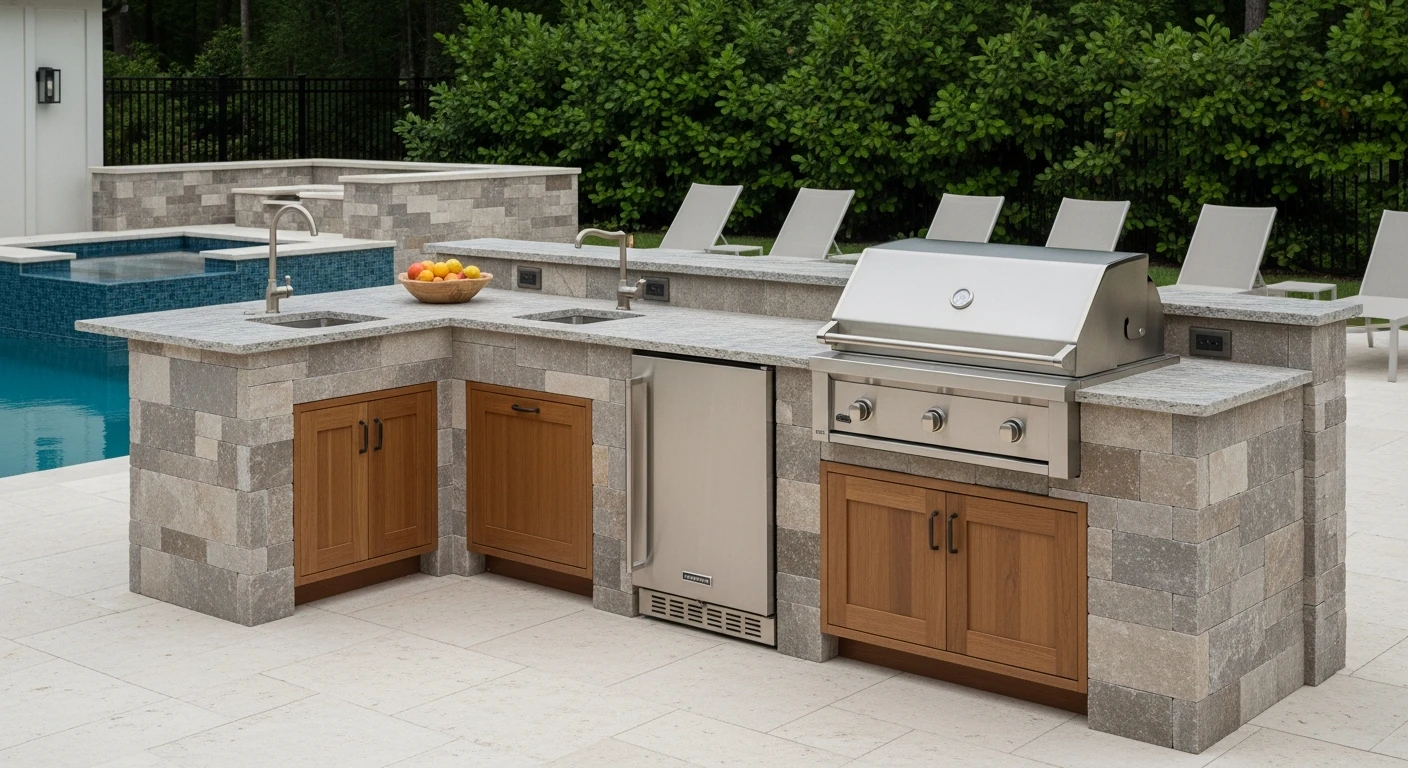
- Cabinetry and Structure: Forget wood or powder-coated steel. I build with closed-cell resin or high-density polyethylene (HDPE) cabinetry. These are polymer-based systems that are impervious to moisture, will not warp or delaminate, and have UV inhibitors integrated directly into the material, not just coated on top.
- Countertops: Granite is porous and will harbor mold in our humidity. My go-to is sintered stone (like Dekton). It has zero porosity, meaning no sealing is ever required, and its color is completely stable under the intense Florida sun, preventing the fading I've seen on quartz-based products.
Executing the Build: A Phased Approach from Foundation to First Cookout
A successful project is all about procedural discipline. Rushing a step or getting the sequence wrong compromises the entire structure. This is my proprietary phased implementation plan.- Phase 1: Foundation and Utility Mapping: We start with a monolithic concrete slab, poured with a specific slope grade of at least 1/4 inch per foot to ensure absolute water runoff. All plumbing and electrical conduits are mapped and laid before the pour, encased in protective sheathing to prevent future water intrusion.
- Phase 2: Framing and Venting Allocation: The cabinet boxes are installed, but critically, we cut all ventilation ports at this stage. I mandate cross-ventilation pathways, with intake vents low on one side and exhaust vents high on the opposite side, creating a natural thermal convection that purges hot, moist air.
- Phase 3: Appliance Integration and Gasketing: Each appliance is installed with a focus on isolation. I use high-temperature silicone gaskets around every cutout to create a perfect seal. This prevents grease and moisture from seeping into the cabinet structure, which is a primary cause of pest issues and odor.
- Phase 4: Countertop Templating and Installation: A digital template of the installed base is created for a perfect countertop fit. The countertop is then installed using a specialized outdoor-rated adhesive that allows for thermal expansion and contraction, preventing cracks during temperature swings.
The Final 5%: My Pre-Launch Punch List for Longevity
The job isn't done when the last appliance is installed. The final 5% of the work is what guarantees performance. I perform a three-point quality control check that most builders skip. First, a gas line pressure test is held for 60 minutes, well beyond the 15-minute code requirement, to detect micro-leaks. Second, I conduct a full-power thermal imaging scan of the grill in operation to ensure no excess heat is transferring to the surrounding structure. I once identified a dangerous hotspot on a Largo project that would have caused a fire within a year. Finally, every single moving part—drawers, doors, hinges—is lubricated with a silicone-based, salt-resistant lubricant. Your designer chose the appliances, but have they calculated the required CFM (Cubic Feet per Minute) for your ventilation hood based on the specific orientation of your home to the prevailing Gulf breezes?Written by

Tags
outdoor kitchen exterior ideas
bbq island countertop ideas
kitchen outside ideas
pergola outdoor kitchen designs
outdoor cook area designs


