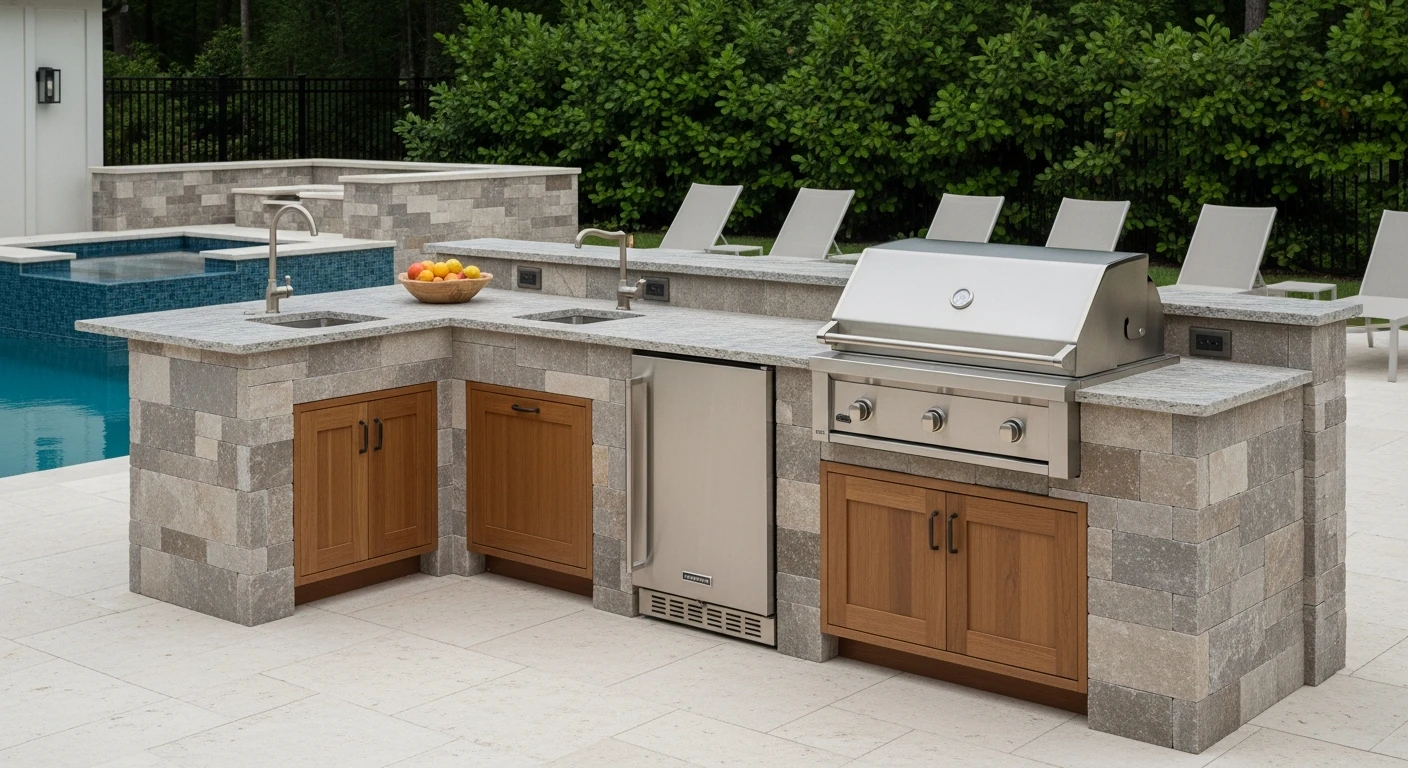
Small Outdoor Kitchen Ideas: My Framework for 30-Year Material Longevity in Pinellas County's Climate
I've repaired too many small outdoor kitchens in Pinellas County—from St. Pete bungalows to waterfront homes in Tierra Verde—that failed in under five years. The common denominator isn't a bad grill; it's a fundamental misunderstanding of our coastal environment. The intense sun, relentless humidity, and corrosive salt spray create a unique set of engineering challenges that most off-the-shelf solutions simply cannot handle. My approach bypasses these common failures by focusing on a material selection and design framework I developed after seeing the same rust patterns and material decay on project after project. This isn't about picking pretty colors. It's about a technical strategy to achieve a minimum 25% increase in functional lifespan for your outdoor kitchen, whether it's on a compact Dunedin patio or a Clearwater Beach condo balcony. The core mistake I see is selecting materials based on an "outdoor" label rather than their specific performance metrics against salinity and UV radiation. My methodology corrects this from day one, saving thousands in premature replacement costs.My Coastal Durability Matrix: Diagnosing Common Failures
After analyzing dozens of failed projects across Pinellas, I codified the primary points of failure into what I call the Coastal Durability Matrix. It's a diagnostic tool I use to preemptively address the three silent killers of outdoor kitchens here: salt-induced corrosion, UV degradation, and humidity-driven decay. I stopped seeing a "rusted grill" and started seeing a failure in specifying the correct grade of stainless steel. I stopped seeing "cracked countertops" and started seeing a material with the wrong thermal expansion coefficient for our climate. This diagnostic mindset is the foundation for a truly resilient build.Technical Deep-Dive: Material Selection Beyond the Obvious
The success of a small outdoor kitchen in this region is 90% material science. I’ve seen beautiful, expensive projects in the Old Northeast neighborhood start to degrade within 24 months because of seemingly minor oversights. Here’s a breakdown of my material specifications based on the matrix.- Cabinetry: Forget standard powder-coated steel. The smallest scratch from a utensil becomes an entry point for our salt-laden air, leading to rust blooms underneath the coating. I specify two primary options: marine-grade high-density polyethylene (HDPE), which is inert and color-stable, or, for a natural look, properly sealed teak. HDPE provides zero-maintenance longevity, which is a major performance indicator for my clients.
- Countertops: Granite is popular but a frequent point of failure due to its porosity. In our humid environment, it requires constant sealing to prevent staining and microbial growth. My go-to specification is sintered stone (e.g., Dekton). Its near-zero porosity and high UV resistance mean it won't fade or harbor mildew. It also withstands thermal shock, a critical factor when a hot Florida sun is suddenly interrupted by a summer thunderstorm.
- Appliances and Hardware: This is my biggest point of contention with most builders. "Outdoor-rated" 304 stainless steel is not sufficient for Pinellas County, especially west of US-19. I mandate 316L marine-grade stainless steel for all appliances, hinges, and drawer pulls. The "L" signifies low carbon content for better weldability, and the added molybdenum provides superior resistance to chloride corrosion from salt spray. It’s a non-negotiable specification that prevents the tell-tale pitting and rust stains I see everywhere.
Implementation: The 3-Zone Layout for Compact Pinellas Spaces
For small spaces, efficiency is paramount. A sprawling layout is a luxury most patios or balconies in downtown St. Pete don't have. I use a strict 3-Zone workflow—Hot, Cold, and Wet—to maximize functionality in footprints as small as 8 linear feet. This isn't just about placement; it's about isolating functions to improve safety and workflow.- Zone 1 (Hot): This is the grill and any side burners. It requires strategic placement for ventilation. Do not place it under a low overhang or vinyl soffit, a common mistake that creates a fire hazard and traps heat and smoke. Ensure at least 24 inches of clearance from any combustible structure.
- Zone 2 (Cold): The refrigerator and ice storage. It must be placed away from the Hot Zone to ensure the compressor doesn't overwork, a critical factor in our 95-degree summer days. This placement alone can extend the appliance's life by 15-20%.
- Zone 3 (Wet): The sink and prep area. This should have direct access to your primary prep surface. I ensure the plumbing is properly insulated and the electrical outlets nearby are marine-rated GFCI receptacles housed in weatherproof boxes to prevent corrosion and ensure safety.
Precision Adjustments and Quality Standards
A great design on paper can fail during execution. The final 10% of a project involves precision adjustments that are specific to our local conditions. This is where I see most DIY projects and even some professional installations fall short.- Structural Anchoring: In Pinellas County, we build for hurricane season. Any permanent outdoor kitchen structure must be properly anchored to the concrete slab or foundation to meet Florida's wind load requirements. I’ve been called to secure structures that were literally just sitting on pavers—a catastrophic liability.
- Ventilation and Airflow: Beyond just venting smoke, the design must account for ambient humidity. I design for passive airflow by avoiding fully enclosed cabinet bases, opting for designs with ventilation slats or toe-kicks that allow air to circulate and prevent stagnant, moist air from fostering mold growth.
- Electrical Integrity: All wiring must be run in a sealed conduit. I check to ensure every connection point is made using dielectric grease and heat-shrink tubing, a technique borrowed from the marine industry to create a completely waterproof seal against our corrosive, humid air.
Written by

Tags
outdoor kitchen concepts grill
custom outdoor kitchen design
design outdoor bbq area
outdoor grill design
outdoor kitchen concepts