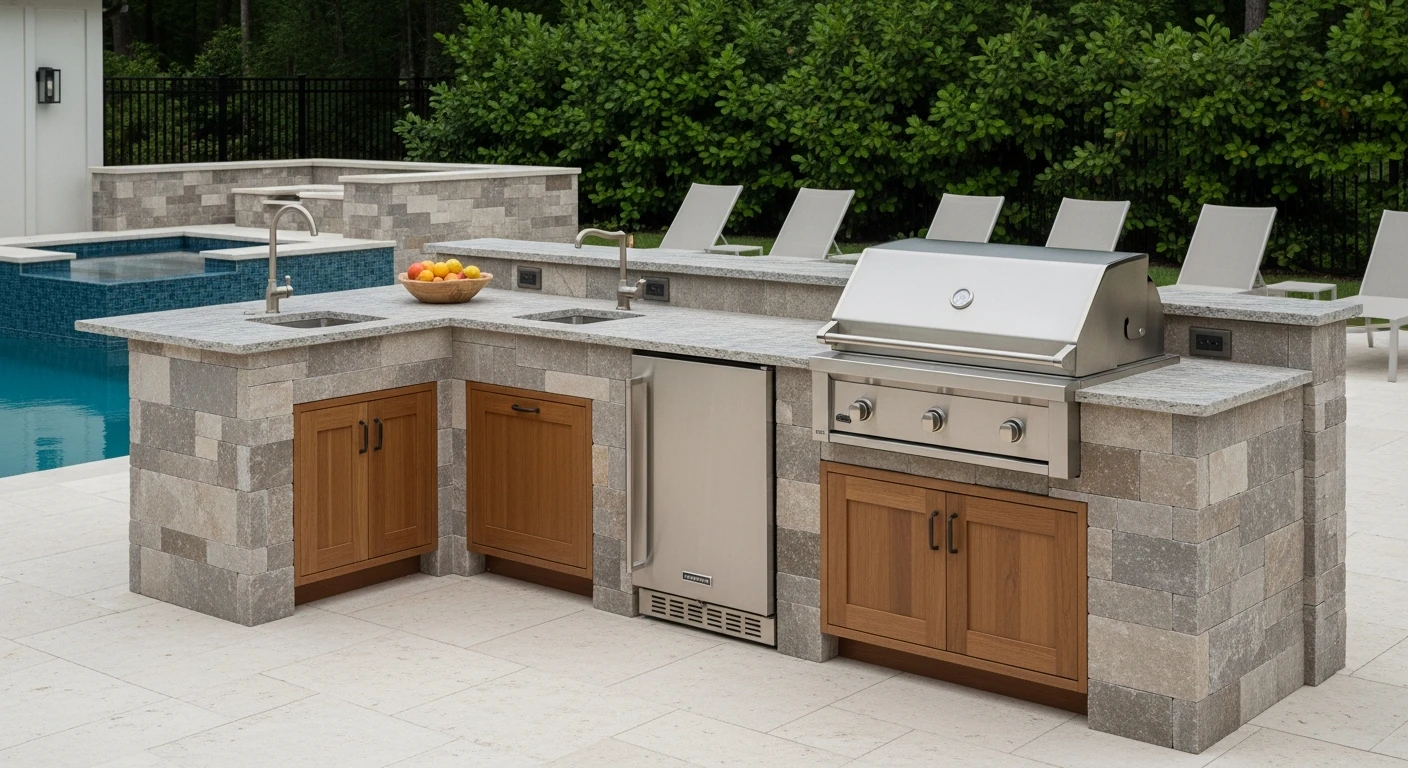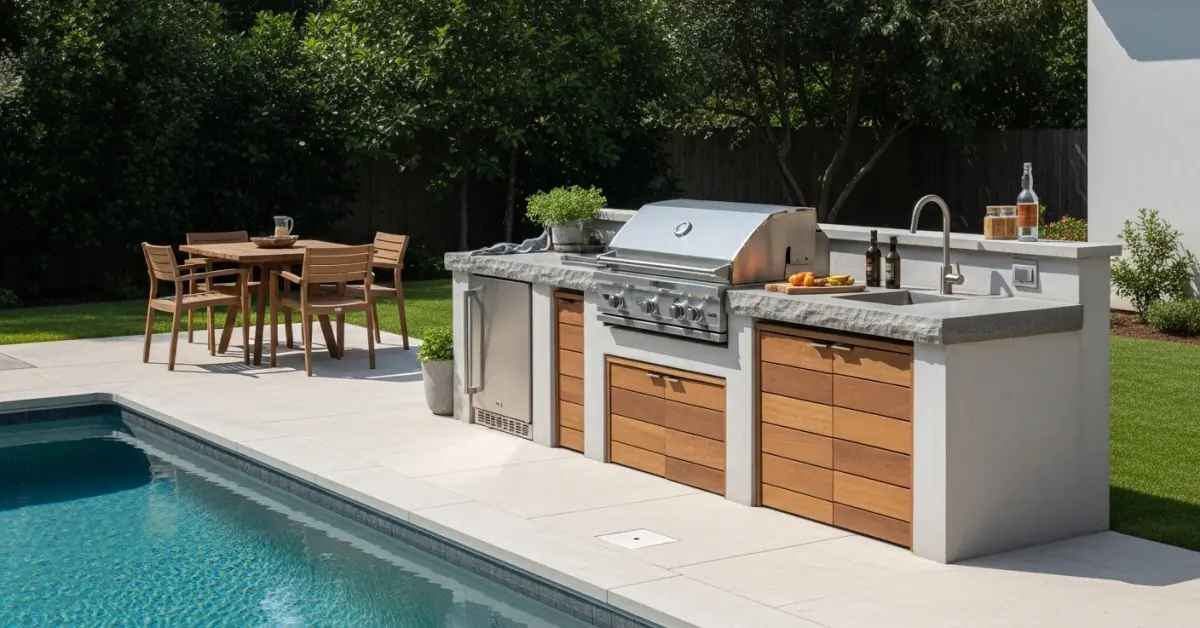
Outdoor Kitchens in Charlotte County: Material Protocols for a 30-Year Lifespan Against Salt Air Corrosion
As a designer specializing in high-performance outdoor structures, I've seen more outdoor kitchens in Charlotte County fail in five years than most see built in a lifetime. The common denominator isn't budget or brand; it's a fundamental misunderstanding of our local environment. The beautiful salt breezes from Charlotte Harbor that make living in Punta Gorda so desirable are the very thing that will aggressively corrode a poorly specified project. Your search for "ideas" must start with material science, not just aesthetics. The biggest mistake I consistently remedy in projects from Port Charlotte to Englewood is the selection of standard "outdoor-rated" materials that simply can't withstand our specific combination of **high salinity, intense UV exposure, and year-round humidity**. My entire approach is built on preventing this premature decay, ensuring the structure not only looks good on day one, but performs flawlessly for decades. This isn't about over-engineering; it's about precision engineering for our unique coastal conditions.My Diagnostic Framework for Climate-Proof Kitchens
Before I even sketch a layout, I run every project through what I call my proprietary **Coastal Durability Matrix**. It's a non-negotiable diagnostic process that filters out 90% of common failure points. I developed this after a large-scale project in Punta Gorda Isles where a competitor's kitchen, less than three years old, showed advanced rust pitting on all appliance faces and fastener heads. The owner had a beautiful layout that was, functionally, crumbling. My matrix analyzes three critical layers: Material Science, Airflow Dynamics, and Foundational Integrity.Technical Deep Dive: The 316L Stainless Steel Imperative
Let's focus on Material Science, as it's the most immediate point of failure. The term "stainless steel" is dangerously vague. Most outdoor appliances and cabinets are made from 304-grade stainless steel. In most parts of the country, that's perfectly adequate. Here in Charlotte County, it's a planned obsolescence. The chloride in our salt air aggressively attacks 304 steel, causing pitting and rust. My protocol makes **marine-grade 316L stainless steel** a mandatory specification for any metallic component, from grill heads and access doors to screws and fasteners. The "L" signifies low carbon content, and the key difference is the addition of molybdenum, which provides a massive increase in corrosion resistance. I've seen 304-grade screws bleed rust stains down a beautiful stone facade in less than a year on an Englewood waterfront property. For cabinetry, I often steer clients toward marine-grade polymers like HDPE, which are impervious to salt and humidity and eliminate this risk entirely.Step-by-Step Implementation for Your Lanai or Waterfront Property
Translating this methodology into a physical build requires a strict, methodical process. The average "builder" often skips these verification steps to save time, which costs the homeowner exponentially more in the long run. Here is my core implementation checklist:- Foundation & Site Analysis: For any home, especially the canal-front properties common here, the concrete foundation for the kitchen island must be properly sealed with a penetrating hydrophobic sealer before framing begins. This prevents moisture from wicking up into the structure, which is a primary cause of mold and cabinet delamination.
- Material Sourcing & Verification: I don't take a supplier's word for it. My process requires that I personally review the **material specification sheet** for every single component. If it doesn't explicitly state "316L" or "Marine-Grade Polymer," it is rejected. This single action is the most crucial step in ensuring longevity.
- Appliance & Ventilation Strategy: Within the popular screened-in lanais of Port Charlotte, proper ventilation is a safety and performance critical issue. I specify grill units with a high CFM exhaust hood vented directly outside the screen, not just into the lanai's open space. This prevents dangerous gas buildup and stops greasy smoke from staining the ceiling and furniture. All appliances must be UL-rated for outdoor use, not just "outdoor-friendly."
- Countertop & Grout Selection: The intense sun and heat demand a countertop with low thermal expansion. I've had great success with ultra-compact surfaces like Dekton. More importantly, I forbid the use of standard cementitious grout. My standard is an **epoxy-based grout**, which is non-porous and will not stain or support mold and mildew growth in our humid climate.
Precision Tuning for Longevity and Low Maintenance
The final 10% of the work is what separates a good kitchen from a generational asset. This is where precision adjustments lock in the performance. I insist on using only **marine-grade wiring and sealed junction boxes** for all electrical connections, with every outlet being a weather-resistant GFCI. After the build is complete, I conduct what I call a "Monsoon Simulation"—a sustained, high-pressure water test on all surfaces and joints to confirm perfect drainage and identify any potential water intrusion points before they become a problem. This stress test has saved clients thousands by revealing tiny sealing flaws that would have led to major water damage within the cabinet structure during our first summer storm. Have you calculated the galvanic corrosion potential between your proposed stainless steel grill and the aluminum framing of your lanai, or is your outdoor kitchen's failure point already built-in?Written by

Tags
outdoor kitchen ideas near me
outdoor kitchen remodeling
backyard kitchen and pool designs
backyard pool and kitchen designs
outdoor kitchen designers
Outdoor Kitchen Ideas in Charlotte FL FAQ
What materials should I choose for cabinets and countertops that won't get ruined by my saltwater pool?
You must select materials specifically rated for coastal or marine environments to prevent rapid corrosion and degradation. For cabinets, marine-grade polymers or teak are superior choices over standard stainless steel, which can still show rust spots from constant salt exposure. For countertops, opt for non-porous materials like granite or sealed concrete, as they resist staining from both food and pool chemicals. A common mistake is using porous stone like travertine, which can absorb chlorinated water and discolor or weaken over time, leading to costly replacement.
Where is the best place to locate my outdoor kitchen relative to the pool?
Position your outdoor kitchen at least 10 to 15 feet away from the pool's edge and downwind from the prevailing breeze direction. This placement minimizes the amount of grease, smoke, and food debris that blows into your pool water, which can clog your cartridge filter and throw off your water chemistry. Placing a grill too close also creates a safety hazard with wet, running children. A poorly placed kitchen can double your pool cleaning workload and increase chemical consumption as you constantly fight organic contaminants.
Do I need a separate drainage system for my outdoor kitchen sink and grill?
Yes, your outdoor kitchen requires a dedicated drainage system completely separate from your pool's plumbing and the surrounding deck drains. Kitchen drainage contains grease, food particles, and cleaning agents that must be routed to your home's sanitary sewer line, not the storm drain or pool filter system. Allowing greasy runoff to enter your pool's skimmer can create a serious scum line and overwhelm your filtration, while draining it onto the deck creates a dangerous, slippery surface and can stain the concrete or pavers.
What are the most important safety features to consider for an outdoor kitchen next to a pool?
Your primary safety focus should be on electrical and fire prevention, especially in a wet environment. All electrical outlets must be GFCI-protected (Ground Fault Circuit Interrupter) and installed in weatherproof boxes to prevent electrocution risk. Ensure your grill has at least 36 inches of clearance from any combustible structures, and install a non-slip surface on the flooring in the kitchen area. A critical but often overlooked feature is task lighting; good illumination prevents accidents during evening cooking and helps you see what you're doing around hot surfaces.
Will adding a refrigerator or ice maker outdoors affect my utility bills much?
An outdoor-rated refrigerator or ice maker will noticeably increase your electricity bill, as it must work much harder to maintain cold temperatures in direct sun and high heat. Unlike an indoor unit, an outdoor model's compressor may run almost constantly on hot summer days, potentially adding $20-$50 per month to your utility costs depending on the climate and unit efficiency. To mitigate this, install the appliance in a shaded area and ensure it has proper ventilation around the back and sides to prevent overheating and premature failure.
How do I prevent pests like ants and rodents from invading my outdoor kitchen?
Effective pest control requires eliminating access to food, water, and shelter by sealing your kitchen components tightly. Choose cabinets with tightly sealed doors and drawers, and ensure any utility pass-throughs for gas or water lines are sealed with caulk or spray foam. A built-in trash bin with a heavy, self-closing lid is essential. The most overlooked step is cleaning the grease trap or drip pan on your grill after every use; accumulated grease is a primary attractant for everything from ants to raccoons.