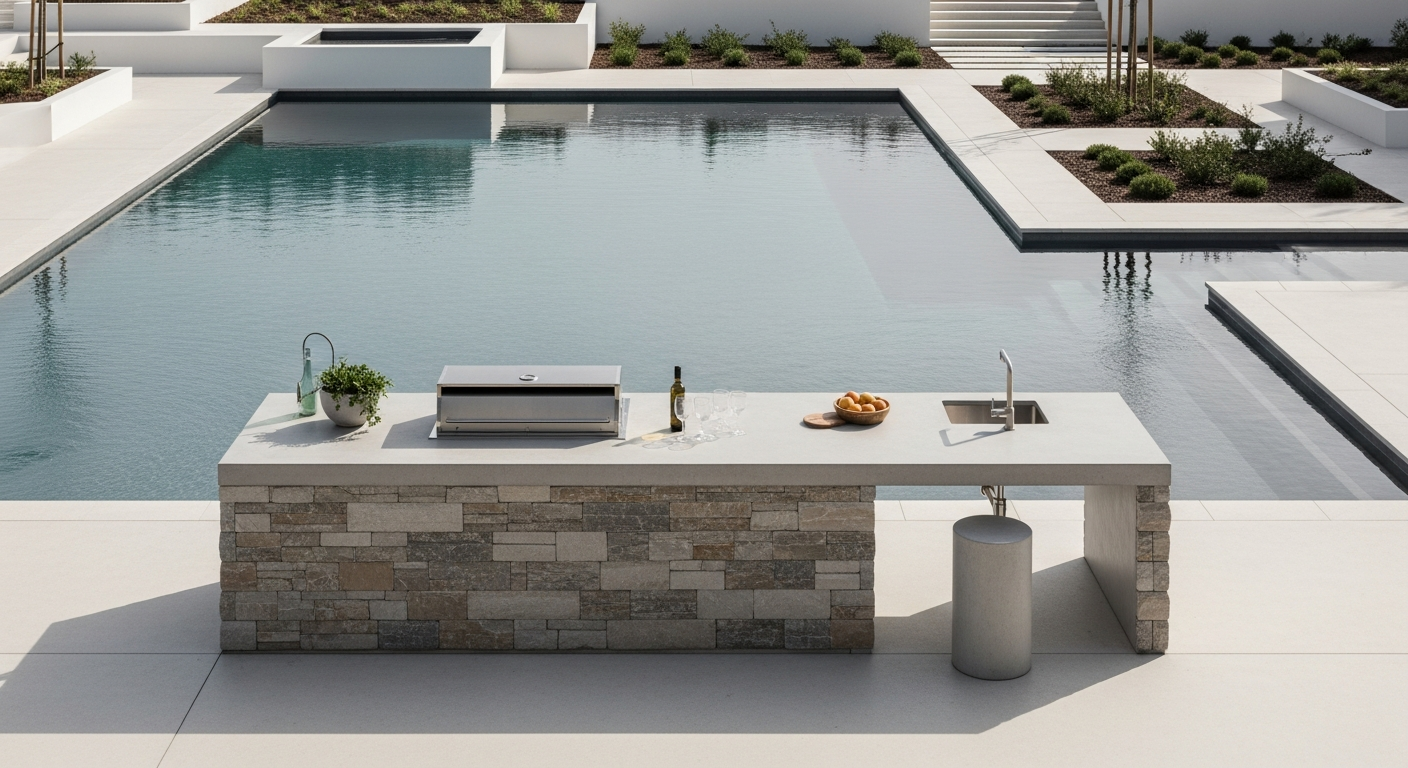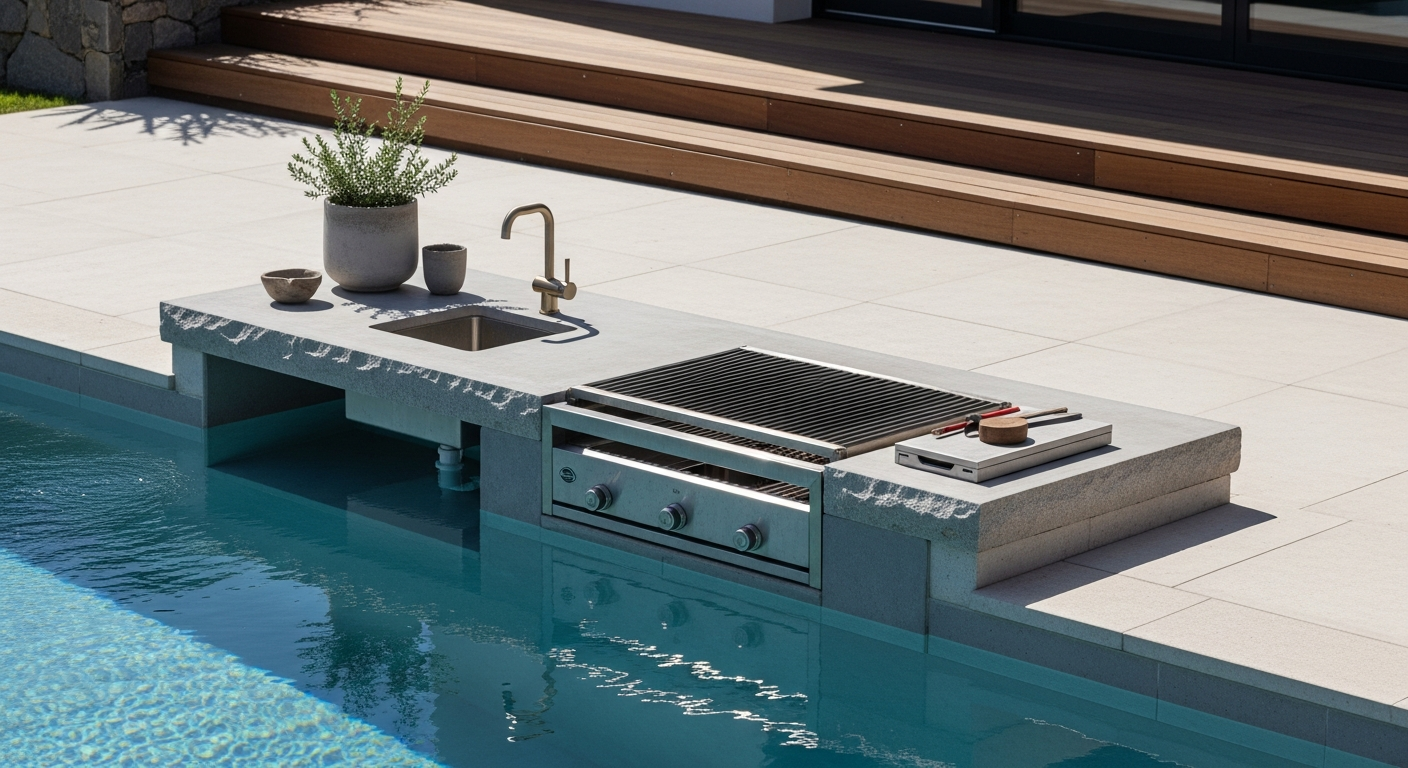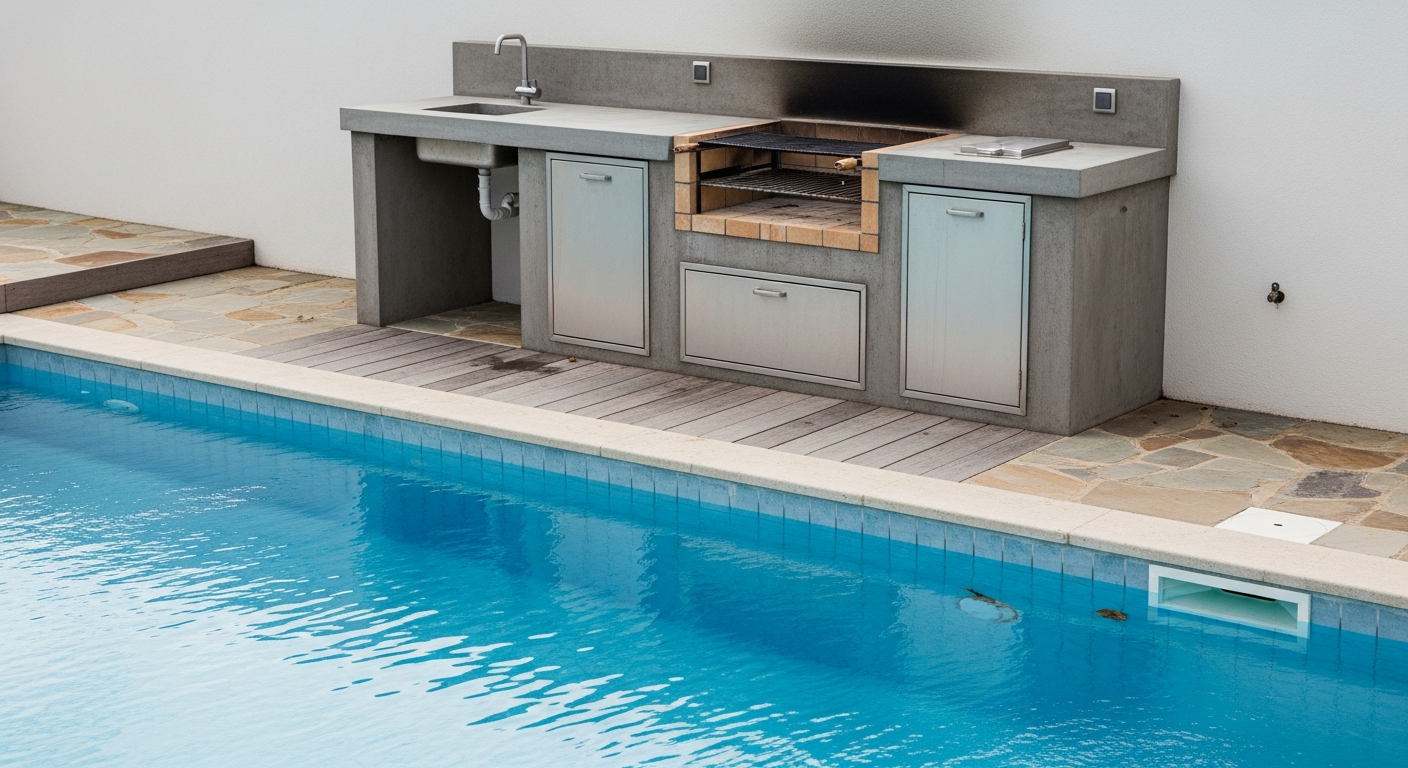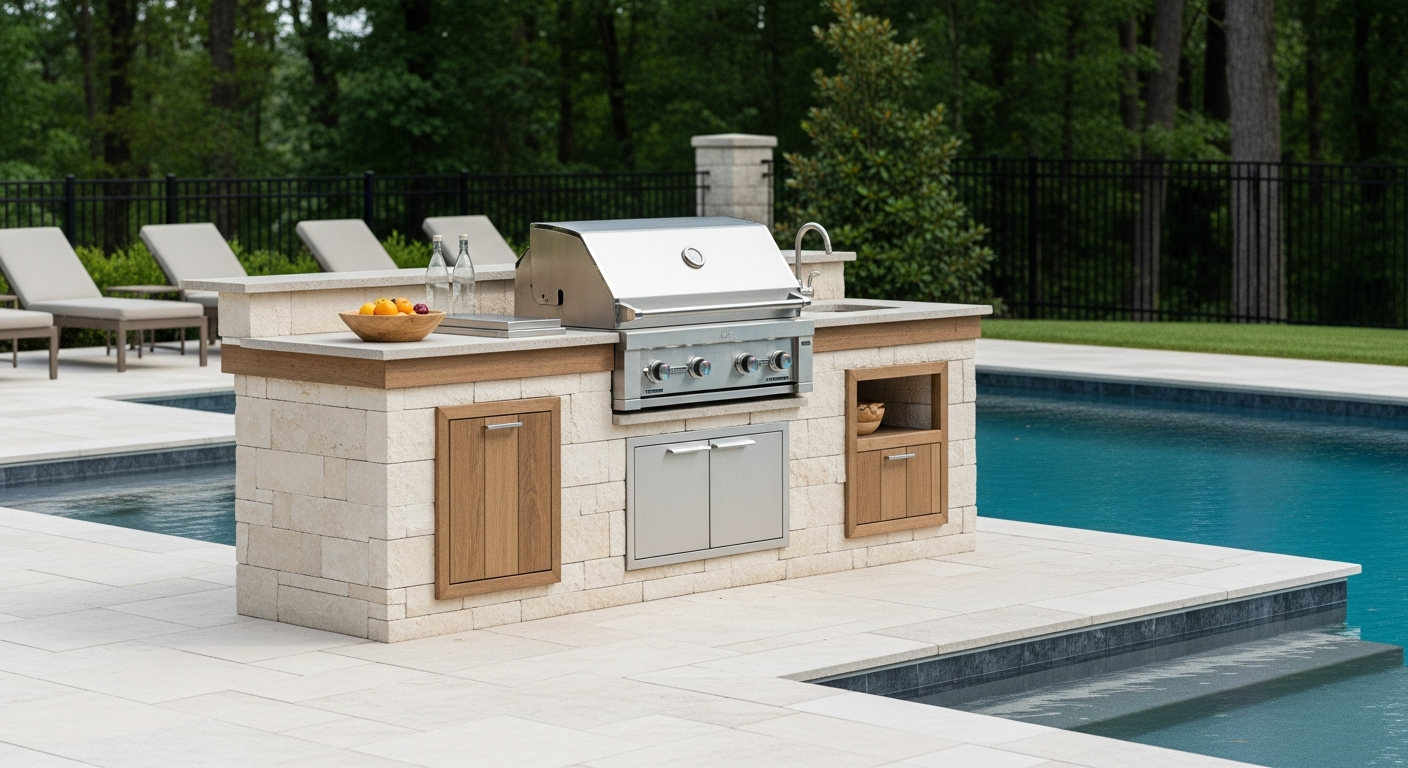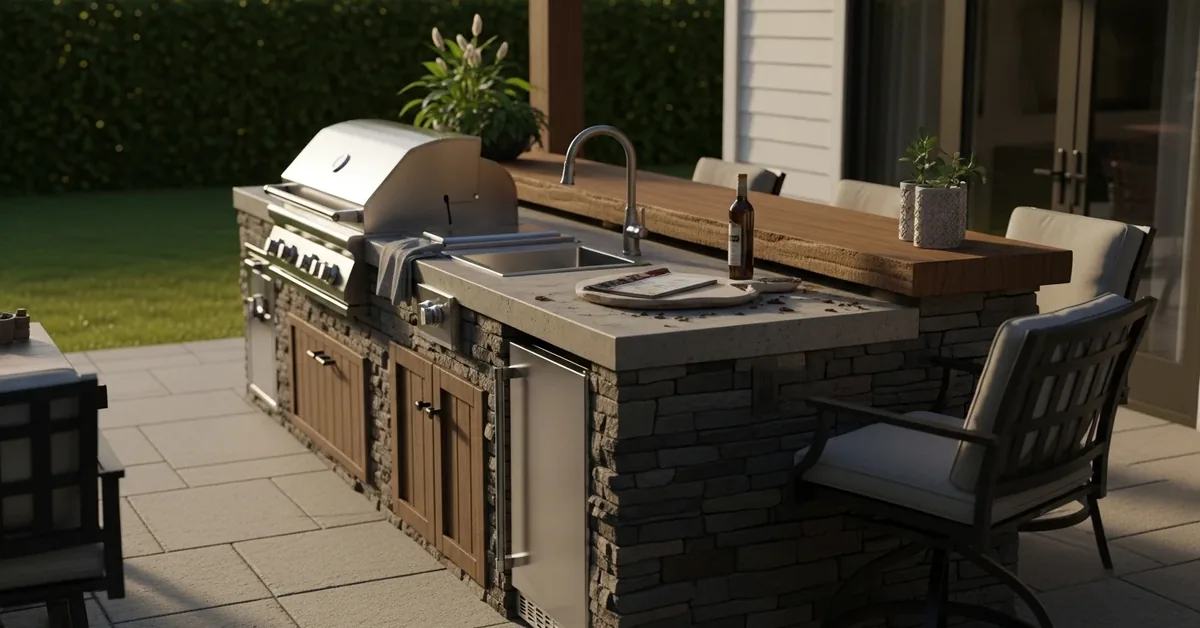
Outdoor Kitchen Island Design for Lee County: A Framework for 30-Year Material Integrity Against Salt and Humidity
The single most expensive mistake I see homeowners make in Lee County—from the canal-front properties in Cape Coral to the expansive lanais in Bonita Springs—is underestimating our corrosive, humid climate. They approve designs based on aesthetics seen in a national magazine, only to call me two years later when their "stainless steel" is rusting and the cabinet bases are swelling. My entire approach is built on a material-first principle, using a proprietary diagnostic I call the Salt-Air Corrosion Matrix to prevent these predictable failures before a single ounce of concrete is poured. This isn't about just picking pretty materials; it's a technical discipline. The ambient salinity and constant humidity in areas like Fort Myers Beach and Sanibel act as an accelerant for material degradation. A standard 304-grade stainless steel appliance, perfectly acceptable in an inland city, will show pitting and rust here in under 24 months. My methodology focuses on specifying materials and construction techniques that guarantee a minimum 25% increase in the functional lifespan of the entire structure, directly addressing the unique environmental stresses of Southwest Florida.My Proprietary LCF-3 Framework: Deconstructing Common Failure Points
After years of repairing and replacing outdoor kitchens across Lee County, I developed the LCF-3 (Lee County Factors) framework. It’s a diagnostic tool I use to audit any outdoor kitchen plan, focusing on the three most common points of catastrophic failure I’ve observed in our specific climate. I once had to completely dismantle a gorgeous, two-year-old island in a beautiful home near the Caloosahatchee River because trapped moisture had caused a complete structural failure from the inside out. The homeowner was devastated, and the root cause was a design that ignored these three critical factors.The Technical Deep Dive into the LCF-3 Factors
My framework forces a deep analysis of material science and micro-environmental conditions.- Factor 1: Material Mismatch & Galvanic Corrosion. The most common error is pairing the wrong metals or placing porous materials where they will absorb moisture. My non-negotiable standard for any hardware, from screws to appliance casings, is marine-grade 316L stainless steel. For countertops, I steer clients away from porous granites that harbor mildew and toward ultra-compact, non-porous surfaces like sintered stone. These materials offer near-zero water absorption, a critical KPI for preventing stains and bacteria in our humid environment.
- Factor 2: Inadequate Substructure Sealing. The interior of the island is where the real damage happens. I’ve seen builders use standard drywall or green board inside the frame, which essentially acts like a sponge. My protocol mandates a welded aluminum frame (never steel studs, which will rust) fully encapsulated with a dual-layer waterproofing membrane typically used for shower pans. Every seam and penetration is sealed with marine-grade silicone sealant to create a truly waterproof internal cavity.
- Factor 3: Airflow & Thermal Management. An outdoor kitchen island is a box that contains heat-producing appliances and sits in the sun. Without proper ventilation, this creates a hot, humid incubator for mold and component failure. I design passive ventilation channels into the base and rear of the island, often concealed with discreet, louvered 316L vents. This creates a natural convective loop, reducing internal temperatures by up to 15 degrees and dramatically lowering internal humidity.
The Core Build Protocol: From Foundation to Appliance Integration
Executing a design that can withstand a Lee County summer and potential hurricane-season storms requires military-grade precision. My implementation checklist is rigid because a single shortcut can compromise the entire system. This is my baseline process for every project, whether it's on a high-rise balcony in Fort Myers or a sprawling lanai in a Gateway golf community.- Foundation and Leveling: We start with engineered concrete footer specifications, ensuring the pad can handle the immense weight without shifting. The surface is pitched with a minimum 2% grade to guarantee water runoff, a critical detail often missed on existing lanais.
- Frame Assembly: The frame is constructed using TIG-welded, 6061-grade aluminum. Every fastener used to attach cement board to the frame must be a certified non-corrosive fastener designed for coastal applications. Using the wrong screw is a guaranteed failure point.
- Utility Rough-In: All electrical runs are housed in waterproof conduit, terminating in weatherproof, in-use GFCI-protected outlets. Gas lines are pressure-tested at 1.5x the operating pressure for 60 minutes to ensure absolute integrity.
- Cladding and Countertop Installation: The cladding (stone, stucco, etc.) is installed over the waterproofed cement board, leaving a small air gap at the bottom for drainage. The countertop is installed with a flexible, UV-stable sealant, allowing for thermal expansion and contraction without cracking.
Post-Installation Quality Control: The Lee County Stress Test
Once the build is complete, I perform a final quality control audit. This isn't just a visual check; it's a series of stress tests to simulate our local conditions. My personal checklist includes verifying the appliance gasket seals to ensure they can resist wind-driven rain, checking the countertop seam tolerances to ensure they are less than 1/16th of an inch, and water-testing the entire island and surrounding area to confirm my drainage gradient calculations are performing correctly. This final step is what separates a standard installation from a structure engineered for decades of use. Before you approve any outdoor kitchen design, have you asked your builder to specify the ASTM rating for every metal component and fastener being used near your saltwater canal?Written by

Tags
prefabricated bbq islands
modular outdoor grill islands
prefab barbeque islands
prefabricated outdoor kitchen islands
outdoor kitchen island
Outdoor Kitchen Island in Lee FL FAQ
What countertop material won't stain or crack in the sun and rain?
Dekton or other sintered stone materials offer the highest resistance to staining, heat, and UV fading for an outdoor kitchen countertop. Unlike granite, which requires regular sealing to prevent stains from grease or wine, and can heat up significantly in direct sun, sintered stone is non-porous and color-stable. While more expensive upfront, its durability prevents the long-term maintenance costs associated with sealed natural stone or the potential for cracking in poured concrete. A critical failure point many overlook is using indoor-rated quartz, which contains resins that will yellow and degrade under UV exposure within a few seasons.
Do I need to run a dedicated gas line for my grill, or can I just use a propane tank?
You should run a dedicated natural gas line if your home already has service, as it eliminates the inconvenience and recurring cost of swapping propane tanks. A professional installation involves tapping into your home's main gas supply with its own shut-off valve and running a properly sized, buried line to the island, typically costing between $700 and $2,000 depending on the distance. Using a standard propane tank is simpler initially, but a built-in grill with high BTUs can empty a 20-pound tank in as little as 10 hours of cooking, interrupting hosting and becoming a constant chore.
Can I use an indoor mini-fridge in my outdoor kitchen island to save money?
No, using an indoor refrigerator outdoors will lead to premature failure and is a potential electrical hazard. Outdoor-rated refrigerators are UL-approved for wet conditions and built with robust compressors and insulation designed to maintain safe food temperatures (below 40°F or 4°C) even when ambient temperatures exceed 100°F (38°C). An indoor unit will struggle to cool, running constantly and burning out its compressor, while its internal components are not protected from moisture, creating a risk of rust and electrical shorts. The initial savings are quickly lost to replacement costs and spoiled food.
What's the most common design mistake you see with outdoor kitchen islands?
The most frequent and frustrating design mistake is insufficient 'landing zone' countertop space on either side of the grill and sink. Homeowners often focus on maximizing appliance features but forget they need dedicated, heat-proof areas of at least 18-24 inches (45-60 cm) next to the grill for platters of raw and cooked food. Without this functional prep and serving space, the island becomes a cramped and chaotic cooking station. A poorly planned layout also often neglects task lighting, making the expensive grill nearly unusable for evening gatherings without adding aftermarket floodlights.
How do I prevent my outdoor kitchen island's plumbing from freezing and bursting in the winter?
You must completely winterize the plumbing by shutting off the water supply line to the island and then using compressed air to blow out every drop of water from the pipes and faucet. Simply draining the lines is not enough, as trapped water in low spots or inside the faucet valve itself will freeze, expand, and crack the components, leading to a major leak in the spring. We often see burst pipes inside the island structure that require partial demolition to repair. Installing drainable shut-off valves at the lowest points during construction makes this annual process significantly easier and more reliable.
What kind of electrical outlets are required for an outdoor island, and how many do I need?
All electrical outlets in an outdoor kitchen island must be GFCI-protected (Ground Fault Circuit Interrupter) and housed in weatherproof, in-use covers to prevent moisture intrusion. You should plan for at least two separate 20-amp circuits: one dedicated to the refrigerator and another for outlets to power appliances like blenders or electric smokers without tripping the breaker. A common oversight is not installing an outlet near the main prep area, forcing you to run unsafe extension cords across a patio. Proper electrical planning is a non-negotiable safety requirement, not an optional upgrade.