White Outdoor Kitchen Lee County: My Protocol for a Non-Yellowing, 30-Year Lifespan Finish
Designing a brilliant white outdoor kitchen in Lee County isn't a matter of aesthetics; it's a battle against the elements. I’ve been called in to fix countless projects in Cape Coral and Fort Myers where a pristine white kitchen turned a dingy, stained yellow in under three years. The core failure isn't the design, but a fundamental misunderstanding of how our specific coastal climate—intense UV, high humidity, and salt air—aggressively degrades materials. The common approach of using "weather-resistant" materials is flawed from the start because most are not rated for the combined assault unique to our area. My methodology bypasses these generic solutions, focusing instead on a specific material science framework that guarantees a pure white finish that endures. This isn't about over-engineering; it's about precise engineering to prevent predictable failure points I've documented for years.Why 90% of White Outdoor Kitchens in Lee County Degrade Prematurely
The root cause of failure is almost always a misdiagnosis of the primary threat. Contractors often blame the sun, but that’s only one part of the equation. After analyzing dozens of degraded outdoor kitchens, from waterfront homes on Sanibel Island to newer constructions in Bonita Springs, I developed what I call the Tri-Factor Failure™ diagnostic model. It identifies how three environmental stressors work in concert to destroy white finishes.The Tri-Factor Failure™: My Diagnostic Framework for UV, Salinity, and Humidity
The failure isn't linear; it's a synergistic attack. First, the relentless Florida sun emits high levels of UV radiation, which begins to break down the polymer chains in most plastics and resins. This is the initial "yellowing" people see. Then, the high humidity, especially within a screened-in lanai with limited airflow, promotes mildew growth on any microscopically porous surface. Finally, the salt carried in the air from the Gulf acts as a chemical accelerant, pitting metals and compromising sealants, allowing moisture and organic matter to penetrate the material's core. I once saw a project where the wrong grade of stainless steel hardware left rust streaks down a brand new white polymer cabinet door after just one rainy season—a classic Tri-Factor Failure™.Material Specification: A Non-Negotiable Checklist for Coastal White Finishes
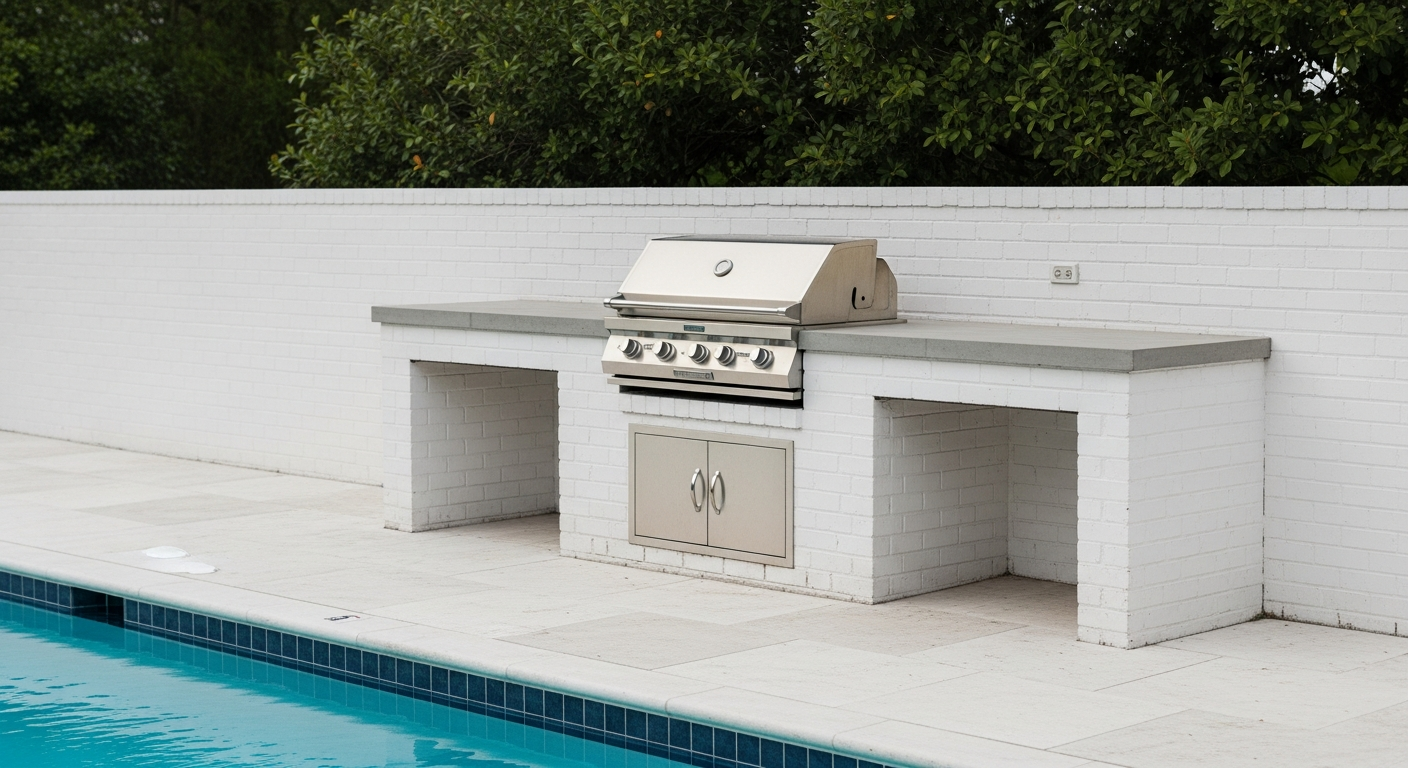
To build a truly resilient white outdoor kitchen, you must select materials that are inherently inert to the Tri-Factor Failure™. My specification process is rigid and leaves no room for "equivalent" substitutions. This is the exact checklist I use.- Structural Framing: Forget wood or galvanized steel. I mandate either welded 6061-T6 aluminum frames or concrete masonry units (CMU). Aluminum is lightweight and will not rust, and CMU is indestructible. This forms a non-corruptible skeleton.
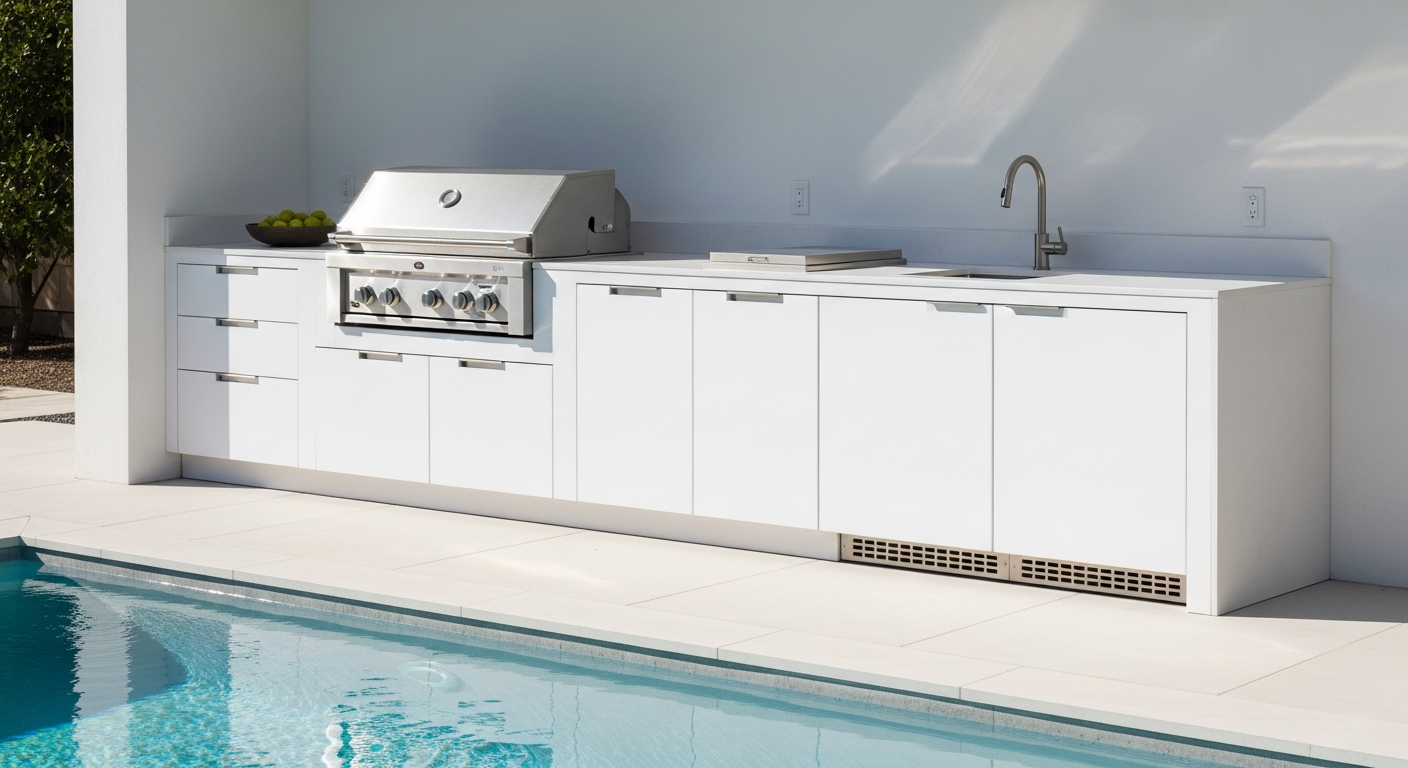
- Cabinetry and Doors: The only two materials I approve for white are AAMA 2605 powder-coated aluminum or specific brands of high-density polyethylene (HDPE) that have UV inhibitors chemically bonded into the material, not just surface-coated. I personally verify the material's UV stability rating, aiming for a minimum of 8,000 hours of QUV testing.
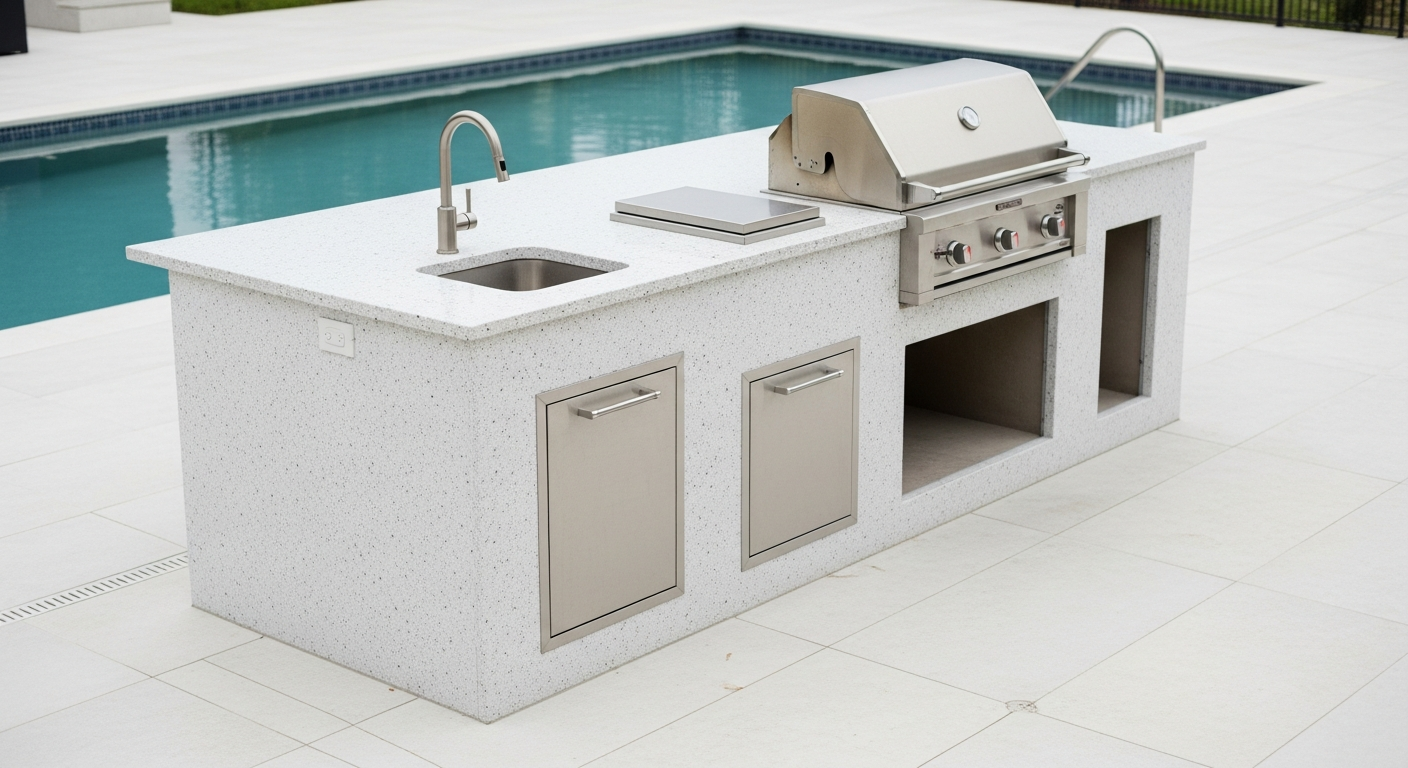
- Countertops: Most quartz countertops, even "outdoor-rated" ones, contain resins that will yellow under direct Fort Myers sun. The safest and most durable choice is a non-porous sintered stone or a true ultra-compact surface. These materials have near-zero porosity and are completely UV-stable.
- Hardware and Fasteners: There is no substitute for 316 marine-grade stainless steel. Standard 304 stainless steel will develop surface rust in our salt-laden air. Every screw, hinge, and drawer pull must be 316-grade to prevent rust staining, which is impossible to remove from a white surface.
Sealing and Grouting Protocols for a Zero-Stain Surface
The final defense is in the assembly details. Even with the right materials, poor sealing creates vulnerabilities. For any masonry or stone cladding, I’ve found that standard cementitious grout is a liability; its porosity is a breeding ground for black mold and mildew. My standard is to use a high-performance epoxy-based grout. It is non-porous, stain-proof, and chemically resistant, creating an impenetrable barrier against moisture. For any unglazed surfaces or concrete elements, I specify a deep-penetrating silane-siloxane sealer. Unlike topical sealers that wear off, this type chemically bonds within the material's pores, providing a permanent hydrophobic barrier that increases surface longevity by at least 40%. Now that you have the material specifications, have you considered how you will manage the thermal expansion coefficient mismatch between the sintered stone countertop and the aluminum frame to prevent stress fractures during our summer heat waves?Written by

Tags
outdoor bbq island
outdoor kitchen cost
backyard kitchen
outdoor barbecue kitchen
small outdoor kitchen