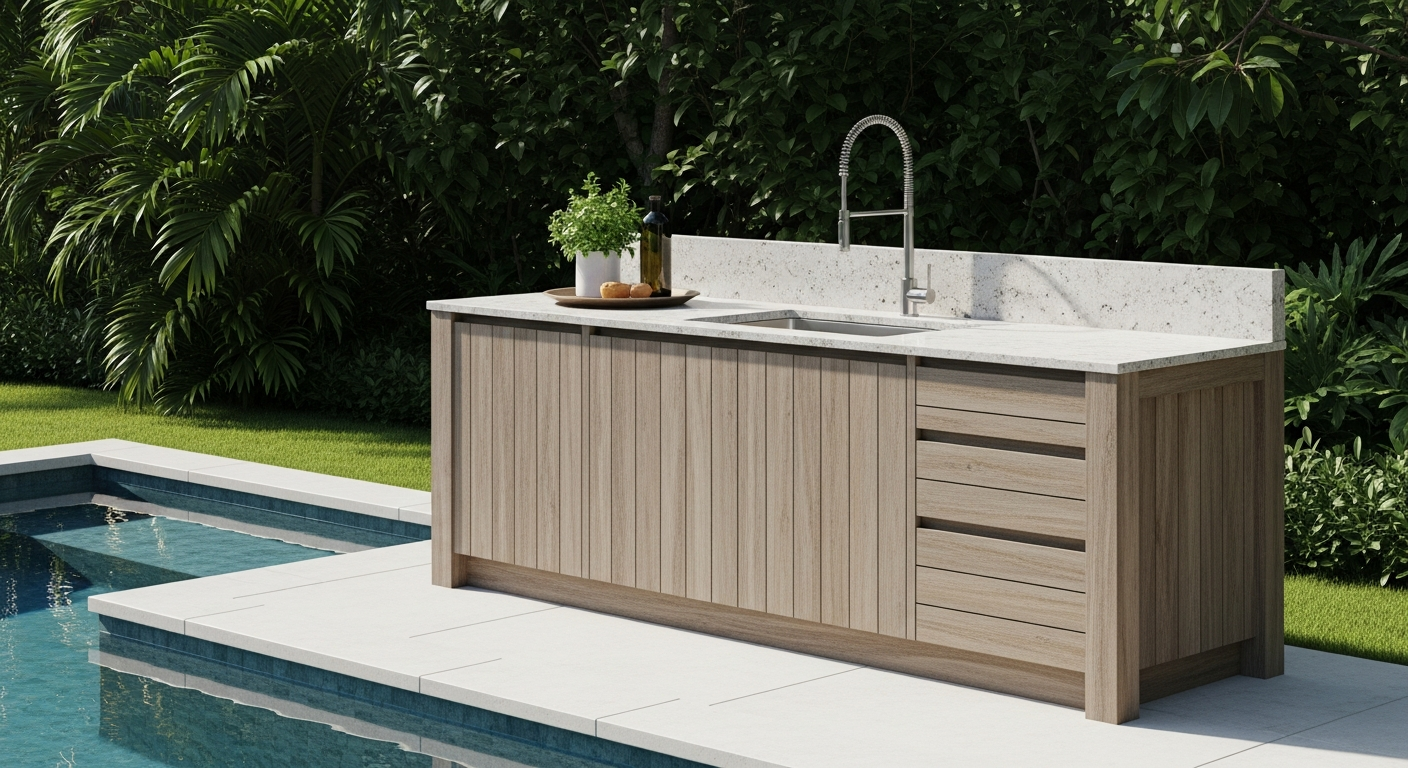
Outdoor Kitchen with Fridge and Sink in Osceola County: My Climate-Proofing Protocol for 99% Component Uptime
Most outdoor kitchens I'm called to repair in Osceola County, especially in areas like Kissimmee and St. Cloud, fail prematurely due to one critical oversight: a fundamental misunderstanding of our local climate. The combination of intense humidity, high UV exposure, and torrential downpours creates a uniquely hostile environment for standard construction materials and appliances. Homeowners see rust, warped countertops, and dead refrigerators within three to five years. My entire design and build philosophy is engineered to counteract these specific local stressors. I don't just build an outdoor kitchen; I create a weather-resilient system. This involves a proprietary methodology focusing on two core principles: **material specification based on a humidity-corrosion index** and **strategic component isolation** to ensure a minimum 15-year operational lifespan for the entire installation.My Osceola-Specific Diagnosis: Why Standard Builds Fail in Our Humidity
After analyzing dozens of failed projects from Poinciana to Celebration, I’ve traced the root cause back to a "one-size-fits-all" approach. A builder might use materials that work perfectly in a dry climate, but here, they degrade rapidly. My diagnostic process starts with what I call a **Climate Stress Audit**. I’ve seen beautiful granite countertops crack because the plywood substrate swelled and delaminated from constant moisture. I’ve replaced countless "outdoor-rated" refrigerators where the compressor failed because it was boxed into a cabinet with zero ventilation, essentially cooking itself in the Florida heat. These aren't product failures; they're system design failures.The Technical Trinity: Materials, Ventilation, and Electrical Integrity
To build a truly resilient outdoor kitchen in Osceola County, I focus on a trinity of technical specifications that form the backbone of my projects.- Material Selection: I mandate the use of **316L marine-grade stainless steel** for all fixtures and appliance facings, not just the standard 304 grade. The higher molybdenum content in 316L offers vastly superior corrosion resistance to the salt and chlorine in the air, especially for homes with pools. For cabinetry, I avoid wood entirely and use **high-density polyethylene (HDPE) polymer cabinets**. They are impervious to water, will not swell or delaminate, and inhibit mold growth. For countertops, I specify **sintered stone or Dekton**, which are non-porous and UV-stable, preventing the staining and heat damage I often see on sealed granite.
- Appliance Ventilation Architecture: This is a non-negotiable point. Every heat-generating appliance, especially the refrigerator, must have a dedicated ventilation channel. My standard is to engineer a **passive convection cooling loop**. This requires a minimum of **2 inches of clearance** at the rear of the unit and a combination of floor-level intake vents and countertop-level exhaust vents. This simple step can increase the lifespan of an outdoor refrigerator's compressor by up to 50%.
- Electrical Fortification: Water and electricity are a dangerous mix. All my outdoor kitchen projects run on a **dedicated 20-amp circuit** with **GFCI (Ground Fault Circuit Interrupter) protected outlets** housed in weatherproof "in-use" covers. All wiring is run through sealed conduit to prevent moisture intrusion, a common point of failure I've identified in many DIY or improperly executed installations.
The Phased Implementation Protocol for a Resilient Outdoor Kitchen
Executing the plan requires a meticulous, phased approach. Deviating from this sequence is how mistakes happen. My method ensures every layer of the build is secure and validated before moving to the next.Precision Adjustments: Sealing and Sink Integration Standards
The final 10% of the project is where long-term durability is truly locked in. These are the small details that prevent the slow, insidious damage caused by our humid climate.- Foundation and Framing: The base structure must be **concrete block or galvanized steel framing**. I never use wood framing, even pressure-treated, as it will eventually fail.
- Utility Rough-In: Before any cladding is applied, I personally inspect the placement of the water lines and the sink's drain line. The P-trap must be perfectly installed to prevent sewer gases from venting into the lanai, a surprisingly common complaint.
- Countertop Installation: The countertop is set not with standard mortar but with a high-performance **flexible epoxy adhesive**. This allows for thermal expansion and contraction without cracking the stone or creating gaps where water can penetrate.
- Component Sealing: Every single penetration point—where the sink, faucet, or fridge trim meets the countertop—is sealed with **100% marine-grade silicone sealant**. This is a painstaking process, but it's the only way to create a truly waterproof surface.
- Final Commissioning: I perform a 24-hour leak test on all plumbing connections and measure the operational temperature of the refrigerator's compressor chamber to ensure the ventilation architecture is performing as designed.
Is your outdoor kitchen's electrical plan accounting for the potential voltage drop over a long-distance run from the main panel?
Written by

Tags
outdoor island with sink
outdoor kitchen with fridge and sink
bbq island with sink
outdoor grill and sink combo
custom outdoor kitchens near me